The Yomiuri Shimbun and other local media reported on October 25 that the governments of the United States and Japan will sign a memorandum of cooperation in seven technology fields, including artificial intelligence (AI) and biotechnology, during their summit next week, in an effort to counter China's growing influence in advanced technologies.
According to the reports, senior science officials from both countries are expected to sign the memorandum on October 28, when President Donald Trump of the United States and Prime Minister Sanae Takaichi of Japan hold a summit in Tokyo.
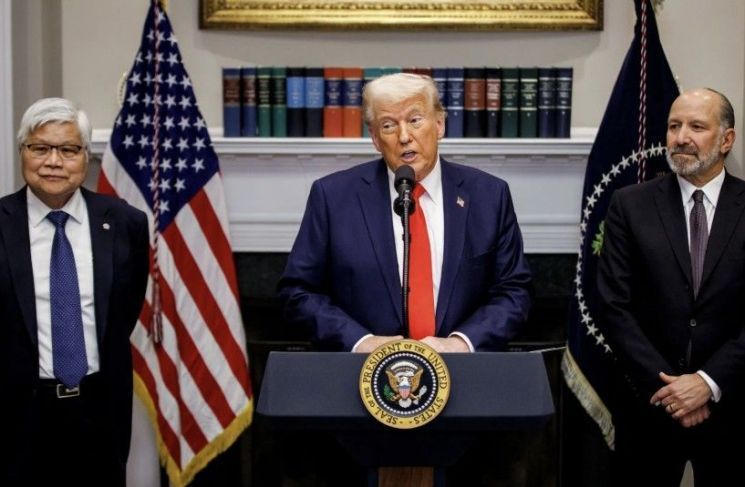
The draft of the memorandum reportedly includes the phrase, "Opening a golden age of innovation to firmly secure freedom and prosperity." It also emphasizes the importance of deepening cooperation as strategic partners in the region.
The specific areas of cooperation are AI, research safety, high-speed communication standards, pharmaceuticals and biotechnology, quantum technology, nuclear fusion, and space. Of these, both countries plan to focus particularly on cooperation in AI, an area where China is actively pursuing technological innovation.
The United States National Science Foundation and Japan's RIKEN, along with other AI research institutions from both countries, will lead efforts to accelerate AI applications in industry and society. They also plan to explore advanced semiconductor cooperation necessary for AI-powered weaponry.
In addition, the two countries intend to expand the interoperability of AI technologies and accelerate export cooperation, taking into account the growing spread of Chinese AI technology in emerging markets and other regions.
The Nihon Keizai Shimbun (Nikkei) reported that concerns about China are behind the US-Japan technology cooperation, noting that "there are concerns about personal data protection and content accuracy in AI developed by China."
The Asahi Shimbun reported that the United States and Japan are also coordinating the creation of a joint document confirming their commitment to faithfully implement the terms of their trade agreement in conjunction with the upcoming summit.
The Asahi Shimbun added that the two leaders are also discussing the possibility of signing the document themselves.
In relation to this, Kyodo News reported that US Secretary of Commerce Howard Lutnick and Japanese Minister of Economy, Trade and Industry Ryosei Akazawa held a 40-minute phone call the previous day.
Kyodo explained, "It is possible that they were making advance arrangements ahead of President Trump's visit to Japan."
Japanese companies are reportedly considering measures to improve the trade imbalance between the two countries in conjunction with President Trump's visit.
Toyota Motor Corporation is said to be coordinating a plan to inform the US side of its intention to "re-import" its vehicles produced in the United States for sale in Japan.
Nissan Motor Corporation is also discussing the possibility of importing sport utility vehicles (SUVs) from the United States to Japan.
NHK analyzed, "The Japanese government is considering changing regulations to allow US-made cars to be sold in Japan without additional testing," adding, "This appears to be an effort by both the public and private sectors to demonstrate their commitment to reducing the trade deficit with the United States."
Separately, Tokyo Gas is also considering procuring about 1 million tons of liquefied natural gas (LNG) annually from Alaska, United States.
President Trump will visit Japan from October 27 to 29 after stopping in Malaysia, and will then head to South Korea. In Japan, in addition to the US-Japan summit, he is scheduled to meet with Emperor Naruhito, visit a US Navy base, and hold meetings with business leaders.
Kyodo News also reported that after the summit on October 28, the two governments are coordinating a plan for President Trump and Prime Minister Takaichi to board the US presidential helicopter Marine One together and travel to the US Navy base in Yokosuka, Kanagawa Prefecture.
Kyodo added, "It is rare for a foreign leader to travel on Marine One together," and emphasized that "this will be an opportunity to demonstrate the strength of the US-Japan alliance."
© The Asia Business Daily(www.asiae.co.kr). All rights reserved.

















