Rapid Adoption of Advanced Technologies...
Dubai Races to Build a Smart City
Korea's H2O Joins Dubai's Digital Tourism Transformation
Future-Oriented and Pragmatic Leadership of the Ruler Stands Out
Dubai is a city where advanced unmanned systems have become an everyday reality, from the airport to the subway and even hotels. At Dubai's subway stations, there are guidance robots designed for tourists. On the 25th of last month, while visiting the Museum of the Future, a landmark of Dubai, I encountered a guidance robot at Emirates Tower Station, which is connected to the museum via an internal passage. The robot, about 150 cm tall and modeled after a human face, greeted passengers clearly, saying, "Don't be afraid of robots. Talk to me." Its large eyes and subtly moving lips added a sense of realism, and it provided information on tourist attractions, restaurants, and hotels in five languages, including English, Arabic, and Chinese. The sight of robots taking on the role of travel guides instead of people felt completely natural.
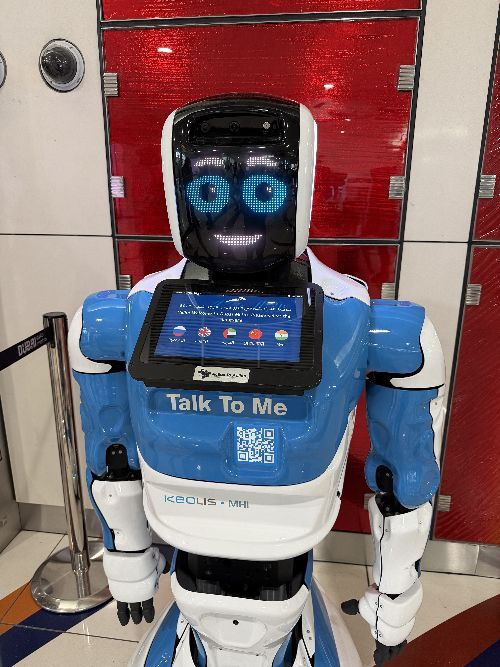 Voice recognition guidance robot photographed at Dubai Emirates Tower Station on the 25th of last month. It provided information on nearby attractions, restaurants, and accommodations in five languages including English, Chinese, and Arabic, assisting travelers' convenience. Photo by Kim Bokyung
The subway is operated without drivers, with artificial intelligence (AI) controlling the entire operation. Dubai's subway system is fully automated across all lines, achieving an on-time operation rate of 99.7%. The AI inspection system "ARIIS," which combines French and Japanese technology, uses sensors, lasers, and 3D cameras to diagnose the tracks without stopping train operations. This technology has reduced both maintenance time and costs by more than 70%. Dubai's Roads and Transport Authority aims to establish ARIIS as an international standard and develop it into an export industry.
Such systems are at the core of the Dubai government's "Smart City Strategy 2030." With a vision to become "the best city to live, work, and visit" by 2030, Dubai is applying AI across administration, transportation, and tourism. The government is proactively adopting new technologies, turning the entire city into a living laboratory. Dubai is working tirelessly to transform itself into a smart city capable of accommodating up to 7.8 million people-about twice its current population-by 2040.
Korean company H2O Hospitality (hereafter H2O) has also joined this wave of change. By introducing a smart check-in solution at the five-star Westminster Dubai Mall Hotel, H2O has led the digital transformation of the Middle Eastern tourism industry. With the smart check-in solution, hotel guests can easily register their information and sign up for membership on their smartphones before arriving at the hotel, all without installing a separate application. Guests simply need to pick up their pre-prepared room key at the front desk, eliminating the need for long waits and enhancing the overall stay experience. In an interview with The Asia Business Daily, H2O CEO Lee Woonghee emphasized the importance of securing tourism data and driving service innovation. [Related Article = Korean Company CEO Granted Golden Visa in UAE: "Making Tourism Smarter"]
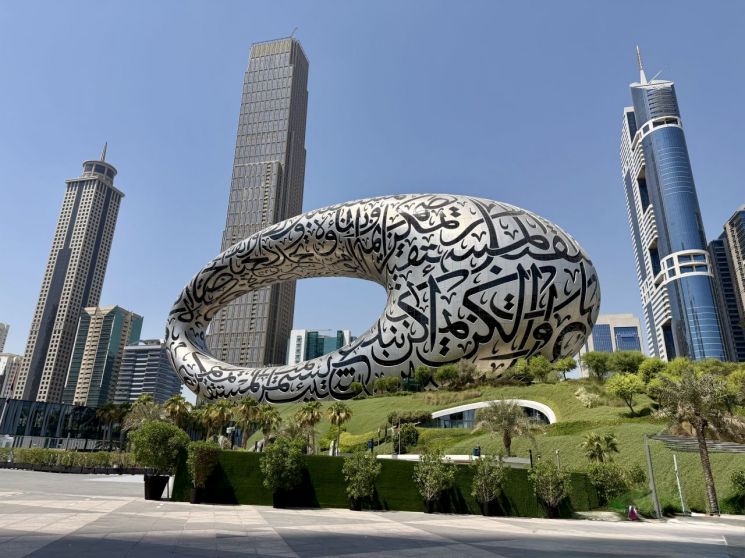 The Museum of the Future, operated by the Dubai Future Foundation, features a unique donut-shaped design and has become a landmark of Dubai. The exterior wall of the building bears the inscription, "The future belongs to those who can imagine, design, and execute." Since its opening in February 2022, it has welcomed over 4.17 million visitors as of the end of September. Photo by Kim Bokyung
The reason Dubai was able to quickly absorb innovative technologies from overseas companies lies in the strong determination of its ruler, Sheikh Mohammed bin Rashid Al Maktoum. He is renowned for prioritizing Dubai's economic development and pursuing pragmatic, future-oriented policies. Since assuming power in 2006, he has left behind memorable quotes such as "The future does not wait for those who hesitate," "The greater the vision, the greater the achievement," and "Technology is the fast gateway to the future," emphasizing a pioneering spirit unafraid of failure and a focus on technological prosperity.
The Dubai Future Foundation, a direct agency under the ruler and a national think tank, was established to realize future visions and develop Dubai into a global city of the future. The exterior wall of the Museum of the Future, operated by the foundation, is inscribed in Arabic with the words, "The future belongs to those who can imagine, design, and execute." Since its opening in February 2022, the Museum of the Future has attracted 4.17 million visitors as of last month, emerging as a new landmark. Kim Byungho, Head of the Middle East Regional Headquarters at KOTRA (Korea Trade-Investment Promotion Agency), which recently signed a digital cooperation agreement with the Dubai Future Foundation, told this reporter, "Thanks to a leader who looks to the future, Dubai has been able to drive rapid change and accumulate wealth."
© The Asia Business Daily(www.asiae.co.kr). All rights reserved.
![Clutching a Stolen Dior Bag, Saying "I Hate Being Poor but Real"... The Grotesque Con of a "Human Knockoff" [Slate]](https://cwcontent.asiae.co.kr/asiaresize/183/2026021902243444107_1771435474.jpg)

















