Trump to Reaffirm Global Leadership Through Bilateral Talks
China to Host Next Year: Taiwan Issue in the Spotlight
Countries Prepare Behind the Scenes According to Their Interests
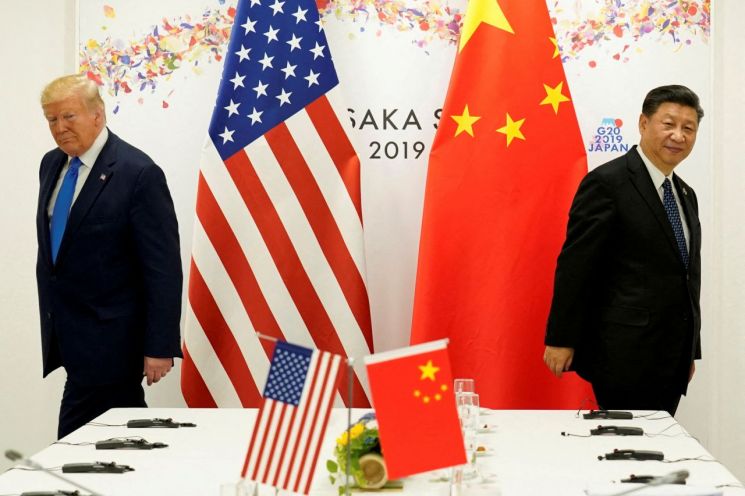 In 2019, during the first term of the Trump administration, U.S. President Donald Trump (left) and Chinese President Xi Jinping are leaving after concluding a summit meeting. Photo by Reuters
The upcoming Asia-Pacific Economic Cooperation (APEC) 2025 summit, to be held next week in Gyeongju, has drawn significant attention as it may serve as an opportunity to find solutions amid heightened tensions between the United States and China and increasing global economic uncertainty.
Mireya Solis, Director of the Center for East Asia Policy Studies at the Brookings Institution, a U.S. think tank headquartered in Washington, D.C., stated on a podcast on the 23rd (local time), "The significance of this APEC summit is extremely important," emphasizing the gravity of the event.
She explained, "During the second Trump administration, unprecedented tariff hikes were imposed, which impacted some Southeast Asian countries, while China responded by shifting its export focus. Issues such as regional overproduction and export controls have highlighted the risks of economic interdependence, and whether APEC can address these issues will be key."
Another major point of interest is who, how, and when U.S. President Donald Trump-who has triggered global economic uncertainty-will meet. He will not attend the multilateral APEC 2025 summit. Instead, he plans to reaffirm global leadership through bilateral meetings with major countries such as China, Japan, and Australia.
Ryan Hass, Director of the Brookings China Center, drew attention to the Taiwan issue. He noted, "Taiwan is an APEC member, and next year, China will serve as the host country. We need to watch how interactions between the United States and Taiwan take place at this meeting, and what agreements may be reached regarding Taiwan's participation next year."
China continues to assert its "One China" policy externally and does not recognize Taiwan as a sovereign state. In response, Taiwan participates in APEC events under the name "Chinese Taipei," and President Lai Ching-te of Taiwan will not attend the summit.
Lin Hsin-yi, former Minister of Economic Affairs and Taiwan's representative, stated at a recent press conference, "As a semiconductor powerhouse, Taiwan has both the capacity and the responsibility to contribute to the prosperity and sustainability of the Asia-Pacific region," adding that she will actively seek exchanges with other national leaders in attendance.
Solis also remarked, "Medium and small countries like Vietnam and Chile gain a voice through APEC," adding, "They hope that practical economic agendas such as supply chain resilience, development challenges, and technological change will take precedence over bilateral meetings. Korea's agenda of 'AI and connectivity' is drawing significant interest."
Countries are making behind-the-scenes preparations to achieve their respective goals at this APEC summit. Canadian Prime Minister Mark Carney is also reportedly hoping to hold talks with Chinese President Xi Jinping during his visit to Korea. This comment comes as Canada and China have been engaged in a trade war since August, exchanging high tariffs and anti-dumping investigations.
Reuters reported that a senior Canadian government official stated in a background briefing, "We hope to have a meeting (with President Xi) and are planning accordingly. If possible, we hope to have a meeting at the (Gyeongju) APEC summit."
© The Asia Business Daily(www.asiae.co.kr). All rights reserved.

















