Joint Research Team Led by Yoo Byungjun of Seoul National University Analyzes Impact
Supplier Retention Drops to 74% Within One Year if Settlement Cycle Is Shortened
Order Volume for SME Products Falls More Sharply Than for Large Companies
After last year's incident involving Tmon and Wemakeprice (T-Meprice) failing to settle payments with sellers, the government and lawmakers are currently discussing measures to shorten the settlement cycle for online platforms. However, there is analysis suggesting that such moves could undermine direct purchase platforms-such as Coupang and Kurly, which buy and sell manufacturers' products directly-and increase damages for small and medium-sized businesses that transact with them.
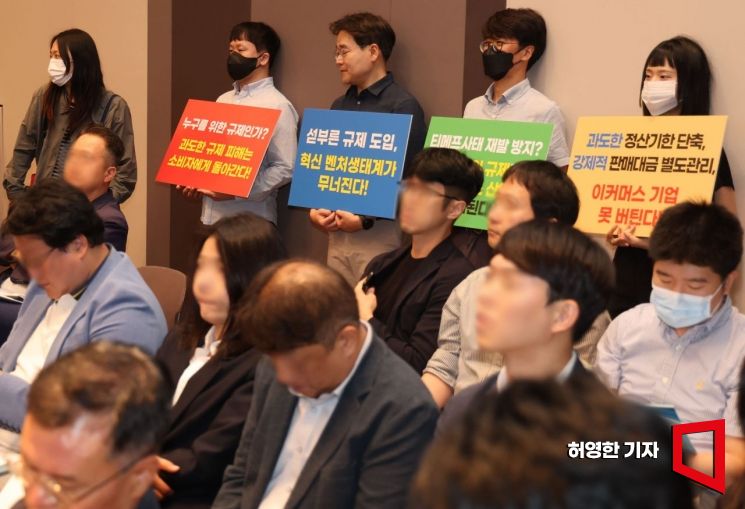 At the public hearing on amendments to the Large-scale Distribution Business Act and the Electronic Financial Transactions Act to prevent a recurrence of last year's Tmon and Wemakeprice incidents, some attendees stood holding placards opposing excessive regulation of e-commerce. Photo by Huh Younghan
According to the results of a joint research team comprised of Yoo Byungjoon, Professor at Seoul National University, Jeon Sungmin, Professor at Gachon University, and Kang Hyunggu, Professor at Hanyang University, published on the 23rd in their study "Economic Impact of Settlement Cycle Shortening Regulations on E-commerce Platforms," if the current settlement cycle for suppliers, which is within 60 days, is shortened to 20 days, the proportion of small and medium-sized suppliers maintaining transactions with these platforms would drop to an average of 74% within a year. On platforms with the lowest 50% working capital, only an average of 48% of companies would survive.
The research team set up scenarios for a one-year period (52 weeks) with settlement cycles of 60 days (9 weeks) and 20 days (3 weeks) for major domestic direct purchase platforms such as Coupang, SSG.com, and Kurly, as well as intermediary platforms like Naver, 11st, and Gmarket. They conducted a total of 100 simulations to comparatively analyze the impact over time on small business suppliers, distributors, and consumers.
Direct purchase platforms currently settle payments within 60 days for goods they purchase, in accordance with the "Act on Fair Transactions in Large-scale Distribution Business." Other intermediary platforms operate settlement systems ranging from the next day to 8 days after the transaction. The Korea Fair Trade Commission is reviewing a plan to shorten the settlement cycle for direct purchase transactions, currently set at 60 days, to within 20 days to better protect suppliers.
The joint research team's simulations found that shortening the settlement cycle would have a much greater negative impact on direct purchase platforms. The annual transaction volume on direct purchase platforms decreased by 13.9% over one year, and the annual transaction loss amounted to 7.7 trillion won, significantly higher than the 1.9 trillion won loss for intermediary platforms. When the settlement cycle was shortened to 20 days, the one-year survival rate for partner companies was lower for direct purchase platforms (68.9%) than for intermediary platforms (79.1%).
The researchers pointed out, "As cost pressures increase due to the shortened settlement cycle, direct purchase platform companies will be forced to keep only a small quantity and variety of products to reduce inventory costs." They added, "Compared to large companies that can offer a wide selection of goods at lower prices, small business suppliers with limited resources may see a significant reduction in order volume."
In fact, as a significant number of partner suppliers and vendors drop out, the gap in production volume between large companies and small businesses in the relevant market is projected to widen by a factor of 2.4 within a year, according to the study. The resulting damages to small and medium-sized businesses are estimated to reach up to 21 trillion won annually, while the social welfare loss from reduced consumer choice and service quality is also estimated at 19 trillion won.
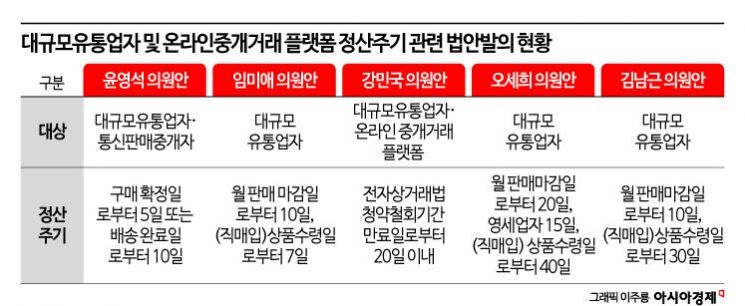
Previously, following the T-Meprice seller payment incident in July last year and Homeplus's application for corporate rehabilitation proceedings earlier this year, the government and lawmakers have consecutively proposed amendments to the Large-scale Distribution Business Act aimed at shortening the settlement period for both online and offline distributors in order to prevent damages to platform partners and suppliers.
Notably, in the 22nd National Assembly, lawmakers including Yoon Youngseok, Lim Mi-ae, Kang Minkook, Oh Sehee, and Kim Namgeun proposed amendments stipulating that large-scale distributors and online intermediary platforms must settle payments within 10 to 20 days after the sales closing date, and in the case of direct purchases, within 30 to 40 days after receiving the goods. The Korea Fair Trade Commission also announced in October last year that it would amend the Large-scale Distribution Business Act to prevent a recurrence of the T-Meprice non-settlement incident. Organizations such as the Korea Federation of Micro Enterprises and the Korea Food Industry Association also requested during a meeting with Chairman Joo Byunggi of the Fair Trade Commission last month that the payment deadline be shortened to within 20 days for stable transactions.
However, concerns have been raised by the distribution industry and academia. At the "Economic Impact of Settlement Cycle Shortening Regulations" forum hosted by the Korea Venture Start-up Association on the 22nd, Yoo Jeonghee, Director General of the Korea Venture Business Association, stated, "Small and medium-sized companies prefer the direct purchase model, where all supplied goods are settled regardless of whether they are sold, over intermediary transactions, which are settled within 20 to 30 days only for sold goods." She pointed out, "If the direct purchase settlement cycle is shortened, distributors may reduce their purchase volume, leading to a chain reaction of decreased supply volume and increased inventory burden for small and medium suppliers."
At a seminar hosted by the Korea Distribution Law Association and the Korea Distribution Association in August, experts also warned, "If the settlement period is uniformly shortened, companies supplying goods to distribution stores may face cash flow and inventory burden issues, causing them to favor products from large companies over those from lesser-known small and medium-sized enterprises, thereby exacerbating the gap between the rich and the poor."
© The Asia Business Daily(www.asiae.co.kr). All rights reserved.


















