Achievement in Transitioning from a Steel Industry City to a Green Ecological City
Efforts Toward Carbon Neutrality Recognized
Lee Kangdeok: "The Result of Changes Made Together with Citizens, We Will Build a Sustainable City"
Pohang City, recognized for its resilience against disasters, was selected as an outstanding local government for urban resilience after ranking 10th nationwide at the "2025 Hankyoreh Regional Resilience Assessment" awards ceremony held at the Korea Chamber of Commerce and Industry International Conference Hall in Jung-gu, Seoul on October 23.
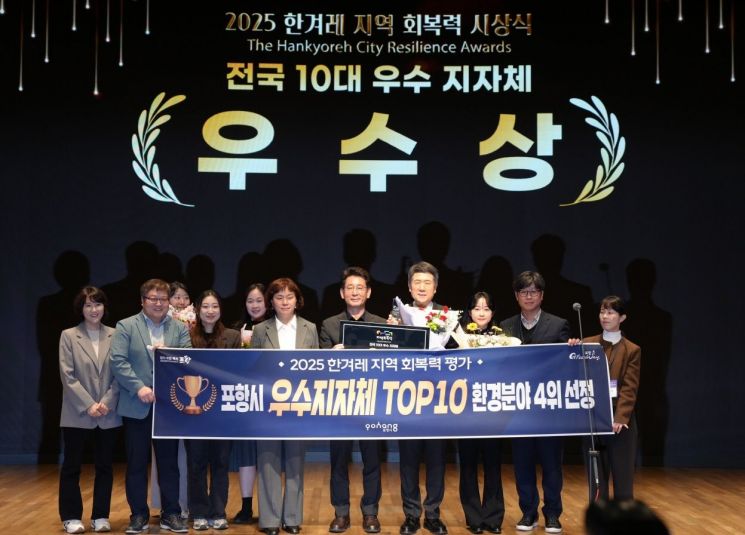 Pohang City is taking a commemorative photo after ranking 10th nationwide in the '2025 Hankyoreh Regional Resilience Assessment' held at the International Conference Hall of the Korea Chamber of Commerce and Industry in Jung-gu, Seoul. Provided by Pohang City
This is the highest ranking among the 22 basic local governments in North Gyeongsang Province.
The assessment was jointly organized by Hankyoreh Newspaper and the Hankyoreh Economic and Social Research Institute, and the awards ceremony was held in conjunction with the 16th Asia Future Forum.
The evaluation comprehensively analyzed the sustainability and crisis response capabilities of 226 basic local governments nationwide across three categories-environment (30 points), economy (30 points), and society (40 points)-covering 10 sectors and 38 detailed indicators.
Pohang City scored a total of 63.4 points out of 100, placing it among the top 10 cities overall. In particular, it ranked 4th nationwide in the environment category (20.4 points), earning recognition for its efforts in transitioning to eco-friendly industries and realizing a green city.
The research institute explained that Pohang has shifted its industrial structure from being centered on steel to fostering new industries such as secondary batteries, biotechnology, and hydrogen, transforming into a low-carbon city. The city has presented a carbon-neutral urban model through its RE100 declaration, the expansion of renewable energy, and the establishment of a decentralized energy system.
Since 2016, Pohang has promoted the "Greenway Project," transforming a total of 9.3 kilometers of former railway in the city center into an ecological and cultural space, creating an urban forest equivalent in size to about 100 soccer fields. This project has been evaluated as fulfilling both environmental and social values by mitigating the urban heat island effect, reducing fine dust, and expanding recreational spaces for citizens.
In the economic sector, Pohang received positive evaluations for various indicators such as the increase in regular jobs at workplaces with more than 300 employees compared to the previous year and growth in regional gross production. The establishment of industrial complexes for secondary batteries, biotechnology, and hydrogen was especially praised for achieving both industrial diversification and job creation.
In the social sector, the city’s "Three-Free Welfare Policy" (free childcare at private daycare centers, free meals for kindergarten, elementary, middle, and high school students, and free school uniforms for new middle and high school students), the establishment of a housing welfare center, operation of a pediatric emergency medical center, and the implementation of the "1,000 Won Housing" program were highly rated for improving citizens’ quality of life.
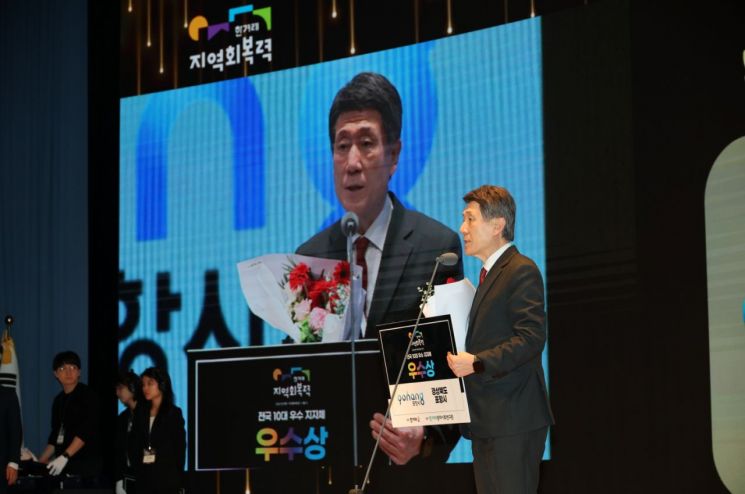
Mayor Lee Kangdeok stated, "This assessment is significant because it provides a realistic and in-depth analysis of urban sustainability and crisis response capabilities, rather than relying on traditional evaluation methods such as economic growth or population size. The results are the fruit of efforts made together with citizens to transform Pohang into a green ecological city. We will continue to do our best to build a sustainable city for future generations and a city equipped with crisis response capabilities."
© The Asia Business Daily(www.asiae.co.kr). All rights reserved.


















