Talent Exchange Posts on Danggeun Market
Up 6.9% Year-on-Year in the Third Quarter
Kim Sangjin, a 33-year-old office worker, recently posted on the secondhand trading platform Danggeun Market because he wanted to relearn the piano, which he played as a child. His post offered to teach soccer in exchange for piano lessons. Regarding such talent exchanges, Kim said, "Talent is also a form of capital, and the advantage is that you can share your abilities without money," adding, "I wanted to do something meaningful in my spare time and acquire another skill."
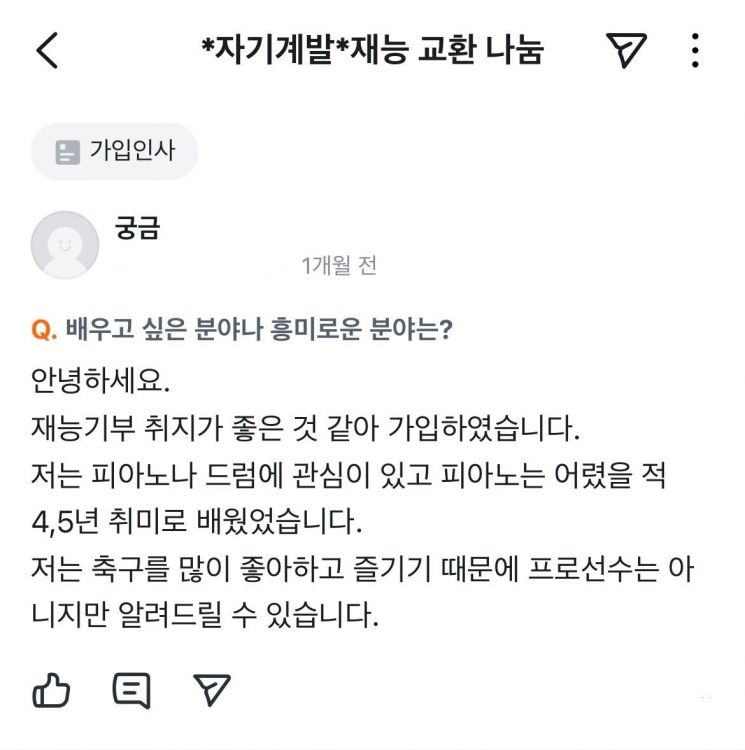 A recent post in the 'Talent Exchange' group on a secondhand trading platform. Screenshot from Danggeun Market
An increasing number of Millennials & Gen Z are seeking to learn new hobbies by exchanging their talents with others.
According to Danggeun Market on October 28, posts related to talent exchange on the platform in the third quarter of this year rose by 6.9% compared to the same period last year. 'Lesson Info,' another platform for talent exchanges, also saw 50 to 60 such posts every year for the past three years.
This culture of talent exchange appears to have originated from Millennials & Gen Z's focus on practicality and their efforts to reduce self-development costs. According to a survey conducted last year by JobPlanet targeting 323 respondents-including office workers, those on leave or seeking jobs, and university students-14.3% of those who said they did not pursue self-development cited cost as the reason.
Another advantage is that it is easier to learn through communication with others. On Danggeun Market and various social networking services, there are numerous posts such as "I will teach programming if you teach me drawing" or "If you teach me composition, I will teach you personal training."
Some people are interested in talent exchange with future career moves in mind, such as changing jobs. Choi Wonho, a 30-year-old office worker, said, "If we exchange what we've learned, such as using my web development skills from work, it would be a win-win," adding, "I plan to switch careers to become a developer, so I want to learn Python."
Experts say this trend has evolved from the era when hobby clubs were popular, taking a step further into a form similar to 'pumasi' (traditional Korean bartering of labor). Kim Heonsik, a popular culture critic, explained, "These activities are based on trust and are carried out through local platforms closely tied to daily life that emphasize open communication," adding, "The younger generation exchanges their talents to fill gaps and achieve their goals, which reflects their characteristics as a 'practical generation.'"
© The Asia Business Daily(www.asiae.co.kr). All rights reserved.
![Clutching a Stolen Dior Bag, Saying "I Hate Being Poor but Real"... The Grotesque Con of a "Human Knockoff" [Slate]](https://cwcontent.asiae.co.kr/asiaresize/183/2026021902243444107_1771435474.jpg)
















