Meeting with U.S. Secretary of Commerce Lutnick
"Some Progress on Remaining Issues"
Expectations for Agreement Before APEC Summit
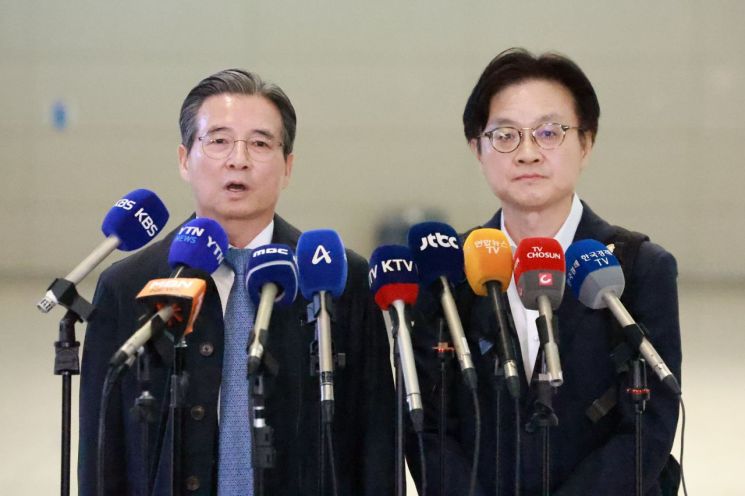 Kim Yongbum, Director of the Presidential Office Policy Office (left), is speaking before departing for Washington DC, USA, from Incheon International Airport Terminal 2 on the 22nd to conduct additional discussions on Korea-US tariff negotiations. On the right is Kim Jeonggwan, Minister of Trade, Industry and Energy. Photo by Yonhap News Agency
The governments of South Korea and the United States held final negotiations on October 22 (local time) regarding the $350 billion (approximately 500 trillion won) investment package for the U.S., which had been considered the "final hurdle" in the Korea-U.S. tariff talks. Kim Yongbum, Director of the Presidential Office Policy Office, stated that "some progress has been made" on the remaining issues, leading to speculation that the bilateral tariff negotiations could be concluded before the upcoming Asia-Pacific Economic Cooperation (APEC) Summit next week.
On this day, Director Kim held a two-hour meeting with Howard Lutnick, Secretary of Commerce, together with Kim Jeonggwan, Minister of Trade, Industry and Energy, at the Department of Commerce building in Washington, D.C. After the meeting, Kim told reporters, "We discussed many of the remaining issues," and added, "There has been some progress."
Director Kim explained that only one or two issues remain, saying, "There aren't many left. Further discussions are needed." He declined to elaborate on the remaining issues or the areas where progress had been made.
However, when asked if the negotiations were in their final stage, he replied, "It's not the final stage yet. In negotiations, nothing is finished until it's truly over."
This atmosphere was somewhat different from earlier in the day, when he had commented that there were significant differences between the two governments on some issues. Upon arriving at Dulles International Airport near Washington, D.C., Kim had said, "There are significant differences between the two countries on one or two topics." Against this backdrop, his comment that "some progress has been made" has led to speculation that the two sides may have reached some degree of consensus.
During the bilateral talks, unresolved issues such as the composition of the $350 billion investment package for the U.S.-including the cash ratio and the duration of funding-were reportedly on the agenda.
The most important remaining issue is the composition of the U.S. investment package promised by the South Korean government. South Korea seeks to reduce the proportion of direct investment and extend the investment period as much as possible, while the United States has demanded that cash investment be maximized within the term of the second Donald Trump administration.
Earlier, before the meeting with Secretary Lutnick, Director Kim told reporters that the extension of the investment period "should be carried out within a range we can tolerate, and it should not cause significant shocks to our foreign exchange market, as all these factors are interconnected." Regarding the foreign exchange market stability standards (annual $15 billion to $20 billion) suggested by the Bank of Korea for U.S. investments, he explained, "Both each institution and the U.S. side have conducted analyses, and discussions are ongoing based on these findings."
Fortunately for the South Korean government, there are signs that the U.S. has recently softened its hardline stance during the negotiations. Deputy Prime Minister and Minister of Economy and Finance Koo Yooncheol mentioned in an interview with Bloomberg TV that, during his meeting with U.S. Treasury Secretary Scott Besant last week, "Secretary Besant fully understands the difficulties facing the Korean foreign exchange market," and that "(the U.S.) is discussing possible responses internally."
It is also reported that Secretary Lutnick, a key U.S. negotiator known as a "hardliner," has recently shown some understanding of South Korea's position that the proportion of direct investment should be reduced compared to the original U.S. demands.
If the Korea-U.S. tariff negotiations are concluded, the unstable domestic foreign exchange market is expected to stabilize. Regarding the recent surge in the won-dollar exchange rate to nearly 1,430 won, Deputy Prime Minister Koo explained to Bloomberg TV, "The recent weakness of the won reflects concerns that the tariff negotiations have not yet been finalized," and added, "Once the tariff issue is resolved, uncertainties will be eliminated."
Meanwhile, when asked whether he would meet with Secretary Lutnick again soon, Director Kim replied, "It will be difficult to meet in person. If there is more to discuss, we will probably have to do it virtually." When asked if he expects a deal to be reached before the APEC Summit, which opens in Gyeongju on October 31, he said, "(APEC) is an important milestone for us."
This was the first time in six days that Director Kim and Minister Kim met with Secretary Lutnick in the United States since October 16. At that time, they held talks for over four hours, including a dinner, and reached a broad agreement, but some issues remained unresolved, prompting another trip to the U.S. Director Kim and Minister Kim are scheduled to travel directly to Atlanta, complete their three-day, no-sleep itinerary in the U.S., and return to Korea.
© The Asia Business Daily(www.asiae.co.kr). All rights reserved.

















