Controversy Over Cicada Nymph Collection in Parks Across Tokyo
Collected for Consumption
Difficult to Regulate, Growing Public Concern
Some Chinese nationals have sparked controversy by indiscriminately collecting cicada nymphs for consumption in various parks throughout Tokyo, Japan.
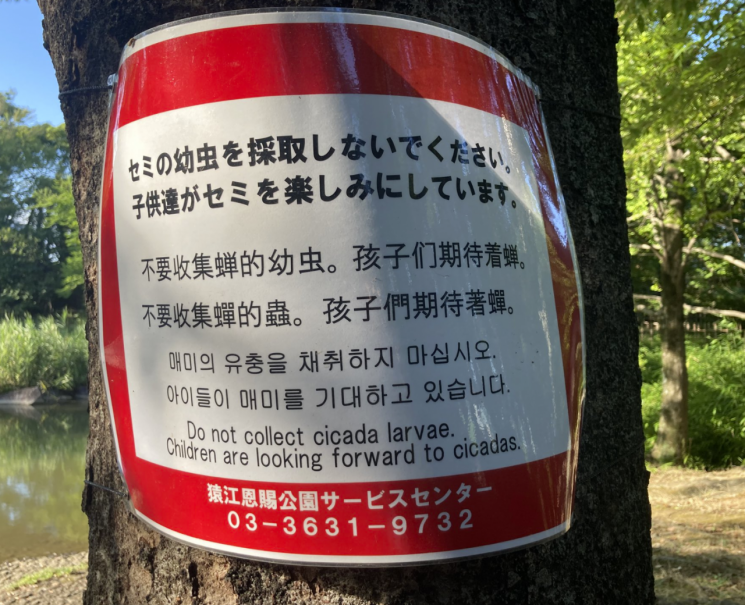
Recently, the Japanese media outlet "President Online" reported that "Chinese people are capturing large numbers of cicada nymphs in several parks in central Tokyo during the evening hours."
According to the report, groups of Chinese speakers have frequently been seen roaming through various parks in Tokyo from dusk until late at night, searching for something. These activities have caused unease among families visiting the parks, leading to a series of reports to the police and the city’s park management department.
It has been determined that these Chinese individuals are collecting cicada nymphs to use as food ingredients. In some regions of China, there is a tradition of eating cicadas, and in places such as Shandong and Henan provinces, cicada nymphs-known as "zhiliao hou"-are considered a popular summer delicacy. Recently, due to increased demand, cicada nymphs have even been treated as a premium ingredient.
Collecting and removing flora and fauna from Japanese parks is prohibited... Some Chinese nationals say, "What's the problem?"
The ordinances of the Tokyo Metropolitan Government and local municipalities prohibit or restrict the collection or removal of animals and plants from within parks.
However, the indiscriminate collection activities by some Chinese nationals have become a growing problem. Akishima Satoru, an investigative and field reporter who has covered the lifestyles and behavior patterns of Chinese people, pointed out, "Although this is prohibited in Japan, manuals and workarounds that make it possible are spreading through social networking services (SNS). In some cases, those who are cautioned even react angrily."
In particular, there have been numerous cases where Chinese nationals, fully aware that their actions are illegal, respond with an attitude of "So, what's the problem?" and display a brazen disregard for the rules. Officials have reported difficulties in enforcing regulations, saying that logical persuasion does not work.
The media outlet further noted, "Organized collection is taking place in groups of dozens or even hundreds of cicadas," and emphasized that "conflict is deepening as foreigners either do not understand or choose to ignore the 'baseline of goodwill' that is naturally shared within Japanese society."
Meanwhile, similar controversies have occurred in South Korea, where some Chinese nationals have been caught collecting large quantities of cicada nymphs. In July, several complaints were posted on the Seoul city civil complaint website "Eungdapso," stating, "Chinese people are repeatedly collecting cicada nymphs in large containers, and although we reported it to the police, they were released because there was no legal basis for punishment."
That same month, Chinese nationals were also seen collecting cicada nymphs at Samnak Ecological Park in Busan. However, since cicadas are neither natural monuments nor legally protected species, it is reportedly difficult to impose sanctions under current law.
© The Asia Business Daily(www.asiae.co.kr). All rights reserved.
![Clutching a Stolen Dior Bag, Saying "I Hate Being Poor but Real"... The Grotesque Con of a "Human Knockoff" [Slate]](https://cwcontent.asiae.co.kr/asiaresize/183/2026021902243444107_1771435474.jpg)

















