Samyang Foods to Launch 'Samyang Ramen 1963' Next Month
First-Ever New Product Launch Event...Challenging 'Nongshim Ramen'
Ramen Rivals Intensify Competition for Brand Leadership
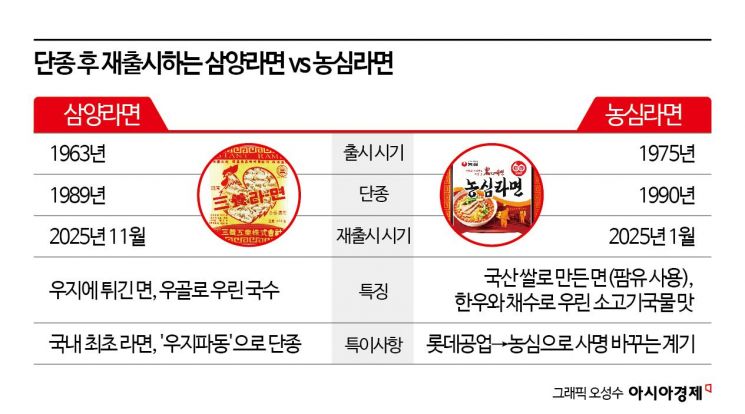
The "original" Samyang Foods, a pioneer in the domestic ramen industry, and the "dominant powerhouse" Nongshim are set to face off, staking their reputations on the line. Samyang Foods will introduce its new product, "Samyang Ramen 1963," next month, directly challenging "Nongshim Ramen," which Nongshim launched earlier this year to commemorate its 60th anniversary. The rivalry between the two companies, which has lasted for over half a century, is being reignited through the resurgence of "retro ramen."
According to Samyang Foods on October 22, the company will hold a media event for its new product, "Samyang Ramen 1963," at a hotel in Seoul on November 3, ahead of the official launch.
This will be the first time in the company's history that Samyang Foods holds a launch event for a new product. Even during the launch of the "Maptaeng" brand, which was reportedly led by third-generation owner Jeon Byungwoo, Chief Marketing Officer of Samyang Foods, and the now mega-brand "Buldak Bokkeummyeon," no such commemorative event was held. This suggests that the company is putting significant emphasis on this new release. There is also speculation that Vice Chairman Kim Jeongsu will attend the event.
"Buldak is for the global market"...Aiming for a domestic comeback with the 'original Samyang Ramen'
The new "Samyang Ramen 1963" is a reinterpretation of the original Samyang Ramen, which debuted in 1963 as Korea's first ramen, making it particularly meaningful. Rather than being a simple retro product, it is seen as a symbolic project to reclaim the pride of the original brand.
The product's most distinctive feature is that the noodles are fried in beef tallow, an animal fat, which is interpreted as an effort to overcome the past disgrace associated with the "tallow scandal." In the past, Samyang Foods dominated the market with products like Samyang Ramen made with beef tallow, but in 1989, the company was investigated by prosecutors over allegations of using industrial-grade tallow, which dealt a significant blow to its reputation. Although the Ministry of Health and Social Affairs (now the Ministry of Health and Welfare) concluded at the time that tallow ramen was harmless to humans, consumer distrust was irreversible. After this incident, Samyang Foods lost its top position in the ramen industry, overtaken by Nongshim and Ottogi, and remained in third place until the early to mid-2010s. Currently, all ramen sold on the market is made by frying noodles in palm oil, a vegetable oil.
Samyang Foods plans to use "Samyang Ramen 1963" as a springboard for a domestic market comeback. Last year, thanks to the global success of the "Buldak Bokkeummyeon" series, overseas sales accounted for 77% of the company's total revenue. In contrast, domestic sales during the same period were 392.1 billion won, making up only 23% of the total. While strong overseas sales have had a positive impact on the company's performance amid sluggish domestic sales, it has been noted that the company has not fully captured the tastes of domestic consumers. In the Korean ramen market, Nongshim maintains its lead with a market share of around 55%, followed by Ottogi and Samyang Foods.
An industry insider commented, "To be honest, Buldak Bokkeummyeon is not particularly popular among domestic consumers," adding, "It seems the company is pursuing a two-track strategy: expanding global sales with Buldak, while targeting the domestic market with 'Samyang Ramen 1963.'"
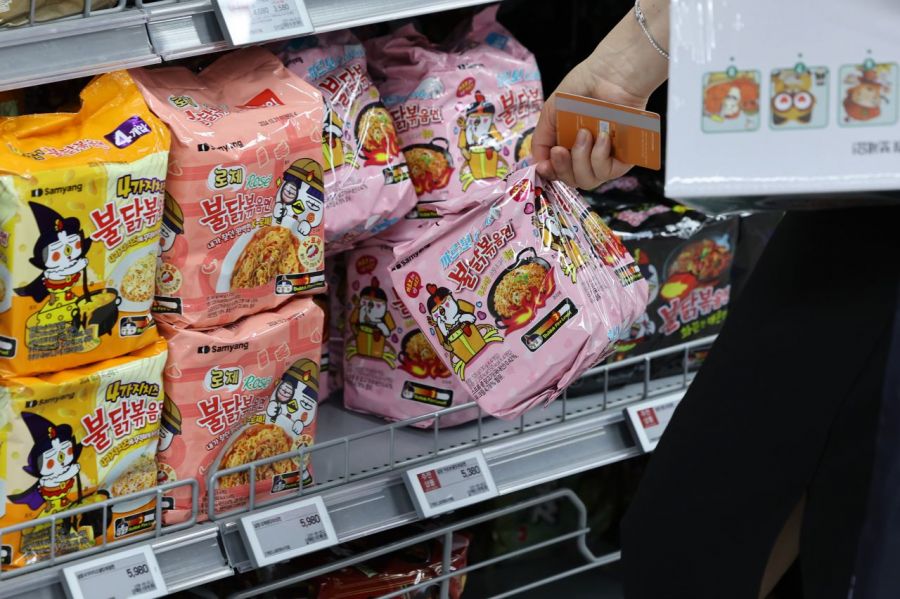 A citizen purchasing Buldak Bokkeummyeon at a large supermarket in downtown Seoul. Photo by Yonhap News Agency
Nongshim Ramen takes the lead...Expanding after securing its place in the market
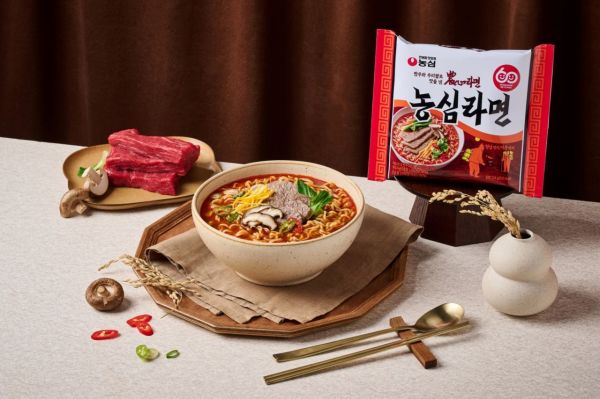
Nongshim, which was the first to launch a ramen product bearing its company name, is closely monitoring the revival of Samyang Ramen. Nongshim released "Nongshim Ramen" in January to mark its 60th anniversary. Originally launched in 1975, Nongshim Ramen is a product that holds special memories for consumers, thanks in part to the advertising slogan, "Older brother first, younger brother next." The product is also highly symbolic, as it was a key factor in the company's decision to change its name from Lotte Industries to Nongshim.
"Nongshim Ramen" achieved early success, surpassing sales of 10 million packs within just three months of its launch. Although detailed cumulative sales figures have not been disclosed, sales have remained steady since then. Industry sources estimate that the brand has stabilized at annual sales of 20 to 30 billion won. In the ramen industry, a new product is considered to have established itself if it achieves annual sales of 20 to 30 billion won, while sales of 50 billion won or more elevate it to a widely recognized brand. Products that generate over 100 billion won in sales are classified as major hits.
Building on this success, Nongshim is accelerating its brand expansion strategy by introducing variations such as "Nongshim Ramen Big Bowl Noodles."
Beyond retro: Brand rebuilding...Quality will determine the winner
The industry views this showdown between Samyang Foods and Nongshim as not just a retro revival, but a competition in "brand rebuilding." While both companies have successful formulas from past hit products, the challenge now is to create new points of resonance with today's consumers, making this more than a simple renewal. There are limits to relying on nostalgic names alone; sustained success requires products and storytelling that reflect the tastes and trends of the current generation.
An industry insider stated, "Retro products tend to generate a quick initial response, but ultimately, it is the quality that determines the brand's longevity. As a generational shift accelerates within the industry, the real contest is over who can secure the staying power to dominate the market with high quality for the longest time."
© The Asia Business Daily(www.asiae.co.kr). All rights reserved.



















