Over 65% of Students at Wolgok-dong Schools Have Migrant Backgrounds
Jung Sungguk: "No Korean Language Classes, Learning Is Avoided"
Superintendent Lee Jungseon: "We Are Struggling, but Working on Improvements"
The issue of the concentration of students with migrant backgrounds at schools near the Goryeoin Village in Gwangju has become a subject of debate during the National Assembly audit. There have even been reports from the field that native students feel like foreigners, raising calls for balanced placement and institutional improvements.
 At the National Assembly Education Committee's audit, Congressman Jung Sungguk is questioning Lee Jungseon, Superintendent of Gwangju Metropolitan Office of Education. Photo by National Assembly Broadcasting System
Jung Sungguk, a member of the People Power Party (representing Busanjin-gu A, Busan), pointed out at the National Assembly Education Committee's audit held at Chonbuk National University on the 22nd, "In the Goryeoin Village in Wolgok-dong, Gwangsan-gu, the proportion of students with migrant backgrounds at certain schools reaches 65.4%. There are even comments that native students appear to be foreigners."
He continued, "Some schools have as many as 100 students with migrant backgrounds, accounting for 34% of the total, yet they do not have Korean language classes. This language barrier makes learning difficult and can lead to emotional instability and conflict among students," he expressed concern.
The total number of students with migrant backgrounds in Gwangju has reached 5,633, with 2,736 of them concentrated in Gwangsan-gu, accounting for nearly half. The concentration is particularly high at the elementary school level, resulting in a significant imbalance at certain schools. Buk-gu follows with 1,370 students, then Nam-gu with 757, Seo-gu with 577, and Dong-gu with 193.
Assemblyman Jung also stated, "Because students from the same country tend to socialize together, they can get by at school without using Korean, which reduces their motivation to learn the language. As a result, there is a growing trend of Korean students avoiding these schools." He emphasized, "Even if there is no legal obligation, the balanced placement of students with migrant backgrounds is an urgent issue," and called for countermeasures.
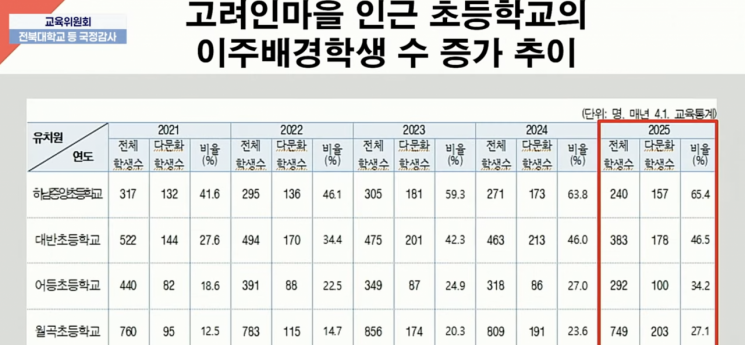 Trend of the proportion of migrant background students at an elementary school near the Korean ethnic village in Gwangsan-gu, Gwangju. In Hanam Jungang Elementary School, 157 out of 240 students in 2025 were of migrant background, accounting for 65.4%. Screenshot from National Assembly Broadcasting
In response, Lee Jungseon, Superintendent of Education of Gwangju City, explained, "In the Goryeoin Village in Gwangsan-gu, the initial migrants invited additional migrants, forming a close-knit community and leading to a concentration of students at certain schools. Students who are foreign nationals have much greater difficulty adapting to learning due to their significantly lower Korean language proficiency compared to students with migrant backgrounds born in Korea."
Superintendent Lee added, "Currently, we are establishing Korean language classes and assigning native language assistant teachers to help students keep up with lessons, but the sudden influx has made it difficult to keep up. We will prepare phased improvement measures and study cases from across the country."
Assemblyman Jung also highlighted the challenges faced by teachers. He said, "The situation is such that even teachers at the site tend to avoid these positions. It is necessary to expand practical incentives such as additional points or allowances," he stressed.
© The Asia Business Daily(www.asiae.co.kr). All rights reserved.


















