It has been confirmed that the National Defense Authorization Act (NDAA) for fiscal year 2026, which passed the U.S. Senate plenary session, includes provisions to maintain the current size of the U.S. Forces Korea. As discussions continue regarding the possibility of reducing or realigning U.S. Forces Korea under a potential second Trump administration, Congress has mandated that the troop level remain at its current strength.
According to the version of the NDAA that passed the Senate and was posted on the U.S. Congress legislative information system on the 22nd (local time), the bill contains a clause stating, "No funds authorized by this Act may be used to reduce the number of U.S. military personnel permanently stationed or deployed in South Korea below 28,500."
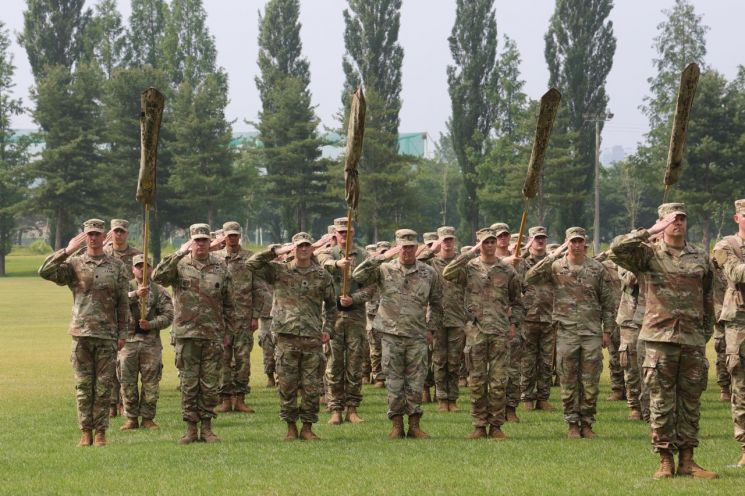
The NDAA is an annual bill that authorizes the Department of Defense's budget expenditures and policies. If this provision is finalized through reconciliation between the Senate and House, it could serve as a basis for Congress to check the administration should the Trump administration attempt to reduce U.S. Forces Korea without prior consultation.
The restriction on using NDAA funds to reduce U.S. Forces Korea was previously included in the NDAA for fiscal years 2019 to 2021, during the first Trump administration, as Congress sought to prevent unilateral reductions by the executive branch. This provision disappeared under the Biden administration but has reappeared after five years with the return of the Trump administration.
Additionally, the bill explicitly prohibits the use of funds for transferring wartime operational control of the Combined Forces Command from a U.S.-led command to a South Korea-led command.
Furthermore, it stipulates that if the Secretary of Defense seeks to reduce U.S. Forces Korea or transfer wartime operational control, a certification must be submitted to Congress confirming that such actions are in the national security interest of the United States and that sufficient consultations have been held with South Korea and other allies.
The use of funds allocated under the NDAA is prohibited for 90 days from the date the required certification is submitted to the relevant congressional committees.
The bill released on this day passed the Senate plenary session on October 9 with 77 votes in favor and 20 against.
Previously, the NDAA passed by the House on September 10 specified that the Secretary of Defense must continue efforts to strengthen U.S. security alliances in the Indo-Pacific region, including "strengthening the alliance with South Korea, maintaining the approximately 28,500 U.S. troops stationed in South Korea, and enhancing mutual defense-based cooperation."
The NDAA passed by the Senate not only specifies the U.S. Forces Korea troop level at 28,500 but also prohibits the use of funds for troop reductions, making it appear more binding than the version passed by the House.
The Senate and House are reportedly working to reconcile the NDAA into a single bill through a conference committee. If the final version passes around the end of December, it could take effect following President Trump's signature.
© The Asia Business Daily(www.asiae.co.kr). All rights reserved.
![Clutching a Stolen Dior Bag, Saying "I Hate Being Poor but Real"... The Grotesque Con of a "Human Knockoff" [Slate]](https://cwcontent.asiae.co.kr/asiaresize/183/2026021902243444107_1771435474.jpg)
















