Joint On-Site Situation Room to Operate from October 25
With the influenza (flu) epidemic starting earlier than usual this year and the authorities issuing a warning, tensions are also rising around the Asia-Pacific Economic Cooperation (APEC) Summit. There are increasing calls for the government to thoroughly establish prevention and emergency medical response systems for various infectious diseases, including the flu, as well as illnesses such as food poisoning.
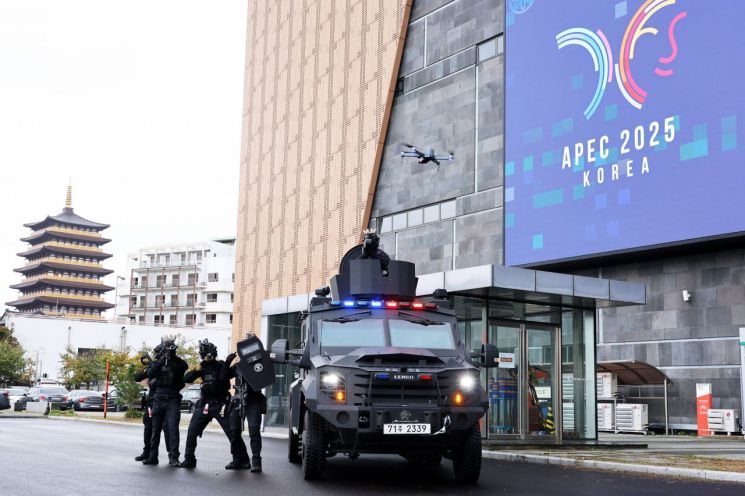 Ahead of the Asia-Pacific Economic Cooperation (APEC) Summit, on the 20th, the Police Special Forces of the Gyeongbuk Provincial Police Agency conducted an anti-terrorism drill using drones at the Gyeongju Hwabaek Convention Center in Gyeongbuk. Photo by Yonhap News Agency
According to health and quarantine authorities on October 22, the Korea Disease Control and Prevention Agency issued an influenza epidemic advisory at midnight on October 17, as the proportion of suspected influenza cases in the 40th week of this year (September 28-October 4) reached 12.1 per 1,000 outpatients, surpassing the 2025-2026 season’s epidemic threshold of 9.1. This means the influenza epidemic started about two months earlier than usual. As a result, influenza prevention and quarantine guidelines are being strengthened nationwide-including in Gyeongju, Gyeongbuk Province, where the APEC Summit is being held-and the need for vaccinations, especially among vulnerable groups, is increasing.
To manage influenza and other infectious diseases, the government will operate a joint on-site situation room starting October 25. An official from the Korea Disease Control and Prevention Agency stated, "Since this is a large-scale international event with world leaders participating, we are urging not only event officials but also local governments to encourage residents to follow personal hygiene rules and participate in disease prevention efforts to ensure there are no gaps in infectious disease prevention or response." The official added, "We will continuously monitor the situation and respond thoroughly in the event of an outbreak."
Due to the record-breaking heat waves this year, the number of food poisoning cases from January to August has already surpassed last year’s annual total, raising nationwide awareness about food safety. The Ministry of Food and Drug Safety is responsible for overseeing the overall food and beverage safety management at hotels and various conference venues where world leaders and delegations will stay, as well as at the media center and event venues in Busan, Pohang, and other locations. The central and local offices of the Ministry, along with local governments such as Gyeongju City, will dispatch on-site inspection teams to collect and rapidly test food samples from hotels in advance. In the event of suspected food poisoning cases, they plan to respond swiftly through epidemiological investigations.
Oh Yoo-kyung, Commissioner of the Ministry of Food and Drug Safety, reported at the National Assembly Health and Welfare Committee’s audit the previous day, "We will strengthen hygiene inspections and food poisoning bacteria tests for kitchen staff at the APEC Summit venues, and assign dedicated inspectors to banquet halls to ensure thorough food poisoning prevention." She added, "We will operate a food and beverage safety support team in cooperation with related agencies, and maintain a continuous food poisoning management system during the event."
The Ministry of Health and Welfare has recently checked the status of emergency medical system preparations in the Gyeongju area in anticipation of possible casualties during the APEC Summit. Starting October 27, the ministry will further strengthen on-site response by assigning ministry staff and emergency medicine specialists from the National Emergency Medical Center to a joint medical support situation room with related agencies.
Earlier this month, Minister of Health and Welfare Chung Eun-kyung visited Gyeongju in person to receive a briefing on emergency medical response plans and to inspect preparations such as securing beds and deploying medical staff at Dongguk University Gyeongju Hospital, as well as the readiness of nearby partner hospitals for the rapid transfer and treatment of emergency patients. Ahead of the summit, Dongguk University Gyeongju Hospital has added emergency room beds and medical equipment and established a new VIP ward with 18 beds.
During the summit, a mobile hospital will be operated outside the conference venue, and 56 ambulances and 5 helicopters will be stationed nearby to transport patients in case of emergencies. As the event is a large-scale international gathering with more than 20,000 participants, the Ministry of Health and Welfare will operate a 24-hour disaster medical surveillance system and has preemptively issued a "watch" level for disaster medical response to strengthen emergency readiness.
Meanwhile, to enhance preparedness and response to bioterrorism, the Korea Disease Control and Prevention Agency formed the "Central Bioterrorism and Infectious Disease Task Force for APEC" in July and has conducted "bioterrorism response simulation drills" and "central joint bioterrorism response drills" in accordance with national major event preparation guidelines. During the APEC period, a special bioterrorism command vehicle and a mobile laboratory vehicle will be deployed on-site, and bioterrorism detectors will also be installed.
© The Asia Business Daily(www.asiae.co.kr). All rights reserved.
![Clutching a Stolen Dior Bag, Saying "I Hate Being Poor but Real"... The Grotesque Con of a "Human Knockoff" [Slate]](https://cwcontent.asiae.co.kr/asiaresize/183/2026021902243444107_1771435474.jpg)

















