Solgeo Museum of Art and WooYang Museum of Art Present Special APEC Exhibitions
Master of Korean Painting Park Daesung Unveils Grand Landscape of Korea
Exhibition of Works by Renowned Korean Artist Nam June Paik
The grandeur and beauty of the Korean Peninsula’s picturesque landscapes have been captured on a canvas that fills an entire wall of the exhibition hall. The 15-meter-wide and 5-meter-high painting intricately depicts scenes from Mount Baekdu, Hallasan in Jeju, Bangudae in Ulsan, and Dokdo. The title of the work is "Korea Fantasy" (2023). Among the masterpieces by Daesung Park, a renowned master of ink painting known for his large-scale works, this is the largest. Meeting with Park on the 21st, he said, "I have been to the Himalayas and the Alps, but the landscapes of Korea are the best," adding, "Our ancestors settled in a truly wonderful place where mountains and rivers harmonize."
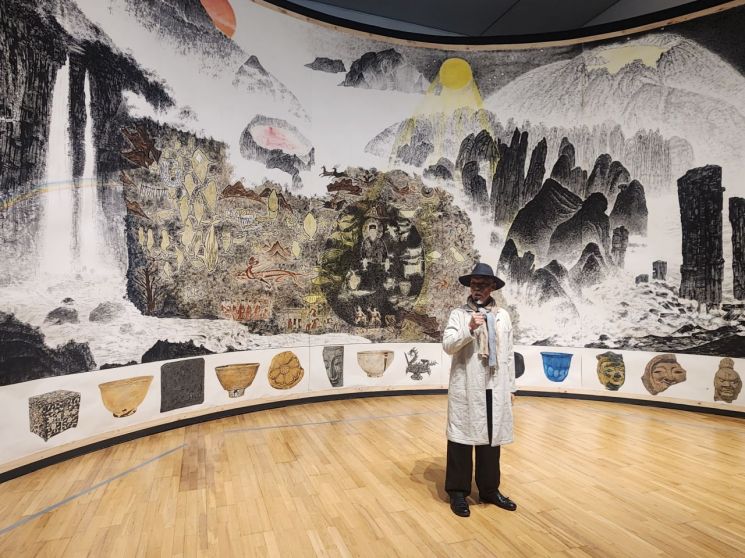 On the 21st, artist Daesung Park is explaining his work "Korea Fantasy" (2023) displayed at Solgeo Museum of Art. Photo by Mideum Seo
The Gyeongju Solgeo Museum of Art will hold a special exhibition of Korean art, "Silla Fragrance," from October 22, 2025, to April 26, 2026, in hopes of a successful 2025 APEC Summit. Hosted by the Ministry of Culture, Sports and Tourism and the Arts Management Support Center, the exhibition will be held in Exhibition Halls 1 to 5 dedicated to Daesung Park within the Solgeo Museum of Art. The museum itself opened in August 2015, following the donation of works by master painter Sosan Daesung Park, as Gyeongsangbuk-do Province and Gyeongju City joined forces to create it.
This exhibition features Daesung Park, as well as Monk Songcheon, a renowned Buddhist painter from Gyeongju, Kim Min, a traditional painting restoration expert and artist, and glass artist Park Sunmin, who transforms discarded glass into beautiful works of art.
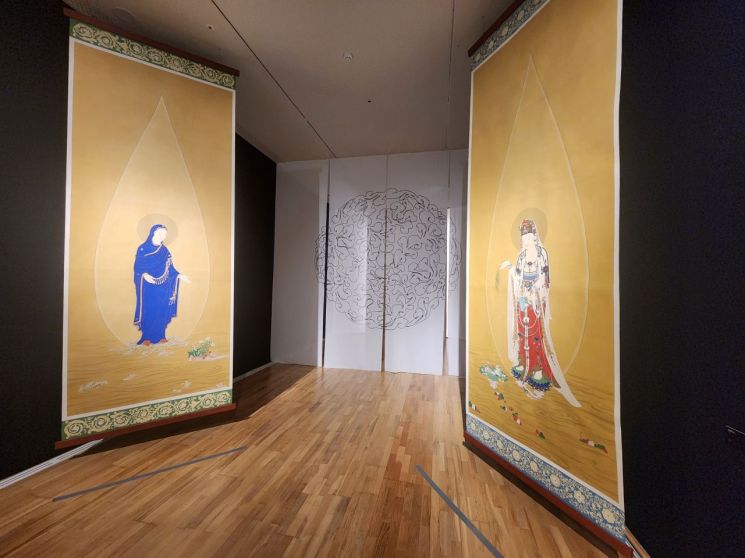 Renewed work of Monk Songcheon’s 'Gwaneum and Maria - The Truth Has Never Left Our Side.' Photo by Seomideum
Monk Songcheon, who explores universal truths shared by religions through the fusion of Buddhist and Christian art, presents a renewed version of one of his signature works, "Gwaneum and Maria - The Truth Has Never Left Our Side." This large-scale piece, standing 4 meters tall, features the Virgin Mary in blue on the left and Avalokitesvara Bodhisattva in red on the right, facing each other. Monk Songcheon explained, "Through this work, I wanted to convey a message of truth and love that transcends religion," adding, "I hoped to discuss coexistence, mutual respect, harmony, and humanism."
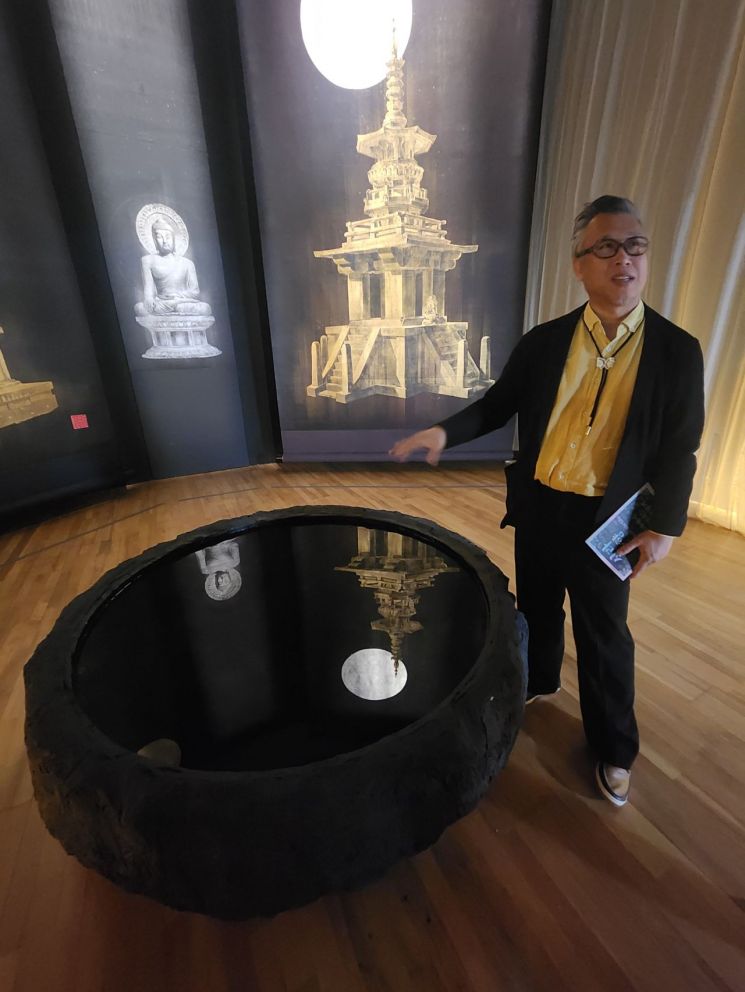
Kim Min, an expert in cultural heritage and painting restoration, reinterpreted the Seokguram Buddha, Seokgatap, and Dabotap in traditional painting. The modern reinterpretation of the values of Buddhism, which was the state religion of Silla, is particularly impressive. At the center of the exhibition hall, a water jar filled to the brim reflects the image of the pagodas hanging on the wall, casting a subtle glow on the water’s surface. Kim Min said, "When visitors create ripples on the water with their fingers, they experience the merging of past and present," and added, "I hope this exhibition allows people to experience such subtle moments."
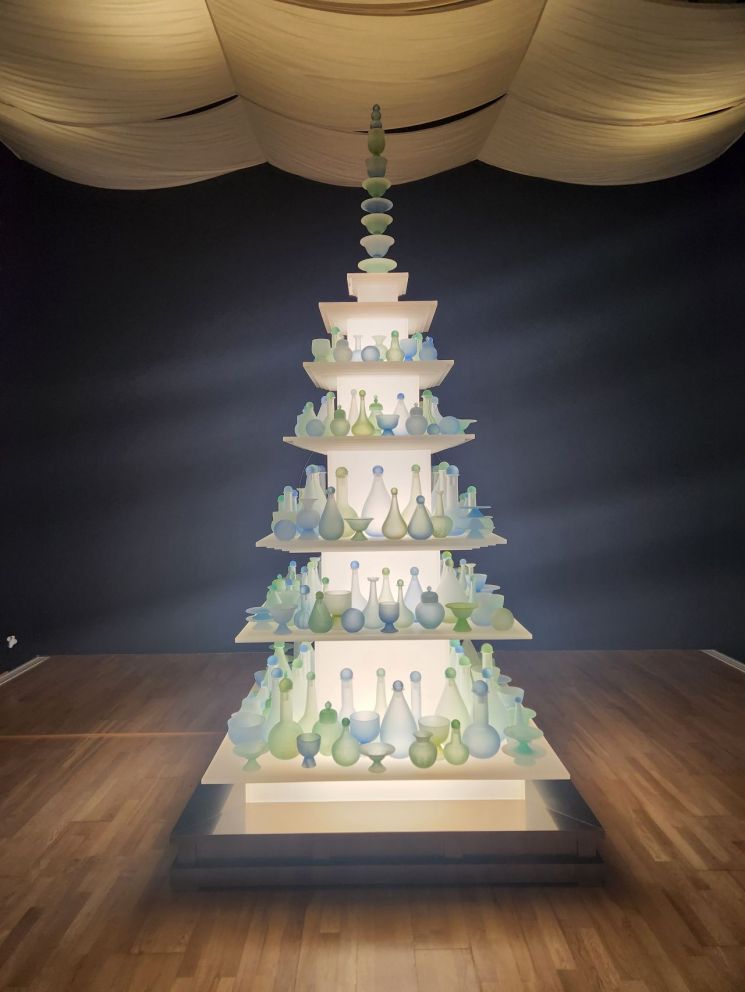
In Park Sunmin’s booth, a tower made from discarded glass bottles adorned with beautiful colors has been erected. Park made the most of the original shapes and colors of the waste glass bottles, while also using the blowing technique to evoke delicate sensations. The blowing technique refers to spreading paint, ink, or pigment by blowing through the mouth or using tools to create natural diffusion and flow. Silver foil is placed between the glass pieces to express a uniquely Korean aesthetic. Park explained, "I was inspired by the fact that glass was considered a precious material during the Silla period and used in reliquaries for enshrining sarira," and added, "I hope visitors can experience the brilliance of Silla’s aesthetics through the tower of light."
Kim Nam-il, President of the Gyeongsangbuk-do Culture & Tourism Organization, commented, "Through this exhibition, I hope that the beauty and culture of Korea, as well as the works of the brilliant artists of Gyeongju and Silla, will once again spread far and wide."
2025 APEC Agenda: 'Inclusive and Sustainable Future' Illuminated Through Nam June Paik’s Art World
WooYang Museum of Art, established in 1991, is also holding a special exhibition, "Nam June Paik: Humanity in the Circuits," to commemorate the hosting of APEC in Gyeongju. Focusing on Nam June Paik’s works from the 1990s, the exhibition artistically explores this year’s core APEC agenda of "an inclusive and sustainable future." As the first exhibition following a year-long comprehensive remodeling, it unveils 12 pieces from the collection, including restoration works that have not been shown to the public for over 20 years.
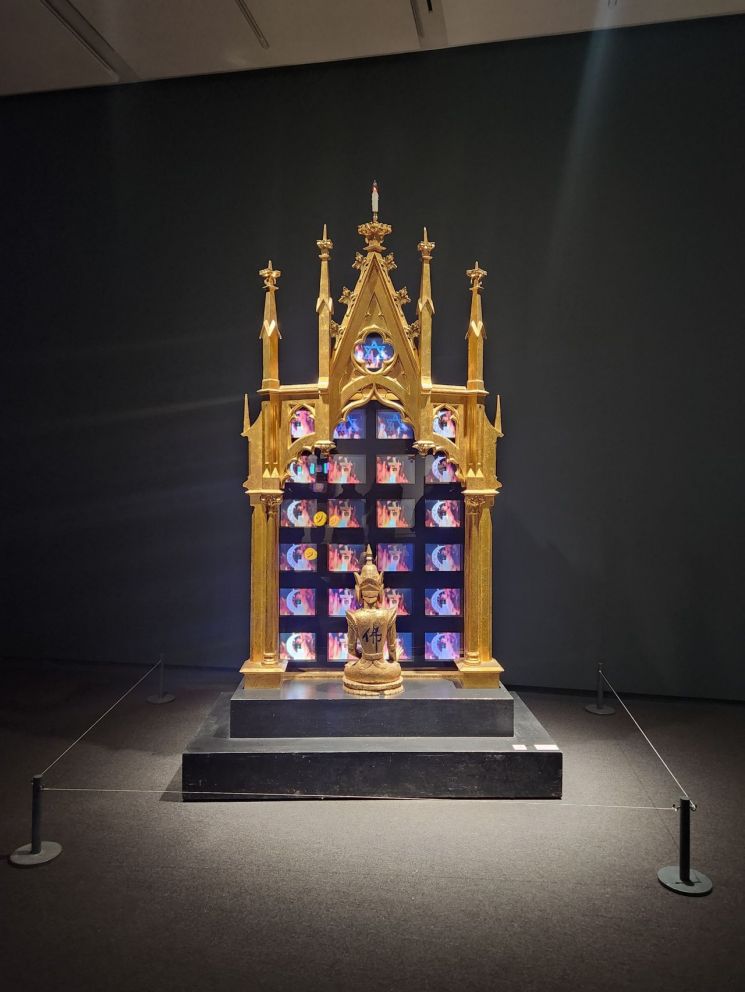 Video installation series "My Faust: Economics" from Nam June Paik's "My Faust" series currently exhibited at Uyang Museum of Art. Photo by Seomibeom.
Among Nam June Paik’s video installation series "My Faust," the works "My Faust - Economics" and "My Faust - Spirituality" are being exhibited in Korea for only the second time since their domestic debut at the National Museum of Modern and Contemporary Art in 1992. Just as "Faust" is regarded as the culmination of Goethe’s imagination, Paik is known to have produced around 500 works in the "My Faust" series between 1989 and 1991, intending to encapsulate the essence of his artistic vision. Two of these works are on display, intersecting the themes of capital, ethics, time, and existence with Eastern and Western philosophies and technological imagination. While "Economics" visualizes the conflict between capital and human values, "Spirituality" explores the possibility of memory and spirit enduring within the limitations of technology.
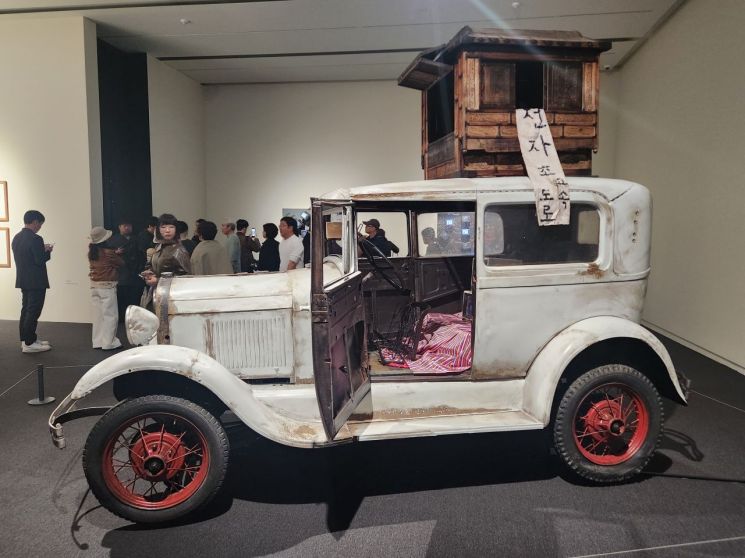 One of the cars from Nam June Paik's "Electronic Superhighway" series was unveiled at this exhibition after two and a half years of restoration work. Photo by Seo Mideum
The "Electronic Superhighway" series is a large-scale installation consisting of three cars, one of which has been unveiled after two and a half years of restoration. Exhibition curator Lee Jiwoo explained, "This work was first presented at the Daejeon Expo, but it was severely damaged, so we removed the rust over the past three years and are now able to display it," adding, "It is an impressive piece that combines a car, symbolizing Western industrial society, with an Asian palanquin, and features silk inscribed with the words 'Electronic Superhighway.' At the time, Nam June Paik said, 'Soon, something will run along the superhighway and unite the world,' which was a prediction of the internet."
Other works on display include "Ancient Horseman," inspired by ancient equestrian pottery excavated in Gyeongju; media experiments such as "Music Heart" and "The Art of Fugue," which fuse video, objects, sound, and sculptural structures. The exhibition goes beyond a simple retrospective, retracing the organic circuits between technology, art, and humanity that Nam June Paik constructed, and serves as an opportunity to sublimate the global vision of the 2025 APEC Summit into the language of art. The exhibition runs until November 30.
© The Asia Business Daily(www.asiae.co.kr). All rights reserved.



















