Base Effect of Last Month's Communication Fee Discount and Eased Progressive Rate for Residential Electricity Bills
Excluding Temporary Impacts from Communication Services and Residential Electricity, Index Rises Only 0.1%
Last month, the producer price index rebounded after a month. This was influenced by the base effect of SK Telecom's 50% discount on all subscriber communication fees in the previous month, as well as the end of the eased summer progressive rate for residential electricity charges.
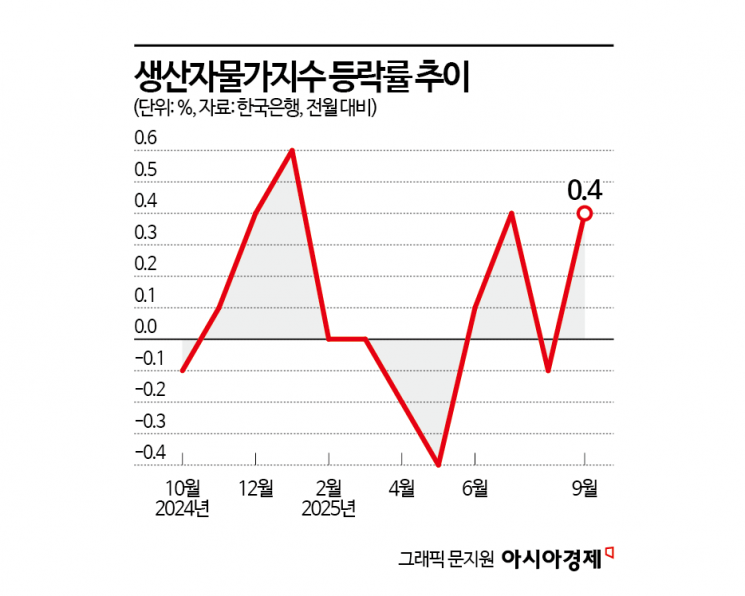
According to the "September 2025 Producer Price Index (Preliminary)" released by the Bank of Korea on October 22, the producer price index last month stood at 120.54 (2020=100), up 0.4% from the previous month. The index turned upward after a month, driven by increases in information and communication and broadcasting services, as well as electricity. Compared to the same period last year, the index rose by 1.2%, showing a wider increase.
By category, electricity, gas, water, and waste led the rise in producer prices. Electricity, gas, water, and waste increased by 1.1% from the previous month, with residential electricity up 14.4% and industrial city gas up 5.8%. Lee Moonhee, head of the Price Statistics Team 1 at the Bank of Korea's Economic Statistics Department, explained, "The easing of the progressive rate for residential electricity charges during the summer months of July and August, which effectively lowered bills, ended in September. As a result, residential electricity charges rose compared to the previous month."
Agricultural, forestry, and fishery products also rose by 0.4% from the previous month, with livestock products up 2.0% and agricultural products up 0.5%. Lee added, "Prices for rice, lettuce, and other vegetables and livestock products increased compared to the previous month. The rise in rice prices is due to a supply shortage, as last year's rice production decreased and this year's new crop has not yet been fully shipped to the market."
Some early-maturing rice was harvested in September, but frequent rainfall delayed both harvesting and distribution. Most of the new rice crop is expected to be shipped in October. Lettuce prices increased as frequent rainfall during the shipping period disrupted harvesting operations. Livestock prices, including beef and pork, rose due to increased demand during the holiday season.
In the service sector, information and communication and broadcasting services (up 4.0%) and financial and insurance services (up 1.4%) led to a 0.4% increase from the previous month. In the previous month, the producer price for services had dropped sharply as the mobile communication service, which included SK Telecom's August communication fee discount, plunged by 26.2%. Among manufactured goods, chemical products (up 0.5%) and primary metal products (up 0.7%) contributed to a 0.2% monthly increase.
However, Lee noted, "When estimating the impact of mobile communication services and residential electricity, both of which had significant temporary effects, on the month-on-month increase in producer prices, mobile communication services are estimated to have contributed about 0.24 percentage points and residential electricity about 0.07 percentage points to the total index. If these two items had not increased in September, the total index would have risen by about 0.1% compared to the previous month."

Last month, the domestic supply price index rose by 0.1% from the previous month. Compared to the same month last year, it increased by 0.6%. The domestic supply price index measures price changes of goods and services supplied domestically (domestic shipments and imports) to assess the ripple effects of price changes. By stage of production, the price of raw materials fell by 1.4%, while intermediate goods rose by 0.2% and final goods by 0.3%.
The total output price index, which measures price changes for goods and services based on total output including exports in addition to domestic shipments, rose by 0.4% from the previous month. Both services (up 0.4%) and manufactured goods (up 0.2%) increased. Compared to the same month last year, the index rose by 1.4%.
© The Asia Business Daily(www.asiae.co.kr). All rights reserved.
![Clutching a Stolen Dior Bag, Saying "I Hate Being Poor but Real"... The Grotesque Con of a "Human Knockoff" [Slate]](https://cwcontent.asiae.co.kr/asiaresize/183/2026021902243444107_1771435474.jpg)












