Minister Choi Gyojin Holds First Press Conference as Minister of Education on October 20
On October 20, Minister of Education Choi Gyojin addressed the issue of early private English education for young children, stating, "English academies targeting infants and young children, which excessively encourage private education for this age group, need to be regulated." However, he also emphasized, "We must proceed cautiously, as such regulations could lead to other unintended side effects."
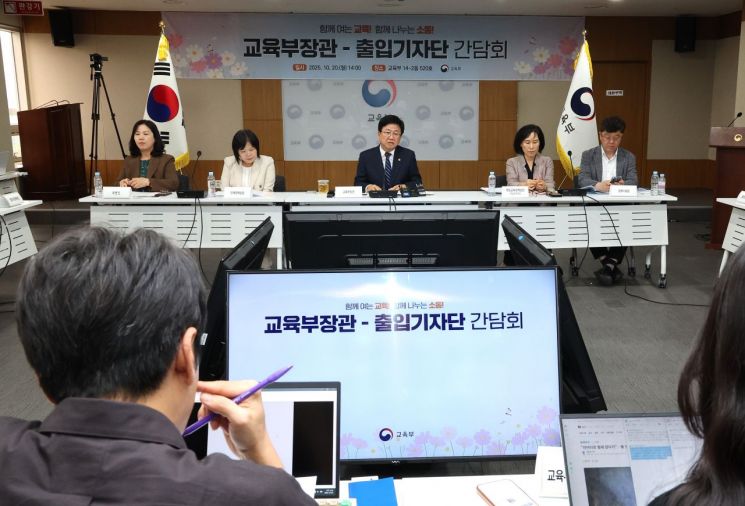
At his first press conference with reporters since taking office, held at the Government Complex Sejong on the same day, Minister Choi said, "It is important that any regulation is both rational and feasible," clarifying his position.
He added, "Although English academies for young children are, in essence, private academies, they should not be operated in the form of kindergartens." He stressed the need for fundamental improvements by asking, "Are we providing education appropriate to the developmental stage of young children? Is it aligned with the true purpose of education?" He went on to say, "Within this framework, we need to review legal and institutional supplements, develop field-oriented improvement measures that align with the original purpose of these institutions, and respect parents' right to choose."
Minister Choi also expressed concerns that a regulation-focused approach could lead to negative consequences, such as the underground proliferation of private education. He said, "There are concerns that private education might simply take on new, covert forms to evade regulation, or that children's right to learn could be infringed." He continued, "This is why the Ministry of Education seeks a balanced approach, not just focusing on penalties, but also on regulatory reviews, administrative guidance, expanding alternative English programs within public education, and improving parental awareness." He further explained, "If regulation becomes unavoidable, it should be made clear that this is not to restrict the right to education, but to provide a minimum safety net to protect children's developmental rights and healthy learning opportunities."
Regarding the AI textbook (AIDT), which was downgraded from "textbook" to "educational material" following the revision of the Elementary and Secondary Education Act in August, Minister Choi stated, "We will continue to provide support to ensure that schools can use it as educational material without any difficulty, based on their autonomous judgment."
He also expressed opposition to abolishing the high school credit system, saying, "Rather than eliminating the system altogether, it would be less disruptive to supplement and firmly establish it in the field." Minister Choi explained, "The implementation of the high school credit system was announced well in advance, and after operating pilot schools, it was rolled out nationwide. However, issues that should have been identified earlier only surfaced later, so we have developed immediate improvement measures." He added, "Since this is a matter of changing the structure and paradigm of high schools, there will be tasks that need to be addressed." He further stated, "Above all, easing the credit completion standards falls under the authority of the National Education Commission, but this also requires a national consensus." He explained, "I understand that the National Education Commission is trying to make a decision as quickly as possible regarding the first and second proposals submitted by the Ministry of Education."
Minister Choi refrained from making further comments on the issue of transitioning to absolute grading for the College Scholastic Ability Test (CSAT) and school records. Last month, he sparked controversy by mentioning the need for such a transition during a parliamentary interpellation session. For this reason, during the parliamentary audit of the Ministry of Education and other agencies on October 14, Minister Choi responded to a related question from Seo Jiyeong, a lawmaker from the People Power Party, by saying, "At the time, the lawmaker asked for my personal opinion as Minister regarding the transition to absolute grading for the CSAT, so I answered accordingly, but in hindsight, I believe it was not a prudent response."
On this day, Minister Choi stated, "The transition to absolute grading for the CSAT and school records is not something the Ministry of Education can simply decide to implement at a certain time." He added, "It is important to ensure that students and parents can prepare in a stable environment where they can fully anticipate any changes."
© The Asia Business Daily(www.asiae.co.kr). All rights reserved.

















