There have been claims that the portion size of grilled squid sold at a market in Seogwipo, Jeju, is excessively small compared to its price.
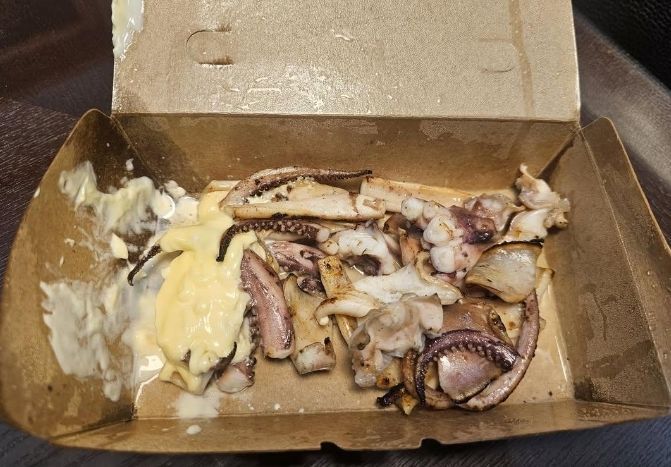 A photo of grilled squid involved in the 'overcharging controversy' at a market in Jeju. Online community
An online post uploaded on October 20 has been gaining attention on social networking services (SNS). Traveler A wrote, "The medium-sized grilled squid cost as much as 15,000 won, but when I actually received it, it felt like I only got half the portion." He added, "Even if it is a tourist destination, this is just unscrupulous business."
The photo released by A shows a small paper box containing only a few squid legs with mayonnaise sauce. Upon seeing the photo, online users commented, "From a business owner's perspective, they probably think customers will only come once, so they sell it like that," "Did they eat the body and just give you the leftover legs?" "Why would they give out such scraps?" along with skeptical remarks such as "Is this really true?"
As the 'overcharging controversy' surrounding Jeju has recently resurfaced, there has been increasing criticism of Jeju's repeated overcharging issues and aggressive business practices.
Overcharging Controversy Persists Despite Growing Tourist Numbers
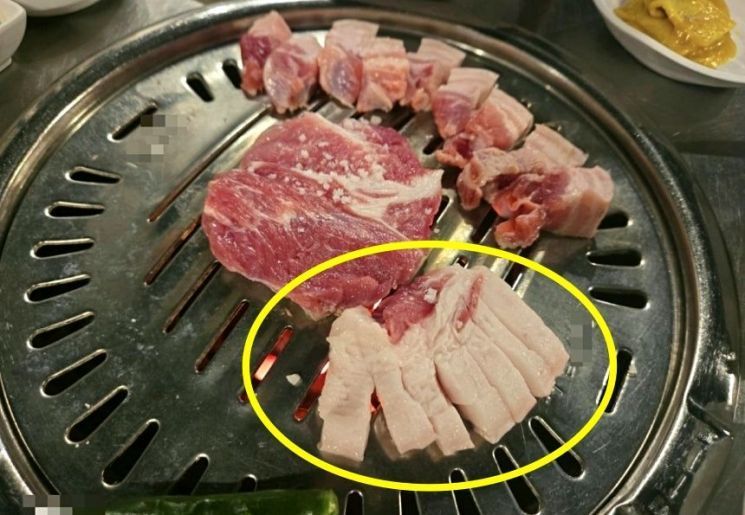 The state of the pork neck meat at a Jeju black pork specialty restaurant, where fat occupies a significant portion. Online community
Previously, on October 18, another controversy erupted in Jeju when a customer reported that "half of the pork ordered at a Jeju black pork specialty restaurant was fat." The photo shared by the poster showed two pieces of pork neck, one of which was entirely fat. The accompanying pork belly also appeared to be about half fat, exceeding the amount of lean meat. Online users who saw this remarked, "Are they really expecting customers to eat that?" and criticized, "Such business practices targeting tourists are still prevalent."
Additionally, at the Jeon-nong-ro Cherry Blossom Festival in April, stir-fried sundae with only six pieces of sundae was sold for 25,000 won, sparking another overcharging controversy. On October 10, at the Tamna Cultural Festival, gimbap sold for 4,000 won per roll was found to contain an overwhelming proportion of rice compared to its fillings, once again fueling the debate.
Meanwhile, according to Jeju Province, from January to October 9 this year, the number of tourists visiting Jeju reached 10,613,183, a 2.2% decrease from the same period last year, but has been steadily increasing since June. In particular, during the Chuseok holiday, 339,926 people visited Jeju, marking an 11% increase compared to the previous year.
Furthermore, the number of cruise tourists visiting Jeju this year has surpassed 640,000, already exceeding last year's total. Despite this recovery in tourism, dissatisfaction among tourists is growing due to the persistent overcharging controversy in Jeju.
© The Asia Business Daily(www.asiae.co.kr). All rights reserved.


















