Assemblywoman Kwon Hyangyeop Obtains Act-Geo Assessment
First Report Shows Trap Success Rates Ranging from 40% to 60%
Second Report Dominated by 100% Ratings
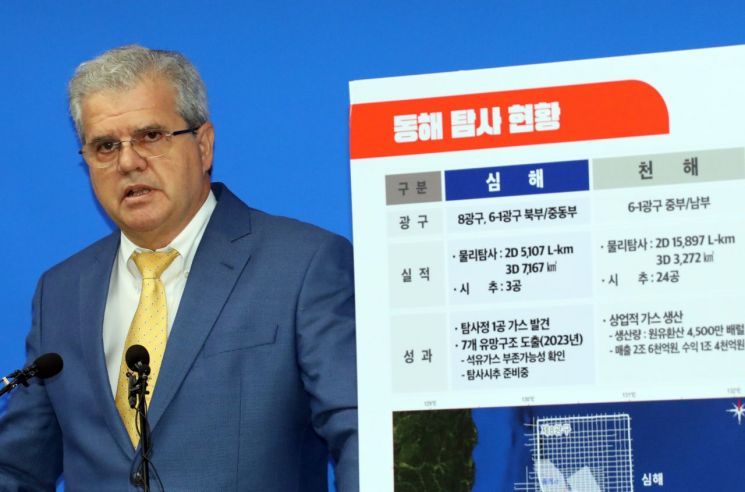 Vitor Abreu, advisor at Act-Geo, a U.S. company responsible for analyzing deep-sea oil and gas deposits in the East Sea, is answering questions related to the development of the deep-sea gas field in the East Sea at the Ministry of Trade, Industry and Energy press room in the Government Complex Sejong on the morning of June 7, 2024. Photo by Yonhap News
There have been claims that the East Sea oil exploration prospect evaluation report, commissioned by Korea National Oil Corporation (KNOC) from Act-Geo, a U.S. geological exploration specialist, was distorted. Act-Geo is suspected of having overestimated the trap success rate to suit KNOC’s preferences. A trap refers to a geological structure that stores oil and gas, and is considered one of the four key conditions for oil accumulation, playing a crucial role in determining exploration success rates.
According to exploration success rate data submitted by KNOC to Assemblywoman Kwon Hyangyeop of the National Assembly’s Trade, Industry, Energy, SMEs and Startups Committee on October 20, Act-Geo identified seven promising structures, including Daewang Whale, in its 2023 prospect evaluation (first evaluation). In 2024, an additional prospect evaluation (second evaluation) identified 14 more promising structures, including Goblin Shark.
In the first evaluation, none of the promising structures were assessed with a 100% trap success rate. Even Daewang Whale, considered the most promising, had a trap success rate of only 60%. The rest ranged between 40% and 60%.
In contrast, in the second evaluation, 12 out of 14 promising structures were assessed with a 100% trap success rate, and only two-'Moray' and 'Shrimp 4N'-were set at 80%. While the trap success rates in the first evaluation generally ranged from 40% to 60%, in the second evaluation, they jumped to between 80% and 100%.
The oil exploration success rate is calculated by multiplying the individual success rates of the four key conditions for oil accumulation: source rock, cap rock, reservoir, and trap. If even one of these figures changes, the overall exploration success rate fluctuates significantly.
For example, in the second evaluation, Goblin Shark, considered the most promising structure, had an exploration success rate of 18.7% when the trap success rate was set at 100%. This is nearly the same as Daewang Whale’s exploration success rate of 19.1%. However, if the trap success rate is adjusted to 60%, the same as Daewang Whale, the exploration success rate drops sharply to 11.2%. This demonstrates that overestimating just the trap success rate can significantly alter the overall exploration success rate.
Meanwhile, in the additional prospect evaluation, except for Viperfish, all structures were identified as stratigraphic traps. Traps are generally divided into structural traps and stratigraphic traps, with most oil typically found in structural traps.
However, among the additional promising structures, there were no cases where a lower success rate was assigned due to being stratigraphic traps. Of the 14 additional promising structures, 13 were stratigraphic traps, with 12 assessed at 100% and one (Shrimp 4N) at 80%, meaning that risk was virtually not reflected at all.
The drilling results for Daewang Whale revealed that the stratigraphic trap was unconfirmed. After the first drilling of Daewang Whale, KNOC commissioned Core Lab to analyze samples, and in the interim report released in June, it concluded that the stratigraphic trap was unconfirmed. However, this information was omitted from the final report submitted to the National Assembly and the Ministry of Trade, Industry and Energy in September. KNOC reported on the four key conditions but left out the trap entirely.
In response, KNOC explained, "Since no significant amount of gas was discovered, there was no need to mention the trap." Assemblywoman Kwon Hyangyeop’s office pointed out, "Given that Abreu was promoted as a 'master of stratigraphic traps' and more than 120 billion won was invested in the drilling, such omission in the report may be seen as an attempt to conceal information, possibly out of concern that it could negatively impact future drilling efforts."
© The Asia Business Daily(www.asiae.co.kr). All rights reserved.
![Clutching a Stolen Dior Bag, Saying "I Hate Being Poor but Real"... The Grotesque Con of a "Human Knockoff" [Slate]](https://cwcontent.asiae.co.kr/asiaresize/183/2026021902243444107_1771435474.jpg)
















