33,000 Kilometers Surveyed Since 2014 Through Last Month
7,760 Underground Cavities Proactively Addressed
Survey Results Disclosed via Platforms Like "Seoul Safety Nuri"
Since Seoul began ground-penetrating radar (GPR) surveys in 2014, a total of 7,760 underground cavities (voids or empty spaces beneath the ground) have been discovered up to last month. However, thanks to proactive measures, the number of cavities found each year has decreased to one-fifth over the past decade.
According to the Seoul Metropolitan Government on October 19, an analysis of GPR survey data, which has been conducted since 2014 to prevent ground subsidence, shows that over the past 10 years, the total survey length has increased by about 12 times, while the number of cavities found per kilometer has dropped to one-fifth its previous level.
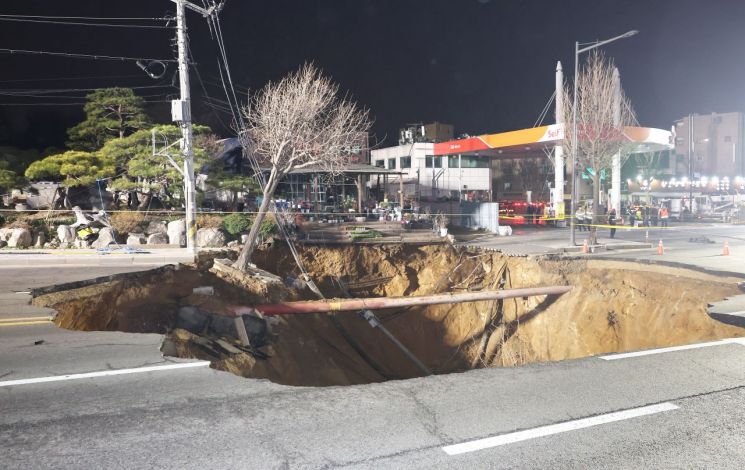 The intersection near Daemyeong Elementary School in Gangdong-gu, Seoul, where a sinkhole accident occurred last March. Photo by Yonhap News
GPR surveys are a ground subsidence prevention activity that involves sending electromagnetic waves into the surface and analyzing the reflected signals to proactively detect and address underground voids. Seoul was the first city in the country to adopt GPR surveys in November 2014 and has been conducting regular surveys in earnest since 2015.
The annual survey length increased from 614 kilometers in 2015 to approximately 7,169 kilometers as of September 2025. Seoul plans to complete surveys covering 9,000 kilometers by the end of the year, and starting next year, will significantly expand its workforce and equipment to survey 18,000 kilometers annually. In addition, the city will conduct comprehensive annual surveys of areas such as the surroundings of excavation sites and general road sections.
To achieve this, the city will increase its team of specialists from the current seven to ten by the end of this year and will add three more vehicle-mounted GPR units, bringing the total to ten (seven vehicle-mounted and three handheld units) by year-end.
From the start of GPR surveys in 2014 through last month, the cumulative survey distance reached 33,129 kilometers. During this period, a total of 7,760 cavities were discovered. The overall detection rate for cavities per kilometer over the entire period was about 0.23.
Although the annual number of cavities discovered increased as the survey distance expanded, the number of cavities found per kilometer decreased from 0.41 in 2015 to 0.08 this year, representing a reduction to about one-fifth over the past decade. The city attributes this to the early detection and proactive removal of voids through thorough GPR surveys.
Seoul has also significantly strengthened GPR surveys around excavation sites. Since April, the city has conducted special monthly inspections of areas near excavation sites, and for large-scale construction sites such as subways and road tunnels, intensive weekly inspections are being carried out. These measures aim to address heightened public anxiety and ensure underground safety following recent major ground subsidence incidents near excavation sites. From January to September this year, the city inspected a total of 312 sites, including 289 excavation sites and 23 large-scale construction sites (such as the Shinansan Line, Dongbuk Line, Subway Line 9 extension, and Yeongdong-daero section), discovering 97 cavities and addressing all of them.
The results of GPR surveys and subsequent actions are transparently disclosed to the public. Through the "GPR Survey Map" on the "Seoul Safety Nuri" platform, Seoul provides information on the locations, discovery dates, sizes, and follow-up actions for all 7,760 cavities discovered and addressed since November 2014. Han Byungyong, Director of Disaster and Safety at the Seoul Metropolitan Government, stated, "Seoul has continuously strengthened GPR surveys, and all discovered cavities have been addressed promptly to prevent ground subsidence in advance. In addition to GPR surveys, we will further reinforce safety management at excavation sites and introduce new technologies to prevent ground subsidence, making Seoul a safer city."
© The Asia Business Daily(www.asiae.co.kr). All rights reserved.

















