Tax Fairness for High-Priced and Multiple-Home Owners Must Be Considered
"Concerns Over Separation of Budget Functions Understood, Will Cooperate Closely"
Deputy Prime Minister and Minister of Economy and Finance Koo Yoon-chul suggested the possibility of a comprehensive restructuring of the tax system, including property holding tax and capital gains tax, if the upward trend in housing prices centered in the Seoul metropolitan area does not subside.
At a meeting with accompanying reporters held on the 16th (local time) at the International Monetary Fund (IMF) headquarters in Washington D.C., USA, Koo stated, "We need to consider the consistency of the tax system at the acquisition, holding, and transfer stages of real estate," adding, "In particular, we will take into account the fairness of taxation on high-priced homes and multiple-home owners."
Koo pointed out, "Currently, in Korea's real estate taxation system, the burden at the holding stage is low, while the tax burden at the transfer stage is high. Because of this, the 'lock-in effect' has intensified, and properties are not being released onto the market." He diagnosed, "It is advantageous to hold onto a house, and the tax burden is only heavy when selling, which blocks market liquidity. As a result, it is difficult to achieve a virtuous cycle in the real estate market."
Koo further explained, "If, like in the United States, a 1% property tax is imposed, the owner of a house worth 5 billion won would pay 50 million won in taxes annually. With such a burden, simply holding onto the property becomes difficult, which activates transactions." He continued, "We also need to design an appropriate level of property holding tax and taxation system through phased approaches and research studies, taking into account the realities of our country."
He added, "This is not an easy decision, but we are preparing to formulate policy by listening to expert opinions and considering the appropriate timing. We will set the policy direction through research and discussion at a level that the public can accept."
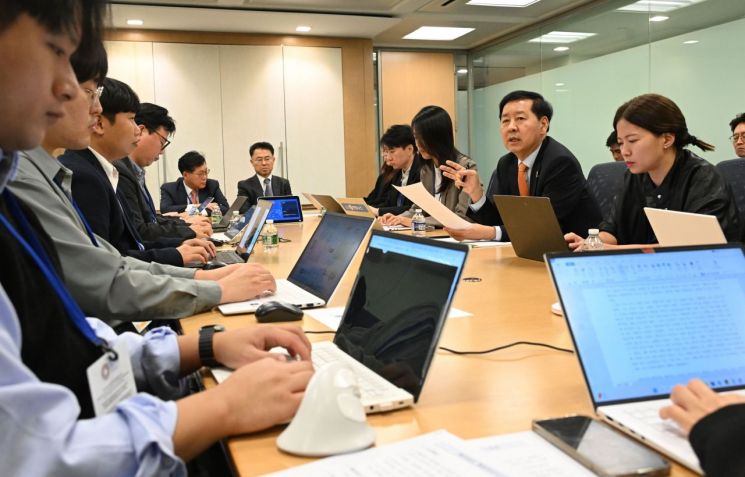 Deputy Prime Minister and Minister of Economy and Finance Koo Yoon-chul held a meeting with accompanying reporters on the 16th (local time) at the International Monetary Fund (IMF) headquarters in Washington D.C., USA. (Provided by the Ministry of Economy and Finance)
"A Fair Approach to Both High-Priced Homes and Multiple-Home Owners"
Regarding the possibility of discussions focusing on strengthening property holding tax for multiple-home owners, Koo said, "Owners of high-priced homes must also be considered." He emphasized, "There are voices in the National Assembly pointing out the fairness issue between owning three homes worth 500 million won each (a total of 1.5 billion won) and a single home worth 5 billion won. We need to examine such cases in a balanced way and ensure the consistency of the overall real estate tax system."
He continued, "It is also important to recognize that even a single home, if it is high-priced, should bear a tax burden appropriate to its value. Rather than simply distinguishing by the number of homes, we must comprehensively consider total asset value, market impact, and fairness."
Koo stressed once again that building public consensus and ensuring policy acceptability are of utmost importance. He noted the need for a gradual and rational approach to minimize market shocks.
"Separation of Budget Functions Makes a Huge Difference in Policy-Making"
Regarding the organizational restructuring that would transfer the Ministry of Economy and Finance’s budget function to a separate budget office, Koo acknowledged, "I understand the concerns that have been raised."
He said, "There is a huge difference between having the tool of a budget when implementing policy and not having it. When there is a budget, cooperation and coordination among ministries are much smoother, but currently, I cannot say that things are favorable in that regard."
He further explained, "While divisions such as the Tax Office or the International Finance Bureau are relatively less affected, the Policy Bureau and Coordination Bureau have maximized policy coordination effects by working with the budget, which is why there are concerns."
However, Koo emphasized, "That does not mean we can say, 'Nothing can be done without a budget.' We must work closely with the budget office through consultative bodies in accordance with the new system, and ensure that financial and budget policies move in the same direction."
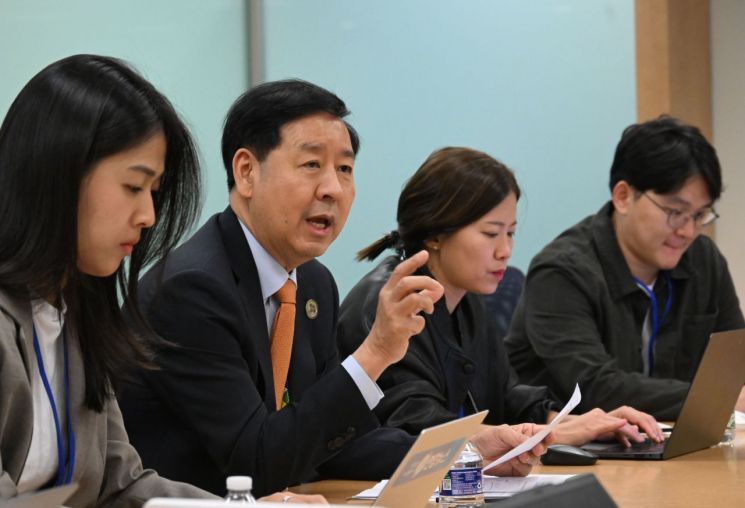 Deputy Prime Minister and Minister of Economy and Finance Koo Yoon-chul held a meeting with accompanying reporters on the 16th (local time) at the International Monetary Fund (IMF) headquarters in Washington D.C., USA. (Provided by Ministry of Economy and Finance)
"Expanding Korea's Network of Friendly Nations on Multilateral Stages... Strengthening 'International Network Diplomacy'"
Regarding his first attendance at multilateral events such as the G20 Finance Ministers’ Meeting, Koo said, "I realized how important networking with finance ministers from other countries is," adding, "If Korea does not build allies, it will be difficult to gain support or assistance for Korea’s initiatives or in times of difficulty in the international community."
On the recent rise in stock prices and the government's policy direction for capital market revitalization, he commented, "Recently, the Korean stock index surpassed the 3,700 mark, showing an upward trend. This is the result of government policies aimed at eliminating the 'Korea discount' in the capital market and transitioning to a 'Korea premium.'"
© The Asia Business Daily(www.asiae.co.kr). All rights reserved.
![Clutching a Stolen Dior Bag, Saying "I Hate Being Poor but Real"... The Grotesque Con of a "Human Knockoff" [Slate]](https://cwcontent.asiae.co.kr/asiaresize/183/2026021902243444107_1771435474.jpg)

















