"Composition of $35 Billion U.S. Investment Package Remains a Barrier"
On Korea-U.S. Shipbuilding Cooperation: "Requesting U.S. Legislative and Administrative Support"
South Korean Ambassador to the United States Kang Kyung-wha stated during a parliamentary audit held in New York on the 17th (local time) that, "To the best of my knowledge, there is no additional request from the United States for further opening of the agricultural and livestock markets" in relation to the Korea-U.S. tariff negotiations.
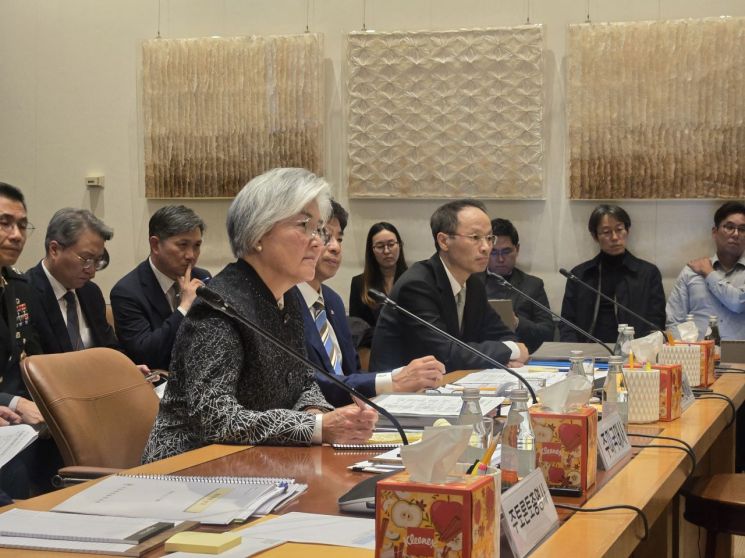 Kang Kyung-wha, the South Korean Ambassador to the United States, listens to questions from lawmakers during the National Assembly Foreign Affairs and Unification Committee's audit held at the Permanent Mission of the Republic of Korea to the United Nations in Manhattan, New York, on the 17th (local time). New York - Photo by Kwon Haeyoung
Ambassador Kang made this remark in response to a question from Assemblywoman Kang Sunwoo of the Democratic Party of Korea regarding additional U.S. demands for market opening of agricultural and livestock products, during the National Assembly Foreign Affairs and Unification Committee's audit held at the Permanent Mission of the Republic of Korea to the United Nations in Manhattan.
Earlier on the same day, Wi Sunglak, Director of the National Security Office at the Presidential Office, stated that the South Korean government is currently discussing expanding imports of U.S. soybeans. Director Wi explained, regarding the U.S. request for increased soybean imports following China's suspension of U.S. soybean imports, "I have not heard of any new negotiations on agricultural products since the broad trade agreement at the end of July," adding, "The only thing I have heard about is soybeans."
Ambassador Kang, addressing key issues in the Korea-U.S. tariff negotiations, said, "The biggest barrier is the composition of the 350 billion dollar investment fund," and noted, "When we held discussions on July 30, there were differences in positions when the United States formalized its stance in writing."
Currently, South Korea and the United States are coordinating the details of the 350 billion dollar investment package pledged by South Korea, including the composition of the investment package and profit distribution. Senior officials such as Presidential Policy Chief Kim Yongbeom, Minister of Trade, Industry and Energy Kim Jeonggwan, and Deputy Prime Minister and Minister of Economy and Finance Koo Yooncheol have all traveled to the United States to conduct final negotiations with their U.S. counterparts.
When asked about the progress of the negotiations, Ambassador Kang replied, "The relevant ministers and the policy chief continued in-depth discussions with Secretary Howard Lutnick of the U.S. Department of Commerce in Washington, D.C.," and added, "Given that the negotiations are being conducted intensively and in depth, it is not appropriate to disclose specific details publicly at this time."
Regarding the possibility of reaching an agreement before the APEC Summit, she said, "Our basic position is that we are not pressed for time and will not engage in negotiations that harm the national interest," adding, "The Embassy in the United States is also providing support to ensure an agreement can be reached in time for APEC."
Additionally, Ambassador Kang stated that, to strengthen Korea-U.S. cooperation regarding the rebuilding of the U.S. shipbuilding industry, "We will work to ensure legislative and administrative support within the United States." The United States currently prohibits foreign shipyards from building naval vessels for the U.S. Navy under the Burns-Tollefson Amendment and the Jones Act. Therefore, for Korean shipping companies to build or repair ships in the United States, legislative amendments are required.
Ambassador Kang said, "The legislative process is a lengthy one, and last week I met with U.S. senators to explain the current situation and understand the trends," adding, "We will continue to monitor areas requiring legislative action, and for matters that can be addressed administratively, we will consult with the U.S. administration."
© The Asia Business Daily(www.asiae.co.kr). All rights reserved.

















