Revised Edition of "Political Prison Facilities in North Korea" Released
A new study has found that North Korea operates four political prison camps, detaining up to 65,000 people and subjecting them to forced labor.
On October 17, the Korea Institute for National Unification released a revised edition of its 2013 report, "Political Prison Facilities in North Korea." The updated version includes new information such as satellite imagery from the U.S. commercial satellite company Maxar and additional testimonies from North Korean defectors.
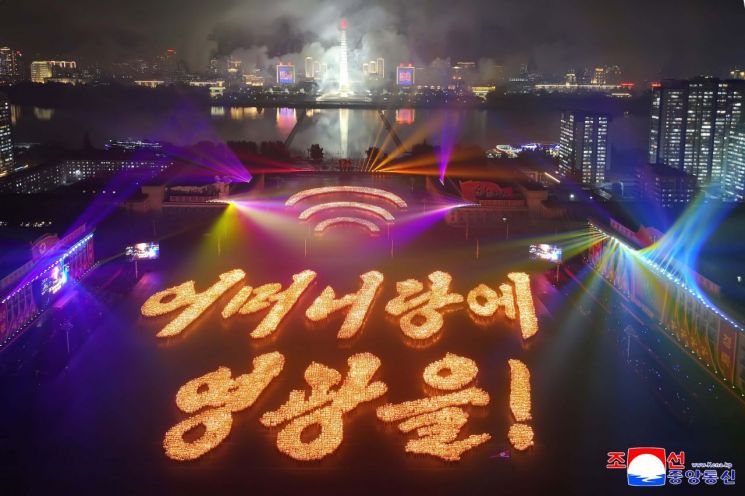 The celebration rally and torchlight gathering for the 80th anniversary of the founding of the Workers' Party of Korea were held on the 11th at Kim Il-sung Square in Pyongyang, according to a report by the Korean Central News Agency on the 12th. Yonhap News Agency
According to the report, North Korea is currently operating four political prison camps: Camp No. 14, Camp No. 16, Camp No. 18, and Camp No. 25. The Ministry of State Security, which is equivalent to South Korea's National Intelligence Service, oversees Camps No. 14, No. 16, and No. 25, while the Ministry of Social Security, which is similar to the national police agency, manages Camp No. 18. Except for Camp No. 25, which is structured as a reeducation facility, the other three camps are located in remote mountainous areas that are difficult for ordinary residents to access.
Camp No. 14, located in Kaechon City, South Pyongan Province, was established in 1965. The report explains that the camp expanded in size after individuals involved in the 2014 purge of Jang Song-thaek, uncle of Chairman Kim Jong-un, were transferred there from Camp No. 18. Similarly, Camp No. 18, also located in Kaechon, was originally in Bukchang County, North Hamgyong Province, but was relocated to its current site in 2006.
Possibility of Forced Labor at the Punggye-ri Nuclear Facility
Camp No. 16, located in Myonggan County and Orang County, North Hamgyong Province, is only about 3 kilometers from the Punggye-ri nuclear test site. For this reason, the U.S.-based Committee for Human Rights in North Korea (HRNK) has raised the possibility that prisoners from Camp No. 16 may have been used for labor at nuclear facilities. Unlike the other camps, which are structured like villages, Camp No. 25 in Chongjin City, North Hamgyong Province, is operated as a "reeducation camp" similar to a prison. The detention area covers 15,000 square meters and can accommodate approximately 5,800 inmates.
The report states that Camp No. 15 (Yodok), which became internationally known for human rights abuses through the testimonies of defectors, was closed by North Korean authorities around 2019.
The report estimates that between 53,000 and 65,000 people are currently detained in these four political prison camps. This is a significant decrease from the 2013 estimate of 80,000 to 120,000 inmates. However, the report notes, "It is difficult to interpret the reduction in the total number of detainees as a sign of the North Korean authorities' willingness to improve human rights." The decrease is attributed to the closure of Yodok Camp and deaths among inmates due to harsh conditions.
The report explains that residents are imprisoned in these political prison camps for reasons such as violating the supreme leader's directives, contravening Workers' Party policies, breaching the Ten Principles for the Establishment of the Party's Monolithic Leadership System, committing anti-state crimes, or engaging in religious activities.
The report states, "The existence of these camps in North Korea continues to serve as a means of strengthening social control and creating an atmosphere of fear by combining the 'songbun' social classification system with the state's surveillance apparatus." It recommends, "The South Korean government should encourage United Nations member states to maintain ongoing attention to the human rights violations in these camps and to cooperate with the international community to develop concrete recommendations, thereby prompting substantive changes in North Korea's attitude."
© The Asia Business Daily(www.asiae.co.kr). All rights reserved.
!["The Woman Who Threw Herself into the Water Clutching a Stolen Dior Bag"...A Grotesque Success Story That Shakes the Korean Psyche [Slate]](https://cwcontent.asiae.co.kr/asiaresize/183/2026021902243444107_1771435474.jpg)
















