Subcommittee for Integrated Review of Small-Scale Housing Maintenance Approves Projects
"Revitalizing Aging Areas Where Development Had Stalled Through Moa Town"
On October 17, the Seoul Metropolitan Government announced that it has finalized four Moa Town projects aimed at improving aging low-rise residential areas, with a total of 3,570 housing units to be supplied.
The city stated that, during the 15th Subcommittee Meeting for Integrated Review of Small-Scale Housing Maintenance held the previous day, it approved four projects, including the "100-48 Gugidong, Jongno-gu Moa Town."
The approved projects are as follows: Moa Town in 100-48 Gugidong, Jongno-gu; Moa Town in 697-20 Nangok-dong, Gwanak-gu; Moa Town in 221-24 Noryangjin-dong, Dongjak-gu; and Moa Town in 322 Hongje-dong, Seodaemun-gu. If these projects proceed, a total of 3,570 Moa Housing units-including 852 rental units-will be supplied.
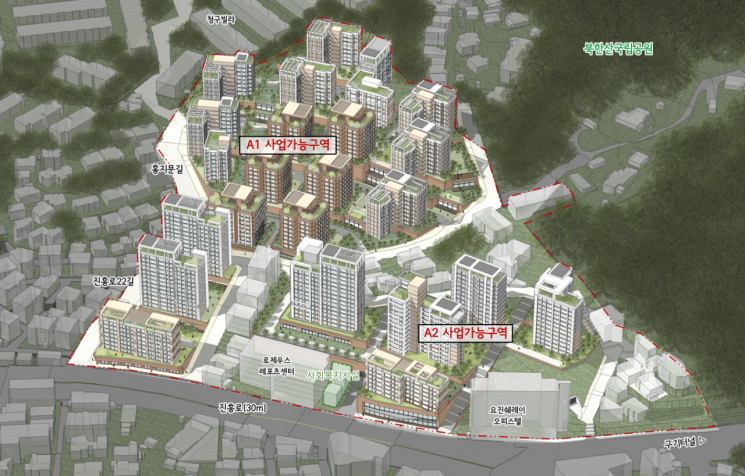
In the 100-48 Gugidong, Jongno-gu area, two Moa Housing complexes are planned, increasing the number of units by 382 compared to the existing stock, for a total of 797 units, including 214 rental units.
This area has a high proportion of aging buildings (65.7%) and semi-basement homes (68.6%). Although there is a need to improve the residential environment, the project has faced restrictions due to height limits in natural landscape and altitude control zones.
The new Moa Town management plan rationally adjusts these height restrictions: the maximum building height in natural landscape zones is relaxed from 16 meters (4 stories) to up to 24 meters, and in altitude control zones from 24 meters to up to 45 meters. The zoning will also be upgraded (from Type 1 and Type 2 (up to 7 stories) to Type 2 General Residential Zone). Jinheung-ro 22-gil will be widened from 5 meters to 10 meters, and Jinheung-ro 22-na-gil from 4 meters to 8 meters. A new sidewalk will be constructed to expand pedestrian space.
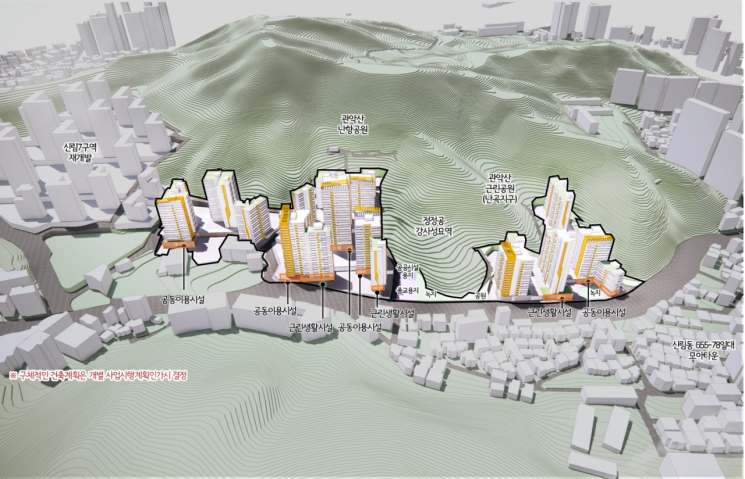
In the 697-20 Nangok-dong, Gwanak-gu area, two Moa Housing complexes are planned, supplying a total of 1,056 housing units, including 253 rental units.
The site has a level difference of up to 33 meters, which has made development challenging and caused delays. The new Moa Town management plan secures project feasibility by expanding the project implementation area and easing the rental housing ratio when there is public participation, upgrading the zoning (from Type 1 and Type 2 (7 stories) to Type 2), and expanding maintenance infrastructure (such as widening roads for parks and hiking trail access, and adding social welfare facilities).
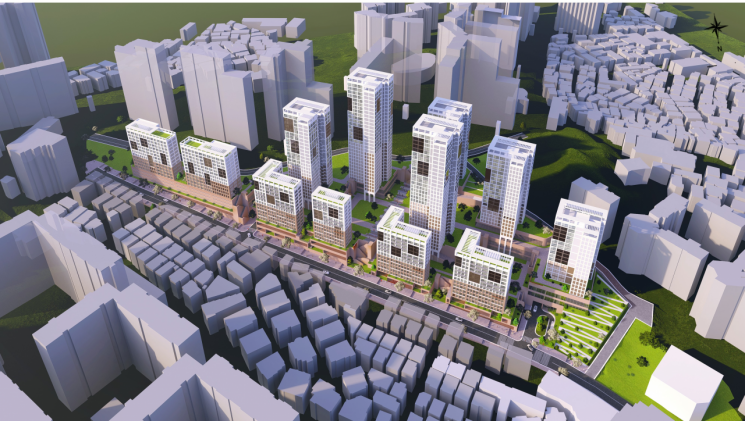
In the 221-24 Noryangjin-dong, Dongjak-gu area, a total of 834 housing units, including 192 rental units, are planned. Development had stalled due to a maximum level difference of 40 meters, but the project will now move forward in earnest.
The new Moa Town management plan includes expanding the project implementation area and easing the requirement for securing rental housing when there is public participation, upgrading the zoning (from Type 2 (7 stories) to Type 3), and expanding maintenance infrastructure (such as public offices and parks).
Topography-adaptive land parcels will be created to reflect the slopes and level differences, and unavoidable level difference areas will be utilized for community facilities and neighborhood living facilities, creating a three-dimensional space.
Additionally, the plan ensures a sense of openness by linking public pedestrian pathways and visual corridors, and aims for a harmonious urban landscape by arranging low-rise buildings along the Manyang-ro frontage.
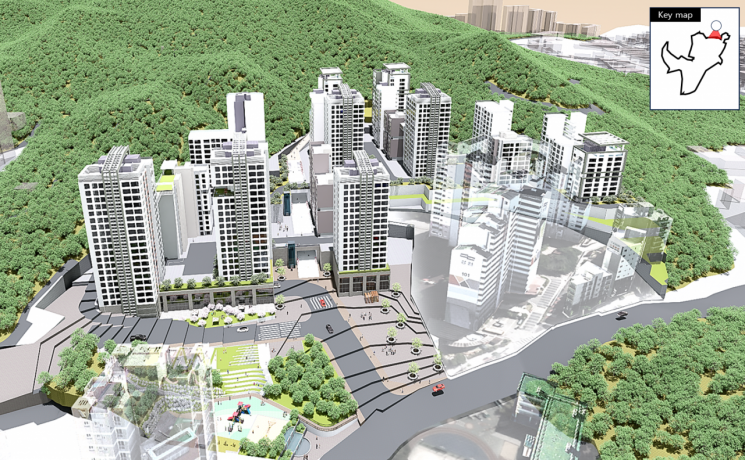
In the 322 Hongje-dong area, adjacent to Ansan, public participation in the Moa Town project will enable the supply of 883 housing units, including 193 rental units.
The new Moa Town management plan includes upgrading the zoning (from Type 1 and Type 2 (up to 7 stories) to Type 2 General Residential Zone), expanding maintenance infrastructure (such as roads and parks), and designating a special architectural district with a basic design concept.
In particular, the project area will be expanded from 20,000 square meters to 40,000 square meters, and the required donation ratio for rental housing-due to the zoning upgrade-will be eased from 50% to 30%.
To address increased traffic and the surrounding environment, including nearby elementary schools, Morenae-ro 24-gil will be widened from 12 meters to 18 meters, and sidewalks will be created using open spaces to improve the pedestrian environment. A 10-meter-wide public pedestrian pathway will be installed, connecting the complex entrance to the park entrance, reflecting the pedestrian flow of the existing Ansan Neighborhood Park. The new children's park will be greatly expanded by integrating it with the existing children's park to form a single play area.
Choi Jinseok, Director of Housing at Seoul Metropolitan Government, stated, "Aging areas where development had been slow due to height restrictions and sloped terrain will be dramatically improved and revitalized through the Moa Town project. We will continue to expand pleasant and high-quality residential environments through plans that harmonize with local residents."
© The Asia Business Daily(www.asiae.co.kr). All rights reserved.
![Clutching a Stolen Dior Bag, Saying "I Hate Being Poor but Real"... The Grotesque Con of a "Human Knockoff" [Slate]](https://cwcontent.asiae.co.kr/asiaresize/183/2026021902243444107_1771435474.jpg)


















