"Early Upfront Payment Is the U.S. Position... Uncertainty in Persuading Trump"
"Foreign Exchange Stability Must Be Assessed Depending on the $350 Billion Investment Scheme"
Kim Jeonggwan and Lutnick Hold Talks... 'MASGA' Discussed at OMB
Regarding the "upfront payment" demand for the $350 billion (approximately 500 trillion won) investment fund in the United States, which remains a key sticking point in the final stages of the Korea-U.S. trade negotiations, the Korean government has conveyed its concerns to the U.S. side, particularly about the potential impact on the stability of Korea's foreign exchange market. However, it remains uncertain whether President Donald Trump can be persuaded on this matter.
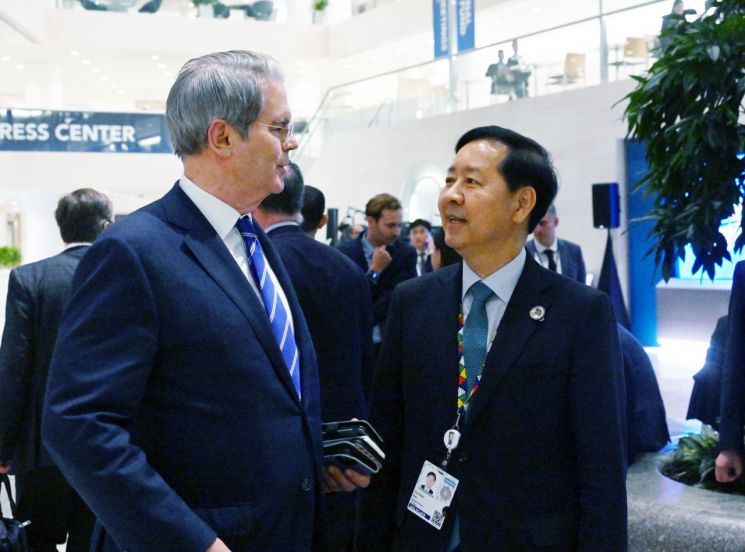 Deputy Prime Minister and Minister of Economy and Finance Koo Yoon-chul is exchanging views with Treasury Secretary Scott Bessent on the 15th (local time) at the International Monetary Fund (IMF) in Washington DC, USA, on the occasion of the G20 Finance Ministers Meeting. Photo by Yonhap News
Deputy Prime Minister and Minister of Economy and Finance Koo Yoon-chul, who is currently visiting the United States, stated at the International Monetary Fund (IMF) headquarters in Washington D.C. on the 16th (local time), "It is my understanding that the United States is asking for the $350 billion 'up front' payment as soon as possible." He added, "While the working-level officials understand the Korean government's position that it is difficult to make the full investment upfront, there is significant uncertainty as to whether President Donald Trump can be convinced to accept this."
Deputy Prime Minister Koo met with U.S. Treasury Secretary Scott Bessent the previous day and expressed concerns that the upfront investment demand could undermine the stability of Korea's foreign exchange market. "I told Secretary Bessent that, given Korea's foreign exchange situation, it would be difficult for us to comply with such a request, and Secretary Bessent is aware that Korea cannot make the payment all at once," Koo said. "I also asked Secretary Bessent to communicate Korea's position to other U.S. administration officials, such as Commerce Secretary Howard Lutnick, and he responded positively, saying he would provide a thorough explanation." When asked whether Secretary Bessent's response could be interpreted as a withdrawal of the upfront payment demand, Koo said, "We are asking the U.S. government to say it is impossible, so it is difficult to say definitively whether the demand has been withdrawn or not."
Deputy Prime Minister Koo explained, "We need to assess the impact on foreign exchange stability depending on the scheme for the $350 billion investment. If the entire amount is paid upfront, it would pose a problem for foreign exchange stability. However, if Korea's position is sufficiently reflected in the scheme and the impact on foreign exchange is minimized, there will be fewer issues for us to address." This suggests that, since the impact on the foreign exchange market will vary depending on the proportions of cash, loans, and guarantees in the $350 billion U.S. investment package, a concrete plan for the investment must be established before discussing measures to stabilize the foreign exchange market.
Regarding the possibility of a bilateral currency swap, Deputy Prime Minister Koo said, "Once the investment scheme is finalized, the resulting foreign exchange requirements will become clear. Since we have already stated that an upfront payment would not be feasible due to foreign exchange constraints, if another alternative emerges, we will assess whether the resulting foreign exchange requirements can be met within the scope of maintaining stability in Korea's foreign exchange market." He added, "Depending on these variables, we will determine whether a currency swap is completely impossible, necessary, unnecessary, how much would be required, and whether it is feasible."
Deputy Prime Minister Koo also commented on some reports that the two countries are discussing dividing the $350 billion investment over up to 10 years and raising the funds in Korean won, saying, "This is the first I have heard of such discussions." Regarding whether the U.S. government has requested Korea to increase imports of U.S. soybeans, he said, "It is difficult to confirm as negotiations are still ongoing."
When asked whether concluding the Korea-U.S. trade agreement before the Asia-Pacific Economic Cooperation (APEC) summit at the end of this month is the goal, Koo replied, "If the content of the negotiations is well organized from a national interest perspective, I believe it would be good to conclude the agreement on the occasion of APEC."
Kim Jeonggwan and Lutnick Hold Talks... 'MASGA' Details Discussed at White House OMB
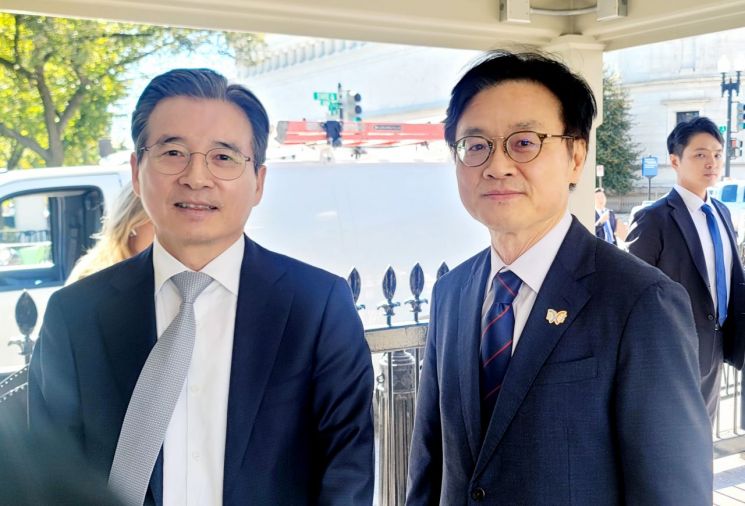 Kim Yongbum, Chief of Policy Office at the Presidential Office (left), and Kim Jeonggwan, Minister of Trade, Industry and Energy, visited the Eisenhower Executive Office Building at the White House in Washington DC on the 16th (local time) to visit the Office of Management and Budget (OMB). Photo by Yonhap News
Kim Jeonggwan, Minister of Trade, Industry and Energy, also visited the U.S. Department of Commerce in Washington D.C. in the afternoon to hold follow-up discussions on the Korea-U.S. trade negotiations with Secretary Lutnick. Kim Yongbum, Director of Policy Office at the Presidential Office, and Yeo Hankoo, Deputy Minister for Trade Negotiations at the Ministry of Trade, Industry and Energy, also attended the meeting.
As their first agenda, Minister Kim and Director Kim visited the Eisenhower Executive Office Building, a White House office facility, where they met with Russell Vought, Director of the Office of Management and Budget (OMB), for about 50 minutes to discuss cooperation measures between the two countries in the shipbuilding industry. After the meeting, Minister Kim stated, "We are having various constructive discussions on 'MASGA' (Make American Shipbuilding Great Again)."
'MASGA' refers to a Korea-U.S. shipbuilding cooperation initiative. Previously, during broad trade negotiations between Korea and the United States in July, the Korean side proposed to the U.S. combining the concept of 'MAGA' (Make America Great Again) with 'Shipbuilding' to create this initiative.
Director Kim, just before visiting OMB, said, "OMB is an extremely important agency for the shipbuilding project. The purpose of today's visit is to hear OMB's perspective and to share mutual understanding of the significance of Korea-U.S. cooperation in the shipbuilding industry." When asked whether he expects any tangible outcomes from the OMB visit while final trade negotiations are still underway, Director Kim replied, "OMB is not directly involved in the negotiations. We are here to listen to the U.S. position on one of the key projects between our two countries."
After the meeting, when asked whether the recent Chinese sanctions targeting five U.S. subsidiaries of Hanwha Ocean, a core company in the MASGA strategy, were discussed, Minister Kim replied, "We did not discuss such matters; instead, we focused on which specific projects to pursue in relation to MASGA."
© The Asia Business Daily(www.asiae.co.kr). All rights reserved.
![Clutching a Stolen Dior Bag, Saying "I Hate Being Poor but Real"... The Grotesque Con of a "Human Knockoff" [Slate]](https://cwcontent.asiae.co.kr/asiaresize/183/2026021902243444107_1771435474.jpg)

















