Up to 9.8 Million Zero-Emission Vehicles by 2035
"Concerns Over Shrinking Core Industries"
Fears of Subsidy Benefits Flowing to Chinese Cars
The government has abruptly postponed indefinitely the public hearing it had prepared to finalize the '2035 National Greenhouse Gas Reduction Target (NDC).' In order to achieve the government's goal, the number of zero-emission vehicles, such as electric and hydrogen cars, would need to increase fivefold over the next five years. Industry insiders interpret this move as a response to concerns that the target is realistically unattainable and could potentially shrink the country's core industries.
According to the industry on October 17, the government urgently canceled the comprehensive NDC discussion hearing, which was scheduled to be held at the National Assembly on October 16, just a few days prior. An industry official said, "We were suddenly notified that the hearing was postponed," adding, "There was no specific mention of how many days it would be delayed."
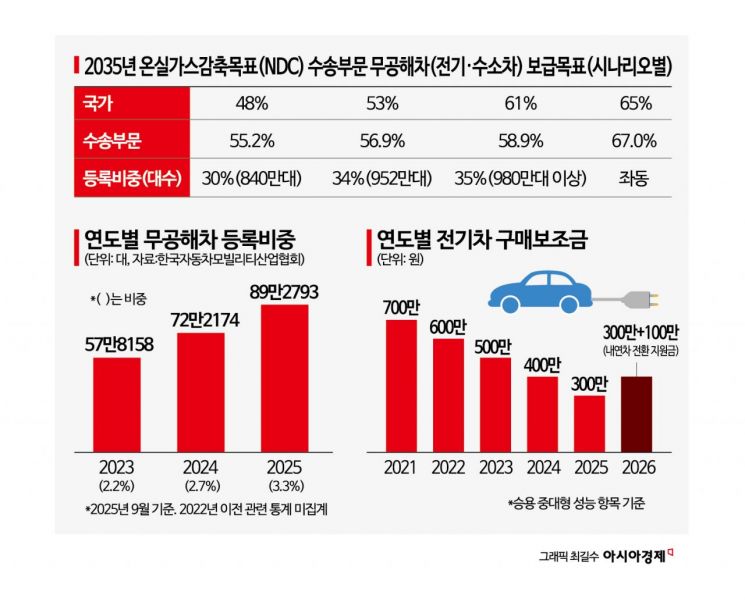
Last month, the government released four NDC proposals and planned to finalize one of them soon after collecting stakeholder opinions and holding a comprehensive discussion. The final NDC plan must be submitted to the United Nations Framework Convention on Climate Change (UNFCCC) by November. The four proposals aim to reduce carbon emissions in 2035 by 48%, 53%, 61%, or 65% compared to 2018 levels. Accordingly, the target for zero-emission vehicle (electric and hydrogen car) distribution has been set at between 8.4 million and 9.8 million units by 2035.
However, the automotive industry has raised objections, stating that to meet these targets, the share of zero-emission vehicle sales would need to exceed 90% within the next 10 years, or the sale of internal combustion engine vehicles would effectively have to be halted. This is because the transition to eco-friendly vehicles has been slow. As of the end of September this year, the number of registered zero-emission vehicles is about 890,000, accounting for only 3.3% of all vehicles. In particular, to achieve the 2030 NDC target of '4.5 million zero-emission vehicles,' 600,000 to 700,000 units would need to be sold annually starting next year.
Experts point out that to rapidly increase the supply of zero-emission vehicles, which are relatively expensive, both the amount of purchase subsidies and the range of eligible recipients must be expanded. However, government subsidies for electric vehicle purchases have actually decreased each year. The subsidy, which was 7 million won in 2021, dropped to 6 million won in 2022, 5 million won in 2023, 4 million won in 2024, and 3 million won this year. However, the government plans to offer an additional 1 million won next year as a conversion incentive for switching from internal combustion engine vehicles.
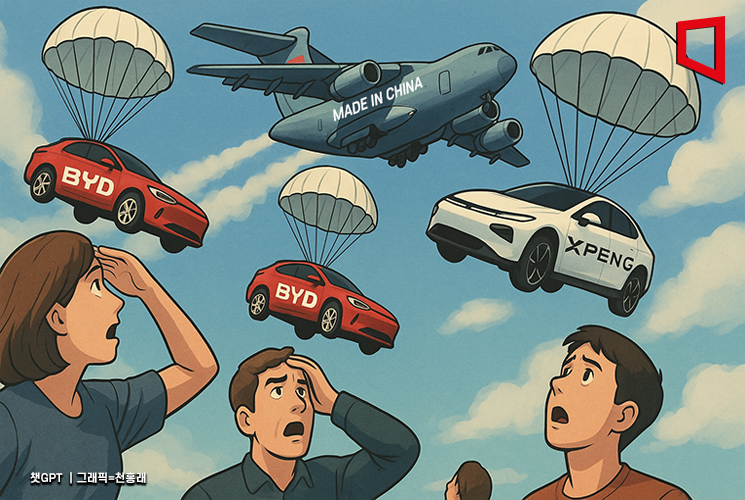
A greater concern is that expanding the range of vehicles eligible for subsidies would mostly benefit imported cars from China. The domestic electric vehicle market is being dominated by Tesla, which is leading with its China-made Model Y.
Tesla has ranked first in sales among major imported car brands for three consecutive months. Its cumulative sales from January to September reached 43,612 units. This level even threatens Hyundai Motor Company, which sold 45,709 electric vehicles during the same period. While Hyundai's Ioniq 5 receives a subsidy of 6 million won, the Model Y receives only 1.88 million won. In addition, Chinese automakers such as BYD and Zeekr are accelerating their entry into the domestic market.
Bae Choongsik, a professor at KAIST, said, "Major European countries are recognizing the practical limitations of excessive regulations such as bans on internal combustion engine vehicle sales, and are easing and adjusting their policy stances. In addition to developing innovative technologies to overcome the chasm for electric and hydrogen fuel cell vehicles, measures must also be prepared to address the limitations of electrification caused by the instability of the battery supply chain, which is centered on China."
© The Asia Business Daily(www.asiae.co.kr). All rights reserved.
![Clutching a Stolen Dior Bag, Saying "I Hate Being Poor but Real"... The Grotesque Con of a "Human Knockoff" [Slate]](https://cwcontent.asiae.co.kr/asiaresize/183/2026021902243444107_1771435474.jpg)

















