Stable Growth Expected Through the First Half of Next Year
The price of gold has surpassed $4,200 per ounce, setting new all-time highs day after day. With a U.S. Federal Reserve interest rate cut now widely seen as inevitable by the first half of next year, central banks around the world-many of which have high proportions of bond holdings-are increasing their gold reserves, an asset that yields no interest, to hedge against a decline in real interest rates. Some analysts even predict that, from a long-term perspective, gold could structurally rise to $5,000 per ounce.
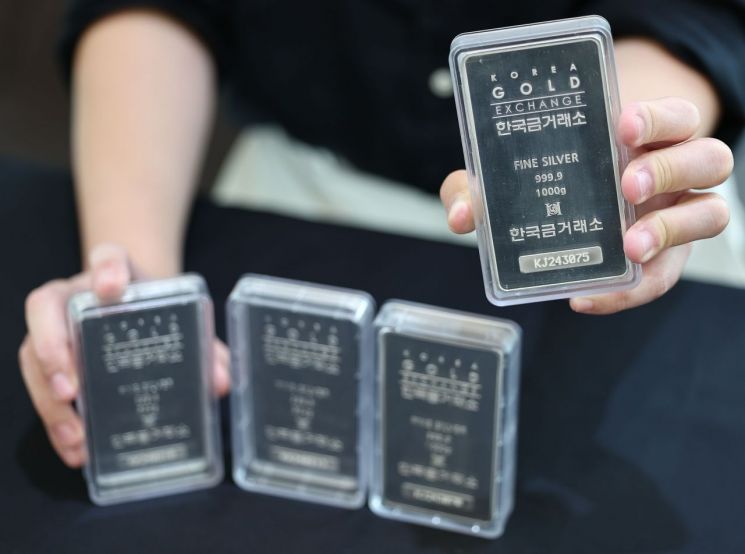
On October 17, Daishin Securities emphasized in its report, "Gold at Record Highs, But Focus Should Still Be on Silver," that during periods of significant liquidity expansion, investors should consider increasing their allocation to silver rather than gold. The report argues that, since gold now carries a hefty premium, it is more advantageous to buy the relatively cheaper silver.
Statistically, gold prices tend to rise when expectations for policy rate cuts increase, while silver prices climb during periods of expanding liquidity. Currently, liquidity appears to be accelerating. On October 14, Federal Reserve Chair Jerome Powell mentioned that quantitative tightening (QT) could end soon. China is also considering the timing of a reserve requirement ratio cut.
This creates an attractive environment for silver, which is highly sensitive to liquidity. However, its higher volatility compared to gold remains a risk factor. Choi Jinyoung, an analyst at Daishin Securities, stated, "Silver, which is sensitive to liquidity, typically lags central banks' policy rate cut and reversal cycles by about 18 months. Given that the sequence of policy rate cuts and reversals has been on the rise, stable growth in silver prices is possible through June next year. If the Federal Reserve's policy rate cut in the second half of this year is included, the upward trend could continue through June 2027."
© The Asia Business Daily(www.asiae.co.kr). All rights reserved.
![Clutching a Stolen Dior Bag, Saying "I Hate Being Poor but Real"... The Grotesque Con of a "Human Knockoff" [Slate]](https://cwcontent.asiae.co.kr/asiaresize/183/2026021902243444107_1771435474.jpg)
















