Interview with Carlos Felipe Jaramillo, World Bank Vice President for East Asia and Pacific
Carlos Felipe Jaramillo, Vice President and the new head of the East Asia and Pacific region at the World Bank (WB), stated that "young people in the East Asia region are increasingly expressing dissatisfaction with the quality and opportunities of jobs."
In an interview with the accompanying press corps of the Group of Twenty (G20) finance ministers meeting on the 15th (local time), Vice President Jaramillo said, "The slowdown in the pace of reforms is leading to slower growth and stagnating job creation." He particularly emphasized, "Artificial intelligence (AI) automation is rapidly changing the structure of jobs, making it urgent to foster startups and reform education."
"East Asia's Growth Slows... Delays in Reform Cause Bottlenecks"
Vice President Jaramillo referred to the recently released East Asia and Pacific Economic Update report by the World Bank, stating, "This year, the growth forecast for the East Asia and Pacific region is set at 4.8 percent. This is a slight decrease from last year's 5 percent. While the absolute figure is not bad, the downward trend is concerning." He pointed out that uncertainty continues in the external environment, which consists of the trading partners of East Asian countries, and this is a source of concern.
He said, "Many countries in this region have entered a growth bottleneck phase," and added, "After a period of growth, structural reforms must follow, but recently, the pace of reform has slowed." Vice President Jaramillo warned, "If reforms are delayed, productivity improvements stagnate, and as a result, both job creation and inclusive growth can slow down."
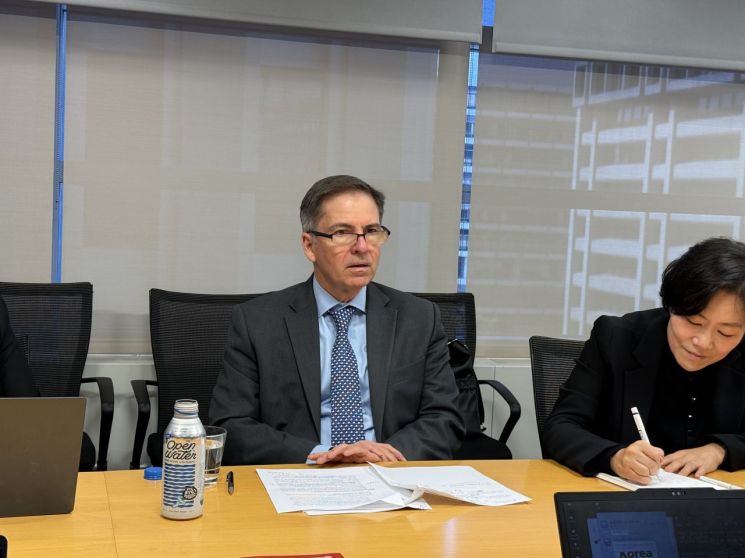 Carlos Felipe Jaramillo, Vice President and new head of the East Asia and Pacific region at the World Bank (WB), is interviewed by the accompanying press corps of the Group of Twenty (G20) Finance Ministers' Meeting at the World Bank in Washington D.C., USA, on the 15th (local time).
"Low Job Satisfaction Among Young People... Dissatisfaction Spreads Among Millennials & Gen Z"
He particularly identified youth employment as a core challenge for East Asian economies. Vice President Jaramillo explained, "Across East Asia, the younger generation is dissatisfied with the types of jobs available to them," and added, "The anxiety is not just about the number of jobs, but increasingly about the quality of jobs and their future prospects."
Vice President Jaramillo said, "This phenomenon is a universal trend observed not only in Korea but around the world," and noted, "There are many cases where Millennials & Gen Z express their dissatisfaction with socioeconomic inequality or difficulties entering the labor market, which sometimes leads to protests."
He said, "Over the past 10 to 20 years, East Asia has created a large number of quality jobs and achieved significant poverty reduction, but the future job structure is much more uncertain." He predicted, "The development of AI and automation technologies will replace a significant number of existing jobs."
He further stated, "The impact of artificial intelligence (AI) automation on future jobs is clear. However, it is still unclear which occupations will disappear and which new ones will emerge." He added, "New opportunities will arise, but the change itself will be a challenge."
"Korea Has the World's Highest Education Level... Need to Expand Knowledge Sharing and Investment"
While evaluating Korea's case positively, Vice President Jaramillo also offered insights applicable to the wider East Asian region. He said, "Korea's education level is among the highest in the world, and it is a leading country in terms of technology and human capital," but stressed, "It is important to share that experience and knowledge more broadly with other countries."
He noted, "Korea has been a long-standing partner of the World Bank, cooperating since its days as a low-income country," and evaluated, "Over more than 45 years of partnership, Korea has become a model case by transitioning from a borrowing country to a donor country."
He continued, "Korea's experience in infrastructure, energy, agriculture, and water management is very useful for other developing countries," and explained, "The World Bank connects Korea's policy know-how with other member countries and supports Korean companies in investing in developing countries."
Vice President Jaramillo emphasized, "Currently, Korean companies have invested more than 4 billion dollars in developing countries through the World Bank," and added, "This is a 'win-win' model that creates jobs not only for Korean companies but also for the recipient countries."
"Without Education Reform, It Will Be Difficult to Respond to Future Jobs"
Vice President Jaramillo identified education as a key area for reform. He said, "Future jobs will require a combination of basic literacy and digital skills," and emphasized, "We need to close the gaps in basic education and strengthen digital skills."
He warned, "A basic literacy assessment of 10-year-old children in 14 East Asian countries showed that a significant number did not meet the standard. In other words, many students do not have literacy skills appropriate for their grade level, which could directly impact their future competitiveness in the labor market."
Vice President Jaramillo stated, "Improving the quality of basic education is the top priority, and at the same time, vocational and technical education suited for the digital transformation era must be provided." He added, "The World Bank is working with governments to address educational inequality and to develop the skills needed for future jobs."
© The Asia Business Daily(www.asiae.co.kr). All rights reserved.
![Clutching a Stolen Dior Bag, Saying "I Hate Being Poor but Real"... The Grotesque Con of a "Human Knockoff" [Slate]](https://cwcontent.asiae.co.kr/asiaresize/183/2026021902243444107_1771435474.jpg)











