Koo Yoon-chul, Deputy Prime Minister for Economic Affairs and Minister of Economy and Finance, who is attending the G20 Finance Ministers Meeting in Washington, D.C., stated on the 16th (local time) regarding the Korea-U.S. tariff negotiations, "The previous day, I met with U.S. Secretary of the Treasury Scott Besant at the meeting venue and had a candid discussion about the Korean foreign exchange market situation and the direction of cooperation between Korea and the United States."
At a press briefing with accompanying reporters held at the headquarters of the International Monetary Fund (IMF) in the afternoon, Deputy Prime Minister Koo said, "Secretary Besant has an accurate understanding of Korea's foreign exchange reserves, exchange rate trends, and the overall situation of the foreign exchange market. He agrees that the stability of the Korean foreign exchange market benefits not only Korea but also the United States."
Previously, Deputy Prime Minister Koo had announced that he would meet with Secretary Besant during the G20 Finance Ministers Meeting to discuss the main issue in the Korea-U.S. tariff negotiations: the method of Korea's promised $350 billion (approximately 500 trillion won) investment in the United States.
Deputy Prime Minister Koo explained, "Although the tariff negotiations are overseen by U.S. Secretary of Commerce Howard Lutnick, I am working closely with Secretary Besant on the issue of foreign exchange market stability." He emphasized, "Secretary Besant recognizes that an excessive depreciation of the Korean won is also disadvantageous to the United States." According to Deputy Prime Minister Koo, the U.S. side agrees that stability in the Korean foreign exchange market is necessary in relation to the Korea-U.S. tariff negotiations and has clearly expressed its willingness to provide support.
Regarding the 'unlimited currency swap agreement' proposed by the government in the context of the Korea-U.S. tariff negotiations, Deputy Prime Minister Koo said, "A currency swap is one of several options that may or may not be necessary depending on the outcome of the negotiations. It is a misunderstanding to think that a swap alone would resolve everything." He added, "The required amount of foreign currency may change as the tariff negotiations proceed, and while a swap can be considered as one method of securing foreign currency, it is not appropriate to focus solely on the swap."
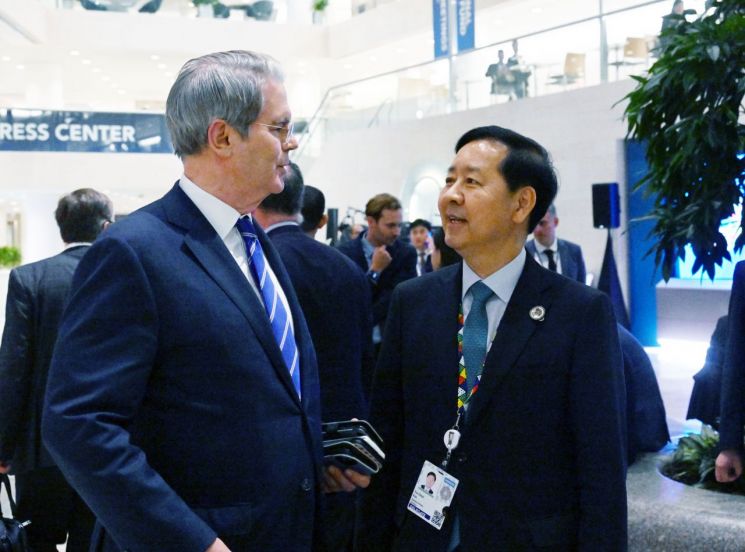 Koo Yoon-chul, Deputy Prime Minister for Economic Affairs and Minister of Economy and Finance, met with Janet Yellen, U.S. Secretary of the Treasury, on the 15th (local time) during the G20 Finance Ministers and Central Bank Governors Meeting to exchange views on bilateral interests.
Regarding speculation that Deputy Prime Minister Koo would meet with the U.S. Office of Management and Budget (OMB) for the tariff negotiations, he stated that he did not attend due to the schedule of the International Monetary and Financial Committee (IMFC) meeting. Deputy Prime Minister Koo added, "The Ministry of Trade, Industry and Energy visited the OMB to discuss matters related to 'MASGA,' requested cooperation from the U.S. side, and provided explanations."
Regarding the timing of the tariff negotiation agreement, Deputy Prime Minister Koo said, "Since there is a counterpart, the timeline is fluid, but it is desirable to reach an agreement as soon as possible if it is in the national interest." He added that while it would be ideal to reach an agreement before the Asia-Pacific Economic Cooperation (APEC) Summit, it is difficult to set a definite deadline. "Since the 25% tariff issue is significant, negotiations are proceeding at a rapid pace," he said.
Regarding the advance payment of the $350 billion investment in the United States, he explained, "There were discussions about this initially, but the Korean side conveyed that it would be realistically difficult to pay the entire amount at once." He evaluated, "Secretary Besant seems to have understood this situation and reflected it in internal discussions. There has been progress on this matter."
Regarding the possibility of an additional meeting with Secretary of Commerce Lutnick, he said, "There are no separate meetings planned during this visit to the United States," and added, "Since the negotiations are led by the Minister of Trade, Industry and Energy, I will focus on a supporting role."
Deputy Prime Minister Koo stated, "The exchange rate is affected not only by the tariff negotiations but also by complex factors such as U.S.-China tensions and political variables in Japan." He predicted, "However, if the tariff negotiations are concluded, it is highly likely to contribute to exchange rate stability and a stronger won. A successful tariff negotiation would be a positive sign for the exchange rate."
© The Asia Business Daily(www.asiae.co.kr). All rights reserved.

















