Opening at the National Museum of Modern and Contemporary Art, Cheongju
156 Works by 11 Modern Art Association Artists on Display
In 1956, just after the devastation of war, the Korean art world was thrown into turmoil once again by the so-called "National Art Exhibition Dispute." Many senior artists who had participated in exhibitions organized by the Japanese Governor-General during the colonial era served as judges for the 5th National Art Exhibition, giving low scores to young artists who broke away from traditional Japanese styles and attempted new approaches. In response, these young artists, advocating for the reflection of postwar reality and the spirit of the times, launched an anti-National Art Exhibition movement, clashing with the established art institutions.
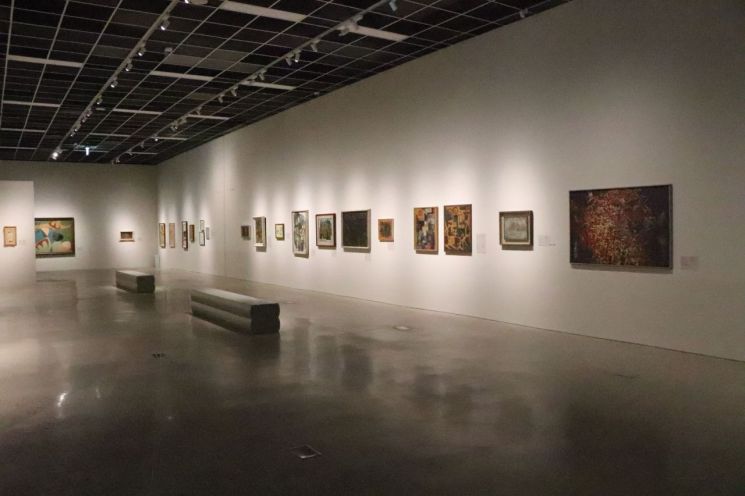 Exhibition view of "Encounter, Modern Art Association 1957-1960" at the National Museum of Modern and Contemporary Art, Cheongju. Provided by the National Museum of Modern and Contemporary Art
Amid this situation, the "Modern Art Association" was formed, signaling a new beginning for Korean contemporary art, led primarily by young artists who had studied in Japan. Eleven artists-including Kim Kyung, Moon Shin, Park Goseok, Han Mook, Hwang Yeomsoo, Yoo Youngkuk, Lee Kyusang, Lim Wankyu, Jeong Kyu, Jeong Jeomsik, and Chun Kyungja-sought a "third way" that transcended both the realism of the National Art Exhibition and the radicalism of Art Informel (formless abstraction).
The Modern Art Association held its first exhibition at Donghwa Gallery in 1957, and over the next four years, with the addition of artists such as Lim Wankyu, Jeong Kyu, Jeong Jeomsik, and Chun Kyungja, staged a total of six exhibitions until 1960. These artists experimented with transforming scenes from daily life and nature into abstract language, understanding abstraction not merely as a style but as an attitude that integrated life, spirit, reality, and thought. They also respected and supported each artist’s individual experimentation.
The exhibition "Encounter, Modern Art Association 1957-1960," currently on view at the National Museum of Modern and Contemporary Art, Cheongju, features 156 works and 30 archival materials by the 11 participating artists. It highlights the efforts of the first generation of modernists who pursued their artistic spirit even amid the poverty and tension of the postwar years. The exhibition is organized into three sections: before the formation of the Modern Art Association, during its activities, and from its dissolution up to the mid-1970s.
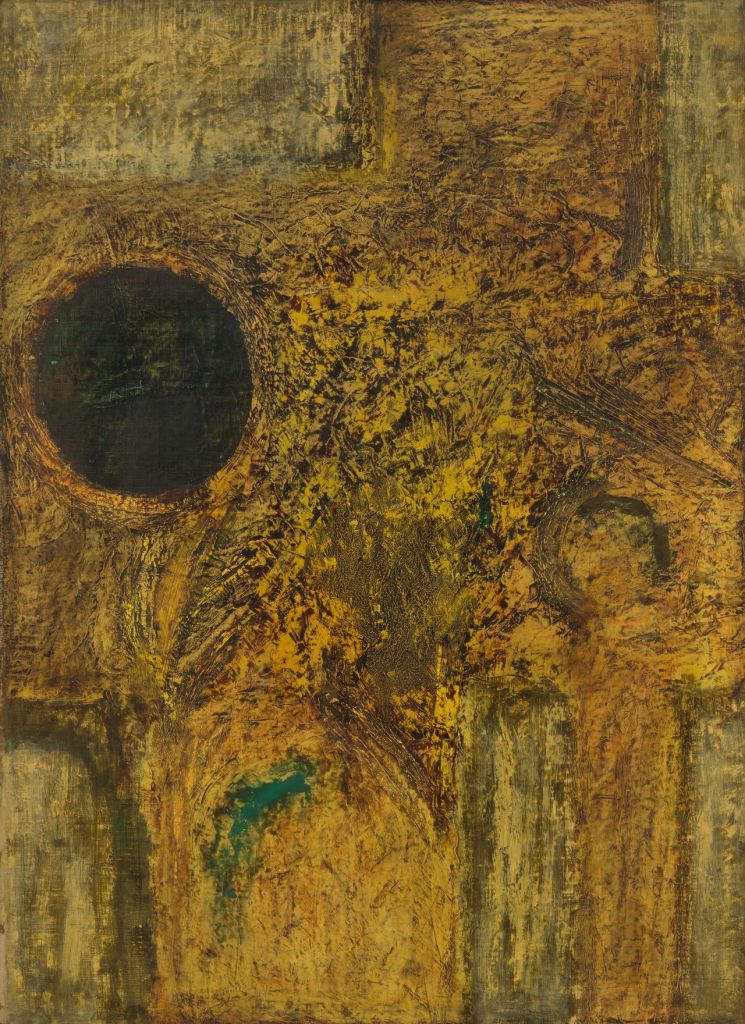
Kim Kyung’s "Encounter" stands out for its striking texture. The artist used the "grattage" technique, applying bright colors over a dark background and then scraping them away to emphasize a rough texture (matiere). Created during a transitional period before Kim’s mastery of matiere, the work is notable for its experimental spirit-maintaining traditional motifs while moving toward modern abstraction.
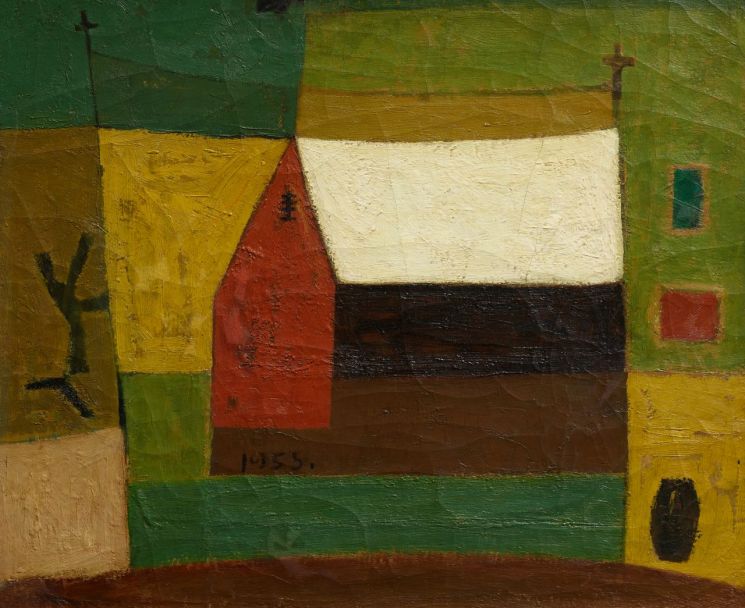
Jeong Kyu’s "Church" (1955) is a representative work of the artist’s painting world, characterized by simple forms and colors. The church, house, and tree are rendered in geometric shapes, and the white roof creates an optical illusion as if it is floating in midair. Jeong Kyu always included his signature character "Kyu" (圭) in his works, and in this piece, it is placed where the church window would be.
Some works are being unveiled for the first time in this exhibition, including Hwang Yeomsoo’s "Tree" from the 1950s, Kim Kyung’s "Encounter" (1960), Park Goseok’s "Cow" (1961), Yoo Youngkuk’s "Dawn" (1966), and Han Mook’s "Untitled" (1965).
Lee Hyojin, curator at the National Museum of Modern and Contemporary Art who organized the exhibition, explained, "The period during which the artists were active in the Modern Art Association was very brief, and their styles changed dramatically afterward, so this era has not received much attention. However, the awareness of issues they raised later expanded into Dansaekhwa and Minjung art, becoming another starting point for Korean contemporary art. Therefore, it is well worth studying and re-examining."
At the entrance to the exhibition hall, visitors can experience the atmosphere of the era through "Warmth of the Avant-Garde," a video work by artist Kim Siheon that uses artificial intelligence (AI) technology to recreate the activities of participating artists from the 1950s onward.
Kim Sunghee, director of the National Museum of Modern and Contemporary Art, stated, "Although the activities of the Modern Art Association were brief, the critical awareness they left behind continued into Dansaekhwa and Minjung art, becoming an important asset for Korean contemporary art. I hope this exhibition, which encompasses the formation, development, and dissolution of the Modern Art Association, will provide an opportunity to reflect on the diverse artistic worlds of the participating artists and the significance of the era, leading to a more multidimensional understanding of the landscape of Korean contemporary art." The exhibition runs until March 8 next year.
© The Asia Business Daily(www.asiae.co.kr). All rights reserved.



















