Timely Harvest of Tea Leaves Using Ride-On Harvesters
Significant Reduction in Labor Requirements
Boseong County in South Jeolla Province (Governor Kim Cheolwoo) announced on the 16th that it had held the "Green Tea Jeonnam Top Management Model Commercialization Project Annual Meeting" in cooperation with the Jeonnam Agricultural Research and Extension Services at Baekrok Tea Garden on the 15th.
About 30 participants, including tea farmers, officials from the Jeonnam Agricultural Research and Extension Services, and the Boseong County Agricultural Technology Center, attended the annual meeting to share the project's achievements. Key technologies were explained, and on-site demonstrations were also conducted.
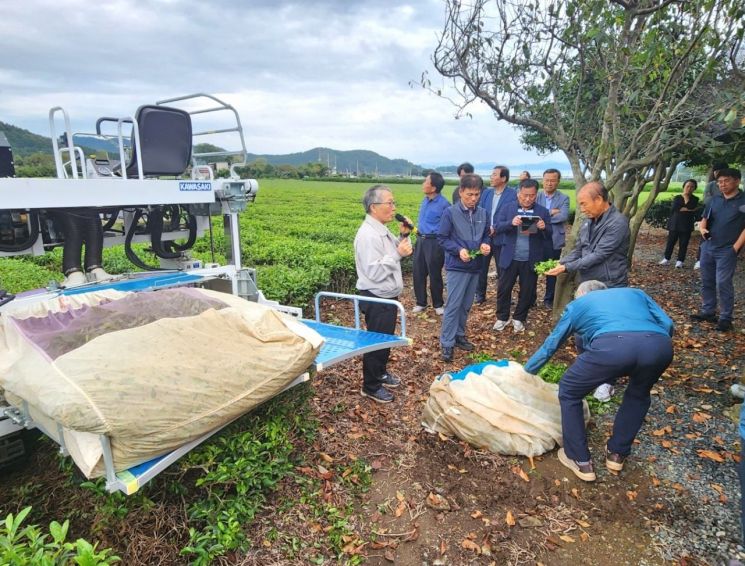 Boseong County held the "Green Tea Jeonnam Top Management Model Commercialization Project Annual Meeting" on the 15th at Baekrok Tea Garden in cooperation with the Jeonnam Agricultural Research and Extension Services. Provided by Boseong County
The core of this year's commercialization project lies in the timely harvesting of tea leaves and reduction of labor through the use of ride-on harvesters, as well as diversification of processed products by introducing rice cake tea makers and primary drying machines.
In particular, the use of ride-on harvesters was found to reduce the number of workers needed to harvest the first flush tea from 20 to 2 per hectare, cutting labor costs by about 96%. In addition, securing uniform tea leaf quality is expected to increase both yield and product rate.
Furthermore, the integration of traditional fermented rice cake tea (tteokcha) and blending tea production technologies has raised the added value of Boseong green tea and strengthened the foundation for sixth-sector industrialization, attracting significant attention.
The county analyzed that this management model could reduce labor input time per hectare by about 90%, while farm income is expected to increase by more than 30%, from 35 million won to 46 million won.
Kim Sookhee, Director of the Boseong Agricultural Technology Center, said, "In a situation where labor shortages and declining productivity are worsening every year, this project is a good example of a sustainable development direction for the Boseong tea industry. We will continue to promote comprehensive management models that can advance every stage from production to processing and distribution."
© The Asia Business Daily(www.asiae.co.kr). All rights reserved.
![From Bar Hostess to Organ Seller to High Society... The Grotesque Con of a "Human Counterfeit" [Slate]](https://cwcontent.asiae.co.kr/asiaresize/183/2026021902243444107_1771435474.jpg)
















