Besant: "Shutdown Slows the Pace of the Investment Boom"
Deficit-to-GDP Ratio Could Fall to the 3% Range
On October 15 (local time), U.S. Treasury Secretary Scott Besant claimed that the ongoing federal government shutdown, which has lasted for more than two weeks, is causing the U.S. economy to lose approximately 15 billion dollars (about 21.3 trillion won) per day.
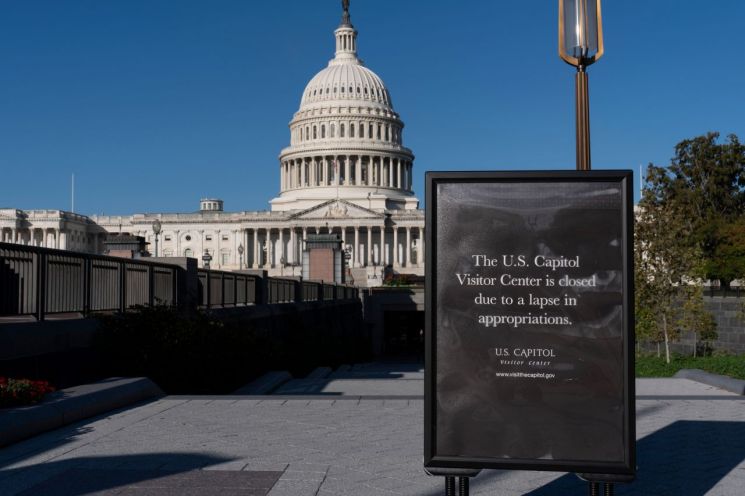 On the 15th (local time), a notice stating that the federal government shutdown has continued for three weeks is posted at the entrance of the U.S. Capitol Visitor Center in Washington D.C. Photo by AP Yonhap News
At a press briefing held at the Treasury Department in Washington D.C. that day, Secretary Besant estimated the economic damage from the shutdown and stated that the shutdown has "begun to erode the muscle of the American economy."
In this regard, a Treasury Department official clarified that Secretary Besant had cited an incorrect figure, and explained that, according to an analysis by the White House Council of Economic Advisers (CEA), the economic impact of the shutdown on gross domestic product (GDP) is 15 billion dollars per week, not per day.
Secretary Besant also predicted that the Republican tax reforms and President Trump's tariff policies would sustain the investment boom and continue economic growth.
He stated, "Just as we saw during the railroad era in the late 19th century or the boom in internet and office technology in the 1990s, I believe we may be entering such an era again."
Secretary Besant pointed out that "the wave of investment across the U.S. economy, including artificial intelligence (AI), is sustainable and only just beginning, but the federal government shutdown is becoming an increasingly significant obstacle."
During an event hosted by CNBC, held in Washington D.C. during the International Monetary Fund (IMF) and World Bank (WB) Annual Meetings, he also said, "There was pent-up demand, and President Trump triggered this boom through his policies," adding, "Right now, the only thing slowing us down is this government shutdown."
Secretary Besant stated that the federal government's fiscal deficit for fiscal year 2025, which ended in September, is smaller than that of fiscal year 2024 (1.833 trillion dollars). While he did not provide specific figures, he said, "The deficit-to-GDP ratio could fall into the 3% range within the next few years."
The Congressional Budget Office (CBO) recently estimated in a report that, despite President Trump's tariff revenues increasing by 118 billion dollars, the fiscal deficit for fiscal year 2025 only decreased slightly to 1.817 trillion dollars.
At the CNBC event, Secretary Besant remarked, "The important figure, the deficit-to-GDP ratio, now starts with a '5.'"
When asked whether he would like to see the deficit ratio start with a '3,' he replied, "Yes. It is still possible." He added, "If the United States grows more, spends less, and restrains expenditures, that ratio will go down."
© The Asia Business Daily(www.asiae.co.kr). All rights reserved.

















