Korea Development Institute Releases October Economic Trends
Omission of "Easing of Economic Downturn" Phrase This Month
Consumption Improves, but Prolonged Slump in Construction Industry Hampers Recovery
US-China Tensions Resurface, Raising Concerns Over Trade Conditions
Although the recent sluggish consumption is easing, a prolonged downturn in the construction industry is being evaluated as a limiting factor for economic recovery. Additionally, the recent rekindling of tensions between the United States and China is increasing trade uncertainty, which poses a downside risk to the economy.
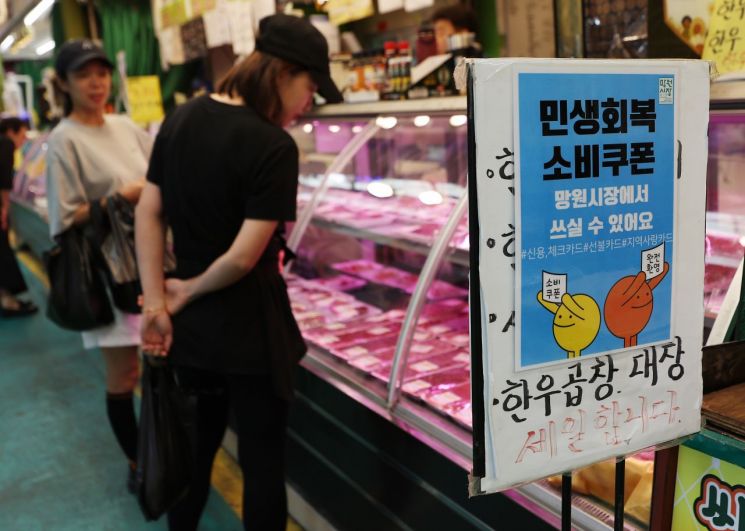 A notice related to the livelihood recovery consumption coupons is posted at a market in downtown Seoul. Photo by Yonhap News
The Korea Development Institute (KDI), a government-funded research institute, stated in its "October 2025 Economic Trends" report released on October 16, "Recently, the Korean economy has continued to see low production growth due to the contraction of the construction industry, although the slump in consumption is easing." In the previous month, KDI had assessed, "Despite sluggish construction investment, the overall economic downturn is somewhat easing, led mainly by consumption." However, this month, the report omitted any positive outlook regarding the economy.
A KDI official explained, "Last month, the economic downturn was alleviated, but this month, it appears that the easing has not continued," adding, "However, the economy has not deteriorated further." The official further noted, "While last month, the improvement in consumption helped ease the downturn, this month, the negative trend in the construction industry has simply maintained the current trajectory."
KDI observed that the prolonged slump in the construction industry is restricting the growth of total industrial production. According to KDI, employment is also slowing, mainly in the construction sector. In August, total industrial production decreased by 0.3 percent, as the improvement in manufacturing was offset by a deepening slump in construction. In particular, construction output fell by 17.9 percent, a sharper decline than the previous month’s 14.0 percent decrease. The number of employed persons in the construction industry also dropped by 132,000, a larger decrease compared to the previous month’s decline of 92,000.
Construction investment continues to show a sluggish trend. In August, the value of construction completed declined by 17.9 percent. KDI explained that the suspension of work at some construction sites recently has negatively affected the value of construction completed. While there is a continued improvement in construction orders, this has not sufficiently translated into actual construction starts, which is considered a factor prolonging the slump in construction investment.
On a positive note, robust growth in passenger car retail sales has led to a surge in automobile production, thereby improving manufacturing indicators. Other retail sales are also seeing an easing of sluggishness, aided by falling market interest rates and government support policies. Although total retail sales in August declined by 0.5 percent, KDI diagnosed that "the seasonally adjusted retail sales figures are maintaining a moderate improvement trend." Last month’s consumer sentiment index also remained relatively high at 110.1. KDI projected that the improvement in consumption is likely to continue for the time being.
Consumer prices are maintaining a stable upward trend, hovering around the inflation target of 2 percent. Last month, consumer prices rose by 2.1 percent, up from 1.7 percent in August, but the same as in July (2.1 percent). The core inflation rate also remained at 2 percent, indicating that underlying inflation is stable. KDI stated, "The improvement in consumption conditions may somewhat ease the downward pressure on demand-side inflation going forward."
Worsening global trade conditions are also a downside risk to the economy. High tariffs on automobile exports to the United States continue, and the recent rekindling of tensions between the United States and China is increasing trade uncertainty. The growth in exports is also gradually slowing. Last month, exports increased by 12.7 percent, helped by a rise in the number of working days, but on a daily average basis, exports declined by 6.1 percent, which was weaker than the previous month’s 5.7 percent decrease.
© The Asia Business Daily(www.asiae.co.kr). All rights reserved.
![Clutching a Stolen Dior Bag, Saying "I Hate Being Poor but Real"... The Grotesque Con of a "Human Knockoff" [Slate]](https://cwcontent.asiae.co.kr/asiaresize/183/2026021902243444107_1771435474.jpg)
















