KDCA Reports 29 Heat-Related Deaths, a 15% Decrease from Last Year
This summer, a total of 4,460 heat-related illness cases were reported to medical institutions, marking a 20.4% increase compared to last year (3,704 cases). The number of deaths was 29, which is a 14.7% decrease from the previous year (34 deaths).
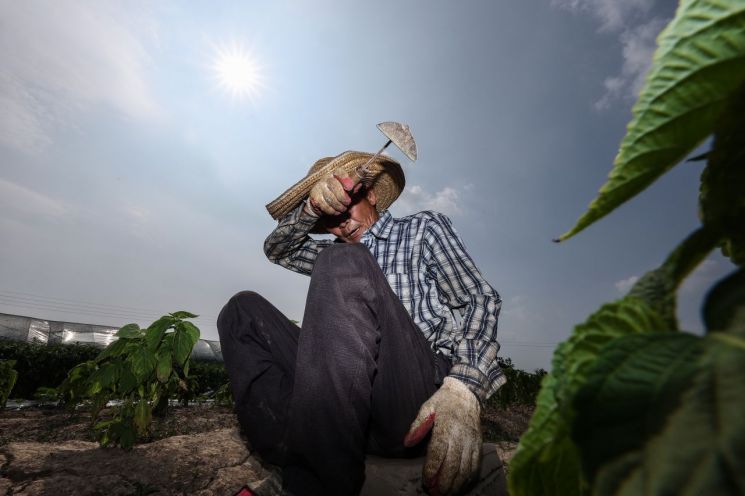 On July 8th of this year, when the highest number of 259 heat-related illness cases occurred, a farmer is wiping sweat while weeding in a field in Dasan-myeon, Goryeong-gun, Gyeongbuk Province. Photo by Yonhap News
On the 16th, the Korea Disease Control and Prevention Agency announced the results of the "2025 Summer Heat-Related Illness Emergency Room Surveillance System Operation," which included these findings.
Heat-related illnesses are acute conditions caused by exposure to heat. Symptoms include headache, dizziness, muscle cramps, fatigue, and decreased consciousness, and if left untreated, they can be life-threatening. The Heat-Related Illness Emergency Room Surveillance System has been operated every summer since 2011 to monitor health damage caused by heat waves and to share the current status and occurrence characteristics.
This year, 29.0% of all heat-related illness cases occurred in late July, and 34.5% of all deaths were also concentrated in late July. The average maximum temperature in late July this year was 33.9°C, which is 1.8°C higher than the previous year.
The highest number of heat-related illness cases occurred on July 8. On that day, there were 259 cases, with the average maximum temperature reaching 34.1°C. This was followed by July 28 with 167 cases and July 22 with 147 cases.
Among this year's heat-related illness cases, 3,553 were men, which is about four times higher than the number of women (907). By age group, those in their 50s accounted for the most cases with 865, followed by those in their 60s with 834, those in their 30s with 608, those in their 40s with 603, and those in their 70s with 485. Seniors aged 65 and older accounted for 30.1% of all patients. The number of reported cases per 100,000 people was also highest among those aged 80 and older.
By region, Gyeonggi Province had the highest number of heat-related illness cases with 978, followed by Gyeongbuk Province with 436, Gyeongnam Province with 382, Jeonnam Province with 381, and Seoul with 378. The number of reported cases per 100,000 people was highest in Jeonnam Province at 21.4, followed by Ulsan and Gyeongbuk Province at 16.9, and Jeju Island at 15.8.
By occupation, simple laborers accounted for the most cases with 1,160, followed by the unemployed with 589, and skilled agricultural, forestry, and fishery workers with 348. By location, 3,534 cases occurred outdoors, which is 3.8 times higher than the 926 cases that occurred indoors. Among outdoor locations, 1,431 cases occurred at outdoor workplaces, 542 in rice paddies and fields, 522 on roadsides, and 445 in other outdoor areas.
The estimated number of heat-related deaths was 29, with 23 men and 6 women. Eighteen of the deaths were among people aged 60 and older. Most deaths occurred outdoors (23 cases), and the presumed cause of death was heatstroke in 27 cases. By region, Gyeonggi Province had 6 deaths, Chungnam Province had 5, Gyeongbuk Province had 4, and Seoul, Jeonnam Province, and Gyeongnam Province each had 3 deaths. The 29 deaths caused by heat waves this year represent the fourth highest number after 48 in 2018, 34 in 2024, and 32 in 2023.
Im Seungkwan, Commissioner of the Korea Disease Control and Prevention Agency, stated, "This year, to prevent heat-related illnesses, we strengthened on-site promotional activities in collaboration with five regional disease response centers and established customized guidelines for vulnerable groups such as people with disabilities. We will continue to develop additional customized prevention manuals for different groups and situations, and strive to minimize health damage caused by heat waves through public guidance."
© The Asia Business Daily(www.asiae.co.kr). All rights reserved.
![Clutching a Stolen Dior Bag, Saying "I Hate Being Poor but Real"... The Grotesque Con of a "Human Knockoff" [Slate]](https://cwcontent.asiae.co.kr/asiaresize/183/2026021902243444107_1771435474.jpg)
















