F1’s Once-Exclusive Nature
Documentary on Team Struggles Attracts New Fans
"Each Driver and Team Has Become a Character in the Show"
Formula One (F1), once perceived as a sport for the wealthy and an exclusive, closed-off competition, is now seeing an influx of female and younger fans. The secret to this transformation is a marketing strategy that has shifted its focus from cars and high-value sponsors to storytelling that highlights individual teams and drivers.
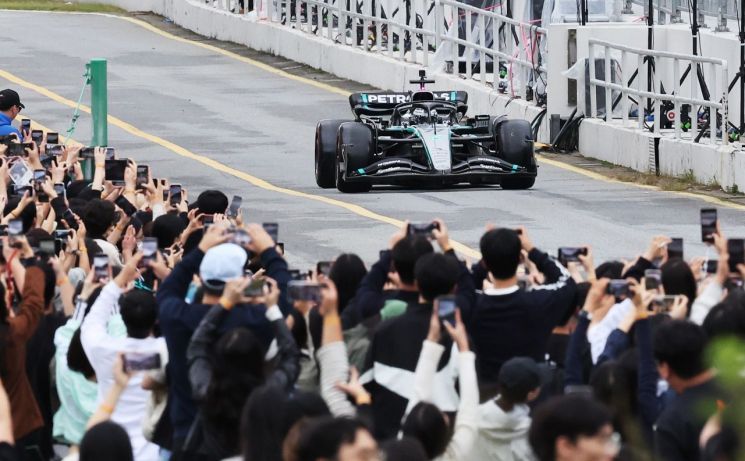 On the 12th, at the Everland Speedway in Yongin, Gyeonggi Province, the Mercedes-AMG Petronas Formula One Team car driven by Valtteri Bottas raced around the circuit during the "Peaches Run Universe 2025." Photo by Yonhap News Agency
A Surge of Female and Gen Z Fans... An Enormous Sport Watched by 800 Million
At the F1 Grand Prix 2025 held in Singapore from October 3 to 5, a total of 300,641 spectators attended. This figure marks an 11.7% increase from the previous year, equivalent to about 5% of Singapore’s population. According to the local media outlet The Straits Times, young women led the excitement at the event. Some female fans even set up tents near the paddock-the passageway where F1 drivers and crews move-waiting for their favorite drivers to appear before the race began.
The changing demographics of F1 fans are also clearly reflected in official statistics. According to the F1 Global Fan Survey, as of early this year, women accounted for 40% of F1 fans, a fivefold increase from just 8% in 2017. The influx of Gen Z fans in their teens and twenties in the United States has also significantly lowered the average age of F1 fans from 36 to 32 over the same period.
The number of F1 fans has reached 827 million, a 63% increase compared to 2018, and the number of people attending Grand Prix events in major cities around the world has risen by 9-11% year-on-year. Last year, F1 generated $3.6 billion (about 5.12 trillion won) in revenue from advertising, ticket sales, and broadcast subscriptions. This makes it the third-largest professional sports market in the world, following the National Football League (NFL) in the United States and the Premier League in the United Kingdom.
'Billionaire Club' F1 Finds a Turning Point Through Documentary Success
Just a few years ago, F1 was nicknamed the "sport of the rich." This reputation stemmed from high ticket prices and an exclusive operational focus on high-value sponsors. Each team participating in F1 builds two race cars every year, deploying the latest technology and spending hundreds of billions of won on manufacturing and research and development costs. As a result, the F1 management committee has had to rely on selling expensive merchandise and tickets or catering to VIP fans to cover these expenses. The 'Paddock Club,' which offers special seating along the paddock as well as gourmet meals and champagne, is a prime example.

Training costs for drivers are also substantial. Many F1 drivers come from upper-middle-class European backgrounds and receive elite training from a young age. British star driver Lewis Hamilton remarked in 2021, "This is a club for billionaire boys," adding, "My father, who comes from a working-class background, sacrificed his own life to pay for my training."
The opportunity for F1 to reinvent itself came with the 2019 release of the Netflix documentary "Drive to Survive." This documentary, a collaboration between Netflix and the ten F1 teams, spotlighted behind-the-scenes stories from each season. While F1 races typically showcase only the cars on the track or the drivers’ perspectives, the documentary delved into the human side-drivers under immense pressure, and the financial struggles of smaller teams.
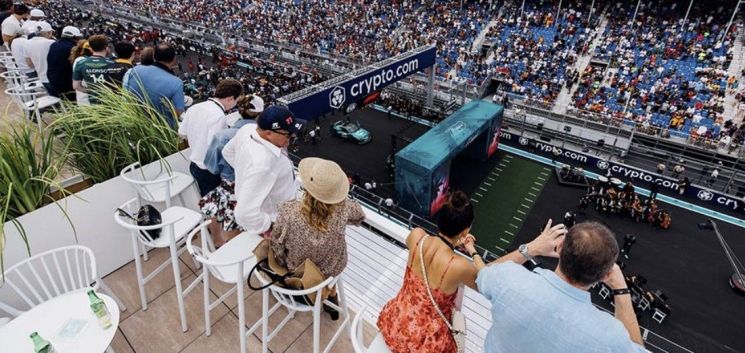
"Drive to Survive" became a huge hit on Netflix throughout its run, drawing in a new wave of fans. From its debut in 2019 through 2022-a span of three years-the number of spectators attending races in person increased by 36%. The film "F1: The Movie," released in 2025, also achieved global box office revenue of $629 million (about 900 billion won), and in South Korea, where F1 is relatively less known, it attracted over 1 million viewers within just three weeks.
A woman in her 30s, identified as Ms. A, who became interested in motorsports through the F1 movie, said, "At first, I only liked the drivers. But as I learned how to watch the races, I became interested in the teams, car technology, and race strategy as well. Korean F1 fans are so passionate that they even translate technical manuals written in English and share them among themselves."
"Drivers Risking Their Lives-Ideal for Character-Driven Storytelling"
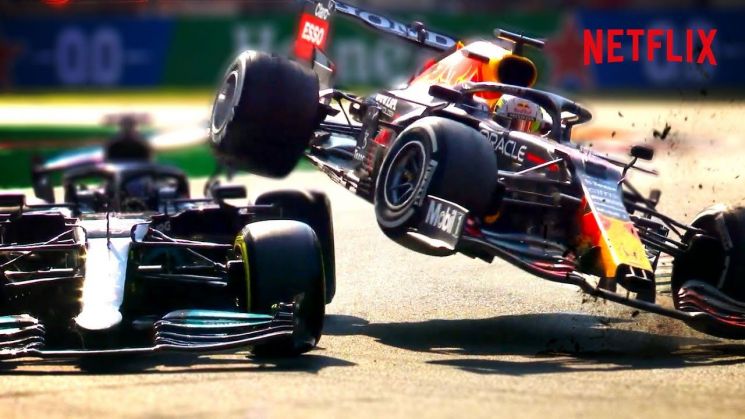 Since 2019, "Drive to Survive," which has been airing on Netflix, has captured behind-the-scenes stories of Formula 1 races. Netflix
Some analysts say F1 is a prime example of successful brand reinvention through storytelling. British TV critic Jack Seale wrote in a column for The Guardian, "Drive to Survive is not a completely new type of content. Over the past five years since 2019, the sports industry has seen a flood of programs highlighting the hardships and psychological pressures faced by athletes and teams. 'Drive to Survive' fits into this format."
However, he added, "What makes 'Drive to Survive' so effective is the unique nature of F1. Financial issues are inevitably crucial in F1, and the drivers literally risk their lives in every race. This makes each team and driver well-suited to become characters for the show. The ruthless competitors, decisive personalities, and rivalries with pride at stake create compelling storylines, which have helped solve the sport’s biggest problem-'the boredom of the broadcast itself.'"
© The Asia Business Daily(www.asiae.co.kr). All rights reserved.
![Clutching a Stolen Dior Bag, Saying "I Hate Being Poor but Real"... The Grotesque Con of a "Human Knockoff" [Slate]](https://cwcontent.asiae.co.kr/asiaresize/183/2026021902243444107_1771435474.jpg)













