Conflict Over Repatriation of Bodies
Israel Prepares for Possible Collapse of Negotiations
Israel and the Palestinian militant group Hamas have begun the second phase of negotiations on the Gaza Strip peace initiative proposed by U.S. President Donald Trump.
According to the Wall Street Journal (WSJ) and other sources on October 15 (local time), Israel and Hamas have entered into procedures for further implementation of the peace initiative.
The Gaza peace initiative presented by President Trump consists of a total of 20 items. The first phase covers only a few of these, such as the exchange of Israeli hostages and Palestinian prisoners. The second phase must address several contentious issues, including the disarmament of Hamas, the post-war governance structure of Gaza, and the deployment of an international stabilization force, all of which are expected to be difficult to resolve.
According to sources, mediating countries are discussing the deployment of 1,000 Palestinian police officers, trained in Egypt and Jordan, to Gaza for security purposes as an initial step. Egypt and Jordan plan to gradually increase this number, eventually expanding the Palestinian security personnel to as many as 10,000. However, Israel has opposed allowing personnel affiliated with the Palestinian Authority (PA) to be responsible for Gaza's security. In this regard, the WSJ reported that Arab countries are also reluctant to appear as occupying forces, making the formation of an international stabilization force unlikely.
The timeline for the withdrawal of Israeli forces from Gaza is also expected to be a point of contention. According to the Gaza peace initiative, the Israeli military will withdraw in stages: the first phase of withdrawal will begin after the release of hostages, the second phase will follow the establishment of a temporary international stabilization force, and the third phase will see withdrawal up to the border areas.
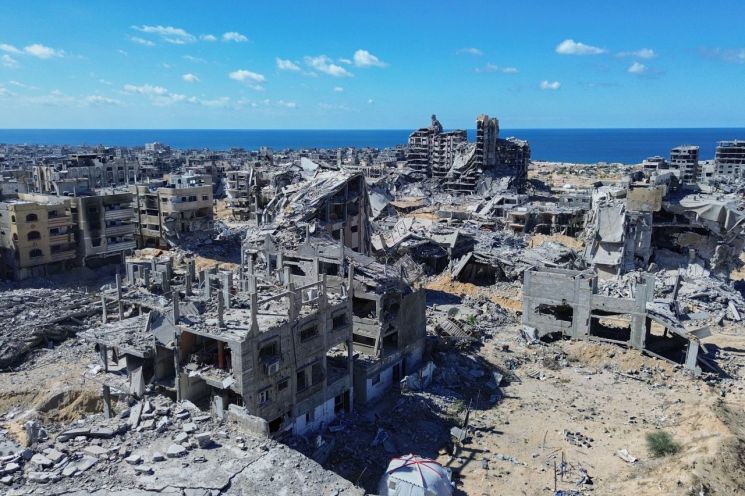
The smooth implementation of the first-phase agreement is necessary for progress to the next stage, but currently, Israel and Hamas are at odds over the return of all the bodies of deceased hostages, which is part of the first-phase agreement. According to the WSJ, Hamas has so far handed over only nine bodies to Israel. Hamas claims that some remains are still under the rubble from Israeli airstrikes or in areas controlled by Israeli forces, and that more time is needed to recover all the bodies.
Israeli Defense Minister Israel Katz issued a statement warning that if Hamas fails to comply with the agreements, including the repatriation of bodies and disarmament, Israel will resume military operations. In a meeting with senior military commanders on the same day, he instructed the military to prepare a "comprehensive plan to defeat Hamas" in anticipation of a possible end to the ceasefire.
As signs of cracks appeared in the first-phase ceasefire agreement in Gaza, the United States intervened. According to AFP, a senior U.S. adviser acknowledged the difficulties in recovering the remains and stated that the United States and other mediators are considering offering rewards to anyone who helps locate the bodies of deceased hostages.
© The Asia Business Daily(www.asiae.co.kr). All rights reserved.
![Clutching a Stolen Dior Bag, Saying "I Hate Being Poor but Real"... The Grotesque Con of a "Human Knockoff" [Slate]](https://cwcontent.asiae.co.kr/asiaresize/183/2026021902243444107_1771435474.jpg)
















