Nvidia Begins Sales of DGX Spark on the 15th
Equipped with 128GB of Memory
Run Large-Parameter Open-Source AI Models Right on Your Desk
Bringing Data Center Supercomputing to the Desktop
Expected to Drive New Changes in the Era of Open-Source AI
Available in Korea Starting on the 24th
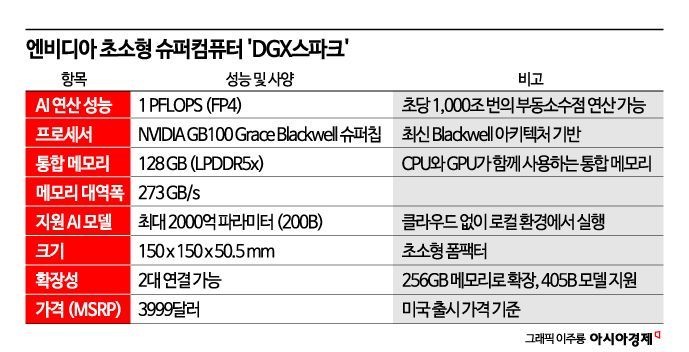
A new era has begun in which researchers in corporate and academic labs can utilize a supercomputer the size of a palm on their desks to conduct a wide range of artificial intelligence (AI) research. This is welcome news for researchers who have struggled due to the lack of expensive equipment. There is growing anticipation that this product could become a new catalyst for scientific advancement in the AI era, especially since even cutting-edge AI companies like OpenAI have welcomed its launch.
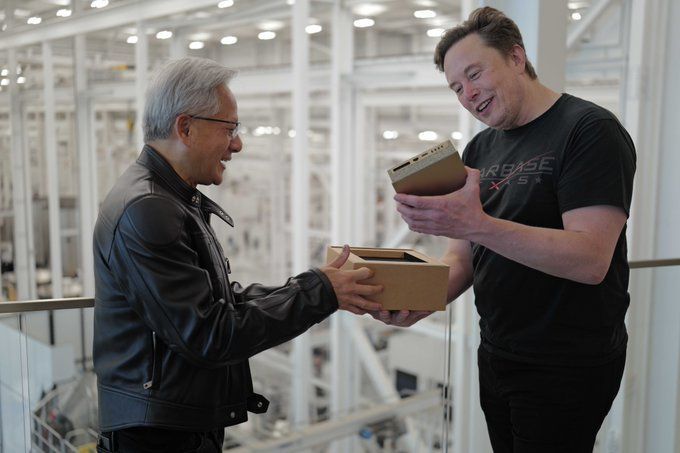 Jensen Huang, CEO of Nvidia (left), visited the SpaceX headquarters in Texas, USA, and personally delivered the latest compact supercomputer, the 'DGX Spark,' to Elon Musk, CEO of SpaceX. Despite being a supercomputer for AI, the DGX Spark is only about the size of Musk's palm. Nvidia X.
According to industry sources on October 16, graphics processing unit (GPU) company Nvidia began supplying the 'DGX Spark' in the United States on October 15 (local time). The DGX Spark is an ultra-compact supercomputer that Jensen Huang, CEO of Nvidia, personally unveiled at the Consumer Electronics Show (CES), the world's largest electronics and IT exhibition, held in Las Vegas in January. Reporters who saw the device in person at the time were also surprised by its small size.
Huang personally brought the product to SpaceX and OpenAI, delivering it to Elon Musk, CEO of Tesla. It is unusual for CEO Huang to engage in such high-profile promotional activities for a product launch. Ahead of SpaceX's eleventh 'Starship' launch, Huang commented, "Imagine delivering the smallest supercomputer next to the largest rocket."
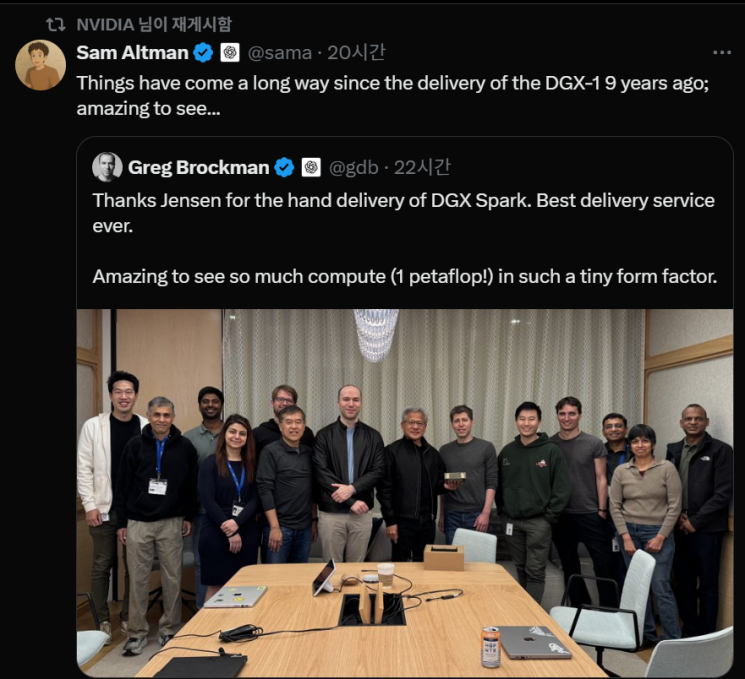 Sam Altman, CEO of OpenAI, shared a commemorative photo with Jensen Huang, CEO of NVIDIA, who personally brought the new ultra-compact supercomputer DGX Spark. Jensen Huang also personally delivered the first DGX supercomputer to OpenAI nine years ago. X.
Huang personally delivered Nvidia's first DGX-1 supercomputer model to OpenAI in 2016. Sam Altman, CEO of OpenAI, welcomed the delivery of the DGX Spark, recalling the memory of that earlier event. The fact that CEO Huang is recreating the moment when the Nvidia DGX supercomputer marked the beginning of AI-dedicated supercomputers is seen as highly significant.
Despite being small enough to fit in the palm of a hand, the DGX Spark boasts powerful AI computing performance. Nvidia introduced the device as capable of delivering up to 1 petaFLOPS (PFLOPS) of processing power for AI inference tasks. This means it can perform 1 quadrillion floating-point operations per second.
It uses the GB10 Grace Blackwell Superchip and is equipped with 128GB of unified memory. Thanks to this large 128GB memory, it can handle AI models with up to 200 billion parameters. With some adjustments, even larger models can be used. In comparison, GPUs for laboratory PCs typically have 24GB of memory. With DGX Spark, users can directly download and use large open-source AI models or test their own models without an internet connection. It would not be an exaggeration to call it a supercomputer for local AI. The rise of open-source AI, which has accelerated since the emergence of DeepSeek, now has an optimal environment. This may also serve as an opportunity to expand the use of memory semiconductors.
Of course, there are criticisms as well. Its speed is slower than GPUs using high-bandwidth memory (HBM). One researcher commented, "Given the price, we may have to accept that level of inconvenience." Jang Dongin, a professor at KAIST, said, "It could be an alternative for researchers."
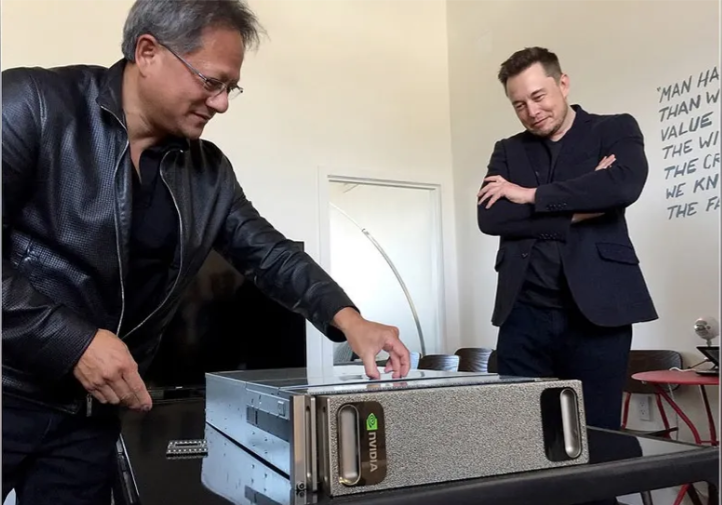 NVIDIA CEO Jensen Huang personally delivered the first DGX supercomputer to OpenAI in 2016, while Elon Musk watched. Elon Musk X.
The price of the DGX Spark is set at $3,999 in the United States. Considering that Nvidia's data center GPUs are difficult to purchase even at prices ranging from tens of thousands to hundreds of thousands of dollars, this is an attractive option for companies and labs with limited budgets.
Nvidia also classifies creators as potential customers for the DGX Spark. This implies that it could eventually encroach on the high-end PC market. It may also impact the existing markets dominated by Apple, Intel, and AMD. The reliance of AI research labs on the cloud may also change. An official from MKScore, which supplies the DGX Spark, said, "It will be launched in Korea starting on the 24th."
© The Asia Business Daily(www.asiae.co.kr). All rights reserved.



















