- Strengthened Regulations on High-Priced Homes and Single-Homeowners Expected to Benefit Non-Regulated Areas
- Outside the Scope of Regulations: No Worries About Interim Payment Loans, and Even Single-Homeowners Can Apply for 'Unjeong I-Park City'
Due to the government's stringent real estate policies, newly launched apartment complexes in non-regulated areas are drawing significant attention. In particular, large-scale branded complexes located in non-regulated zones and benefitting from development opportunities are expected to attract even more interest from potential buyers.
On October 15, the government announced the 'Housing Market Stabilization Measures,' designating all 25 districts of Seoul, as well as Gwacheon, Gwangmyeong, and Bundang District in Seongnam, among a total of 12 areas, as regulated zones. Once designated as regulated areas, the loan-to-value (LTV) ratio for first-time homebuyers and single-homeowners planning to sell their property is tightened from 70% to 40%. The debt-to-income (DTI) ratio is also reduced to 40%, making it more difficult to secure funds for home purchases through loans. Multi-homeowners face additional disadvantages, including higher acquisition and capital gains taxes, restrictions on the resale of pre-sale rights, and limitations on reapplying for housing subscriptions.
Furthermore, loan regulations for high-priced homes in the Seoul metropolitan area have been further tightened. The mortgage loan limit for purchasing homes in regulated areas of the metropolitan region now varies depending on the property price. For homes priced at 1.5 billion won or less, the maximum loan remains at 600 million won. However, for homes priced between 1.5 billion and 2.5 billion won, the limit is reduced to 400 million won, and for those exceeding 2.5 billion won, it drops to 200 million won. In addition, the minimum threshold for the 'stress DSR,' which reflects potential interest rate increases when assessing a borrower's repayment ability, has been raised from 1.5% to 3%, effectively reducing the actual loan limit.
Regulations on single-homeowners have also been strengthened. Single-homeowners in regulated areas who take out interim or relocation loans for reconstruction or redevelopment projects are now restricted from purchasing additional homes. The capital gains tax exemption requirement for single-homeowners has been tightened from two years of ownership to two years of both ownership and residency, making gap investment impossible. Additionally, the requirements for issuing guarantees on interim payment loans have been reinforced: a 10% down payment on the contract price is now mandatory, and only one guarantee per household is allowed.
A real estate expert commented, "With the entire city of Seoul and key areas in Gyeonggi Province now designated as regulated zones and loan regulations tightened, apartment complexes in the metropolitan area that remain free from these restrictions are likely to experience a 'balloon effect.' Despite the October 15 measures, if housing prices continue to rise, further regulations cannot be ruled out. Therefore, it is wise to secure a spot in complexes with clear future value as soon as possible."
As continued regulations make it increasingly difficult to obtain loans, the market is seeing a trend where demand is concentrating on large-scale branded complexes that offer both strong product appeal and stability, while being relatively less affected by regulations. These branded complexes, which ease the burden of raising funds and offer solid fundamentals such as location, transportation, and community facilities, are being regarded as 'safe choices' in an uncertain market environment.
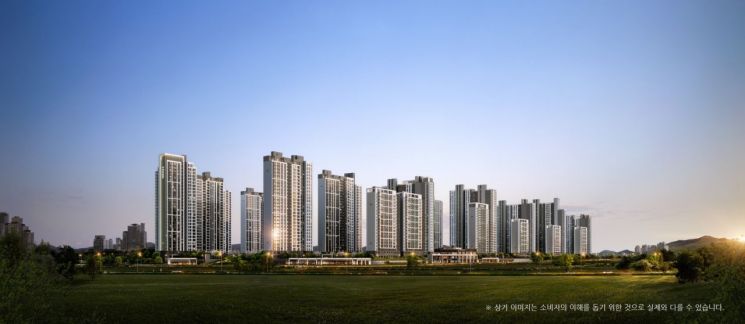
Accordingly, among the complexes scheduled for launch this year, large-scale branded complexes that are free from the influence of regulations are capturing the market's attention. Among them, 'Unjeong I-Park City,' which HDC Hyundai Development Company is launching this month, is attracting significant interest from buyers thanks to its excellent accessibility to Seoul, abundant lifestyle infrastructure, and the premium associated with a large-scale branded complex.
In particular, 'Unjeong I-Park City' is located in a non-regulated area, allowing even single-homeowners to apply for subscriptions, and is not subject to the stricter interim payment loan issuance requirements. In addition, the resale restriction period is only six months, making it relatively easy to resell, which is expected to draw even more interest from buyers.
Its outstanding accessibility to Seoul is another key advantage. Residents can use Unjeong Jungang Station on the GTX-A line to reach Seoul Station and the planned Samseong Station in about 20 minutes. Major road networks such as Jayu-ro, the Second Metropolitan Area Ring Expressway, and the planned Pyeongtaek-Paju Expressway are also nearby, making it easy to travel throughout the metropolitan area.
Paju Book City, Munbal General Industrial Complex, and Sinchon General Industrial Complex are all located within a 3-kilometer radius, offering excellent proximity to workplaces. Sharing the Unjeong living zone, the area also boasts abundant lifestyle infrastructure. Residents can conveniently access large shopping and cultural facilities such as Emart, Homeplus, Lotte Premium Outlet, Lotte Cinema, and the planned Starfield Village.
Various development projects further enhance the area's future value. The complex is being built within the Paju Medical Cluster, which will house a general hospital, an innovative medical facility, and a planned bio-convergence complex, allowing residents to directly benefit from medical and industrial infrastructure and ongoing development. In particular, once the general hospital and medical/bio research facilities become fully operational, the area is expected to become the ideal residential base for professionals such as medical staff and researchers. Paju City plans to invite proposals next month to attract a university hospital-level 'Unjeong General Hospital' (tentative name).
In addition, nearby Unjeong Technovalley, which is being developed as an ICT-based industrial complex, and Gyoha-dong, which is being considered for designation as a free economic zone, will further boost the area's future value.
'Unjeong I-Park City' also features distinctive design elements. The complex will include a range of community facilities befitting a large-scale development, such as a swimming pool, sauna, and indoor gymnasium. Differentiated residential services, including concierge and telemedicine services, are also planned.
The large-scale landscaping is also noteworthy. The complex will feature themed gardens such as Signature Field, Urban Cluster, and Life Garden within a landscaped area of approximately 64,000 square meters-about nine times the size of a soccer field-transforming the entire complex into a vast park. This will allow residents to enjoy a comfortable living environment and a leisurely lifestyle rarely found in urban settings.
'Unjeong I-Park City' will be located in Block A2 of the Paju Medical Cluster Urban Development Zone (around 432 Seopae-dong, Paju, Gyeonggi Province), consisting of 25 buildings ranging from two basement levels to a maximum of 29 above-ground floors, with exclusive areas of 63 to 197 square meters, and a total of 3,250 units.
The model home will be located in the Wadong-dong area of Paju, Gyeonggi Province, and is scheduled to open in October.
© The Asia Business Daily(www.asiae.co.kr). All rights reserved.
!["The Woman Who Threw Herself into the Water Clutching a Stolen Dior Bag"...A Grotesque Success Story That Shakes the Korean Psyche [Slate]](https://cwcontent.asiae.co.kr/asiaresize/183/2026021902243444107_1771435474.jpg)
















