"President Lee Jaemyung Has Effectively Issued an Expulsion Order From Seoul to Homeless Citizens"
On October 16, the People Power Party proposed the formation of a "four-party real estate consultative body" involving both the ruling and opposition parties, the Ministry of Land, Infrastructure and Transport, and the Seoul Metropolitan Government to address the issue of housing supply in Seoul.
Song Eonseok, floor leader of the People Power Party, criticized the government's October 15 real estate measures at the Supreme Council meeting held at the National Assembly that day, saying, "This is a rehash and a renewed cycle of 20 years of failed left-wing real estate policies under the Roh Moo-hyun, Moon Jae-in, and Lee Jaemyung administrations." He further stated, "President Lee Jaemyung has effectively issued an expulsion order from Seoul to homeless citizens."
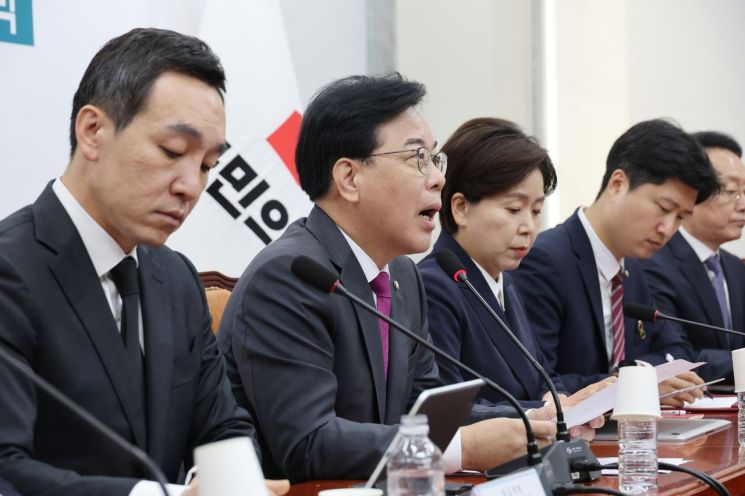
He said, "Real estate policy should focus on genuine end-users who own a single home for actual residence, but unfortunately, left-wing administrations have failed to grasp this point." He added, "Because of this lack of understanding, the lives of ordinary young couples preparing for marriage and childbirth, as well as working-class citizens dreaming of owning a home, are being trampled upon."
In particular, regarding the lowering of the loan-to-value (LTV) ratio for non-residential mortgage loans such as commercial spaces and officetels from 70% to 40%, he pointed out, "Even if a homeless worker borrows up to 570 million won at an LTV of 40%, they would still need to come up with 858 million won on their own." He criticized the policy as "a real estate measure that makes only young people and the working class into scapegoats."
He called on the government to come up with effective measures to expand housing supply. Song stated, "Policies to increase the floor area ratio in central Seoul must be essentially included," and added, "It is also inevitable to ease redevelopment and reconstruction regulations and to adjust building coverage and floor area ratios." He further demanded, "Please significantly increase the supply of new private apartments, especially for young people, newlyweds, and single-person households near subway stations."
He then proposed forming a "four-party real estate consultative body" involving the Democratic Party of Korea, the People Power Party, the Ministry of Land, Infrastructure and Transport, and the Seoul Metropolitan Government. He said, "There can be no partisan divide when it comes to policies to expand housing supply for homeless citizens," and added, "Let us start bipartisan cooperation in real estate policy by listening to reality and the voices of the market, not ideology."
Previously, the government announced a real estate policy on the previous day, designating all of Seoul and 12 areas in southern Gyeonggi Province as land transaction permission zones, regulated areas, and speculation-prone districts, thereby imposing an obligation for actual residence when purchasing a home. In addition, the government lowered the mortgage loan limit to 400 million won for homes priced over 1.5 billion won and up to 2.5 billion won, and to 200 million won for homes priced over 2.5 billion won.
© The Asia Business Daily(www.asiae.co.kr). All rights reserved.
![Clutching a Stolen Dior Bag, Saying "I Hate Being Poor but Real"... The Grotesque Con of a "Human Knockoff" [Slate]](https://cwcontent.asiae.co.kr/asiaresize/183/2026021902243444107_1771435474.jpg)










