"Asset Division Ratio Based on Roh Tae-woo Slush Fund Contribution Deemed Incorrect"
Legal Uncertainty Remains... Possible Recalculation in Remanded Trial
On October 16, the Supreme Court partially overturned and remanded the appellate court’s decision in the divorce lawsuit between SK Group Chairman Chey Tae-won and Art Center Nabi Director No Soyoung. As a result, SK Group is seen as having overcome a major hurdle. The immediate liquidity pressure has eased with the reversal of the second trial ruling, which had ordered more than 1 trillion won in asset division to be paid in cash. The risk that the owner’s personal issues could impact the entire management of the group has also been mitigated. The ongoing group business restructuring (rebalancing) can now proceed without disruption. However, as the case has been sent back to the High Court, legal uncertainty remains. The appeal regarding the amount of consolation money was dismissed, so the 2 billion won in consolation money awarded to Director No remains confirmed.
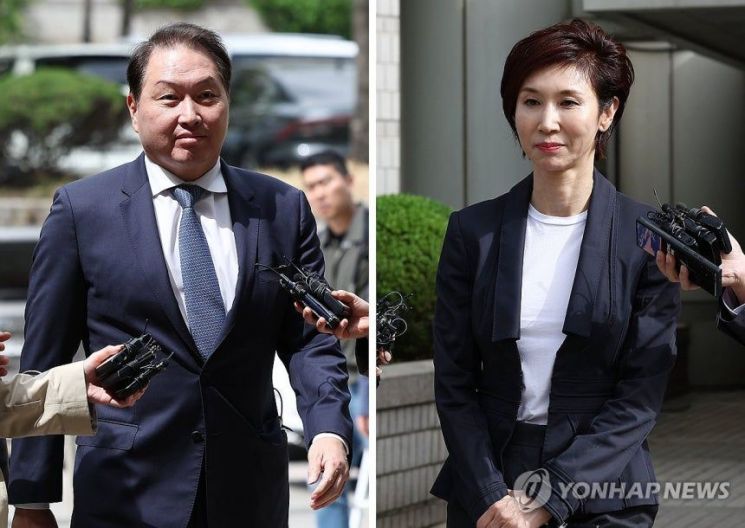 Chairman Chey Tae-won of SK and Director No Soyoung of Art Center Nabi attending the divorce lawsuit appeal trial held on the afternoon of April 16 last year at the Seoul High Court in Seocho-gu, Seoul. Photo by Yonhap News
According to business and legal circles, the Supreme Court’s partial acceptance of Chairman Chey’s appeal and remand of the case has alleviated immediate concerns over SK Group’s governance structure. Had the appellate ruling been upheld, Chairman Chey would have had to pay Director No 1.3808 trillion won in assets and 2 billion won in consolation money. Given that most of his assets are tied up in stocks, he would have faced significant liquidity pressure.
Currently, Chairman Chey holds 12,975,472 shares (17.90%) of SK Inc. He also indirectly owns 29.4% of SK Siltron through a total return swap, and holds 67,971 preferred shares (3.21%) of SK Chemicals. A significant portion of these shares are already pledged as collateral to financial institutions, so in the event of a large cash outflow, there would have been no clear way to secure liquidity other than selling shares. Including related parties, the total shareholding in SK Inc. is only 25.46%. If even part of these shares were sold or if collateral rights were exercised, there were concerns that foreign capital could enter and trigger a management control crisis similar to the 2003 Sovereign incident.
Chairman Chey and SK Group are focusing on the intent behind the remand. The Supreme Court determined that the 30 billion won in financial support from former President Roh Tae-woo, which was a key basis for the asset division exceeding 1 trillion won, could not be considered as a contribution by the defendant (Director No). The Court stated that property disposed of by Chairman Chey through gifts to third parties, unrelated to the formation of marital property, cannot be included in the division. The core issues in this case were the distinction between assets held before marriage and those accumulated during the marriage, as well as the nature of the 30 billion won financial support from former President Roh. Chairman Chey’s side has consistently argued that some of the funds originated from his separate property, making the division ratio excessive. With the Supreme Court pointing this out for reconsideration, both sides will once again contest the legal issues in the remanded trial.
SK Group considers that it has overcome a critical phase of instability in its governance structure. With the remand decision, the liquidity burden and threat to management control, which had been looming due to the risk of a large cash outflow from the owner’s personal assets, have been eased for the time being.
This ruling is also seen as symbolically significant for the business community as a whole. It demonstrates that personal disputes involving major corporate owners can directly translate into corporate governance risks. Changes are expected in how unlisted holding companies and owner families manage their assets in the future. An industry insider commented, “This ruling essentially resets the baseline for ‘corporate risk management,’ as it shows that the personal risk of an owner can affect large-scale investments and fund operations.”
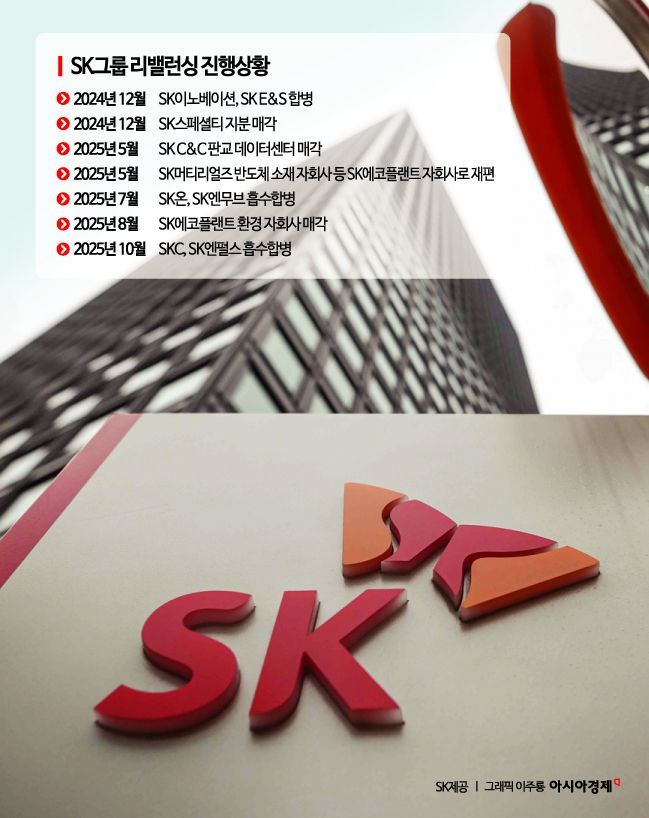
The group’s large-scale investment plans are also expected to take a breather for now. Chairman Chey is leading a ‘future-oriented growth strategy’ centered on semiconductors and artificial intelligence (AI) infrastructure. He personally announced a mid- to long-term plan to invest a total of 82 trillion won in AI and semiconductor sectors by 2030, and in June, he partnered with Amazon Web Services (AWS) to launch a 7 trillion won project to build an AI data center in Ulsan.
However, there is still a possibility that the standards for asset division may be adjusted in the remanded trial, and depending on the outcome, the burden of a large-scale cash payment could reemerge. An industry insider said, “The immediate crisis has passed, but the legal risks have not been completely extinguished. If the owner’s personal risk resurfaces, it could create new variables in the group’s fund management plans or investment schedules.”
© The Asia Business Daily(www.asiae.co.kr). All rights reserved.


















