Chairman Lee Eogwon Holds First Meeting with Insurance Company CEOs on the 16th
Insurance Industry Pledges Three-Part Support Package for Low Birth Rate
Lee Eogwon Promises Regulatory Easing to Foster a Virtuous Cycle of Productive Finance
Lee Eogwon, Chairman of the Financial Services Commission, met with insurance company CEOs for the first time since taking office and encouraged their active participation in productive finance. He also promised to ease regulations in the insurance sector, such as rationalizing discount rates and expanding ancillary business activities.
On the 16th, Chairman Lee held a meeting with the heads of 20 insurance companies, including the Life Insurance Association and the General Insurance Association. During the meeting, they discussed operational plans for the three-part support package to address low birth rates, ways to rationalize discount rates and introduce duration regulations, and other key issues facing the insurance sector.
As part of their commitment to productive finance, the insurance industry presented a third support plan related to low birth rates, following the securitization of death benefit payouts and local government partnership products. The main initiatives include discounts on children's insurance premiums, premium payment deferrals, and deferrals on insurance contract loan repayments.
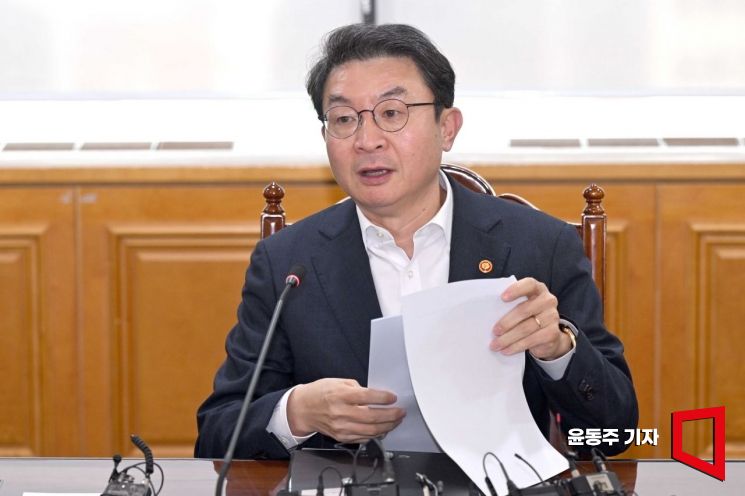 Lee Eokwon, Chairman of the Financial Services Commission, is delivering opening remarks at the Bank Presidents' Meeting held on the 29th of last month at the Bankers' Hall in Jung-gu, Seoul. Photo by Yoon Dongjoo
The children's insurance premium discount is a support measure that provides reduced premiums for children's insurance in the event of childbirth or parental leave. All children's insurance policies, totaling approximately 9.4 trillion won, are eligible, and the discount period and rate will be determined autonomously by each insurer. Premium payment deferrals apply to protection-type life insurance policies held by the policyholder or their spouse, with some contracts excluded. The deferral period can be chosen by the policyholder as either six months or one year, and no additional interest will be charged for the deferral. For insurance contract loan repayment deferrals, policyholders or their spouses can choose a deferral period of up to one year, with no additional interest applied during the deferral period.
Chairman Lee expressed his gratitude for the insurance industry's proposals and promised to ensure sound management of insurance companies and establish a virtuous cycle of productive finance. He stated that the regulatory framework would be gradually reformed so that the insurance industry, based on long-term asset management, could contribute to the development of the national economy.
In this regard, the Financial Services Commission plans to specify actuarial assumptions such as loss ratios to enhance the comparability of the capital adequacy ratio (K-ICS). A regulatory plan for the basic capital ratio will also be prepared within the year to help manage the quality of capital. Chairman Lee mentioned that rationalizing the accumulation of surrender value reserves would also be considered so that the strengthening of capital quality management leads to increased shareholder returns and higher corporate value. The discount rate system, which was conservatively introduced in consideration of market conditions such as interest rates, will be implemented over a 10-year period, extending the final observation maturity from the previously announced 2030 to 2035. During this process, a duration regulation will also be introduced to mitigate the impact of market interest rate fluctuations.
To ensure that insurance industry capital can be directed toward productive finance and social needs, policy support will be provided for asset-liability management (ALM) and improving investment returns. Regulations on equity acquisition, loans, and fund investments that support the real economy will also be rationalized. The scope of ancillary business activities for insurance company subsidiaries will be expanded so that long-term investment returns can be returned to consumers through premium discounts or customized services. Future-oriented initiatives, such as the service-oriented transformation of insurance and the activation of trusts, will also be pursued.
Chairman Lee urged insurance company CEOs to strengthen internal controls and foster organizational cultures that ensure consumer protection throughout the entire insurance product lifecycle, so that collaborative efforts are not undermined. He also called on them to participate in addressing social issues, such as expanding youth employment. The financial authorities pledged to complete the restructuring of sales commissions within the year and address key consumer protection tasks by early next year.
Chairman Lee stated, "The insurance industry is a social safety net responsible for the safety, health, and retirement of the people, and a source of capital formation for our economy. I ask you to look beyond the terms of your office or short-term performance and work toward a major transformation of the insurance industry with a broad and long-term perspective."
Kim Cheolju, President of the Life Insurance Association, said, "We will reorganize the entire value chain of the life insurance industry with a focus on consumer protection to lay the foundation for trusted finance." Lee Byungrae, President of the General Insurance Association, added, "We will actively support productive finance and strive to develop dedicated products for vulnerable groups."
© The Asia Business Daily(www.asiae.co.kr). All rights reserved.
![Clutching a Stolen Dior Bag, Saying "I Hate Being Poor but Real"... The Grotesque Con of a "Human Knockoff" [Slate]](https://cwcontent.asiae.co.kr/asiaresize/183/2026021902243444107_1771435474.jpg)
















