Deepnoid, a medical artificial intelligence (AI) company, announced on October 16 that three abstracts from its research team have been accepted for presentation at 'KoSAIM 2025'.
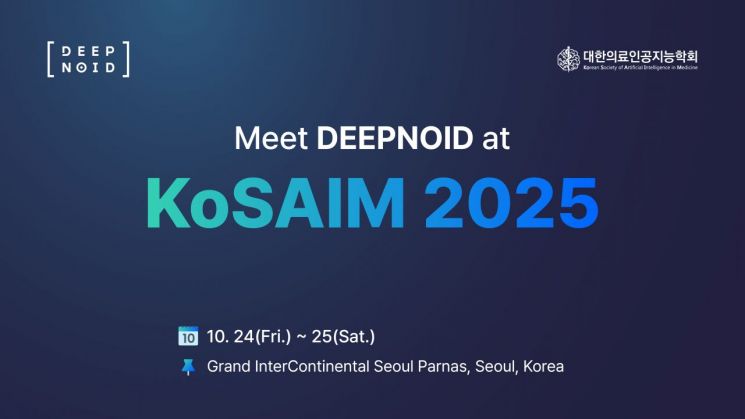
KoSAIM is an annual academic conference organized by the Korean Society of Artificial Intelligence in Medicine. It will be held from October 24 to 25 on the second floor of the Grand InterContinental Seoul Parnas. This is a leading domestic conference that integrates AI across a wide range of medical data, including radiology, pathology, biosignals, and electronic medical records (EMR). The event focuses on the clinical applicability of AI technologies and their interpretability in medical practice.
The three accepted abstracts from Deepnoid cover the following topics: ▲ An automated brain aneurysm reporting model that incorporates vascular phase information ▲ A technique for detecting cerebral microbleeds and reducing false positives using anatomical segmentation data ▲ A hybrid state-space transformer structure for colorectal cancer pathology images that reflects bidirectional tissue interactions.
All three studies were recognized for their academic significance in that they go beyond simple analysis of medical images and pathology data. By directly integrating medical context and structural information-such as anatomical, vascular, and tissue interactions-into model training, the research enhances both the interpretability and clinical utility of AI.
At the conference, Deepnoid will present research abstracts through poster sessions and operate an exhibition booth. At the booth, medical professionals, hospital representatives, and AI researchers will be able to experience two medical AI solutions firsthand: ▲ 'DEEP:NEURO', an AI solution that assists in diagnosing cerebrovascular diseases, and ▲ 'M4CXR', a generative AI-based solution for drafting radiology reports from chest X-rays.
Choi Woosik, CEO of Deepnoid, stated, "The acceptance of our abstracts at KoSAIM is significant, as it aligns with the Korean Society of Artificial Intelligence in Medicine's direction that medical AI must ensure both clinical reliability and explainability, beyond mere model performance." He added, "Through our poster presentations, we will share our research achievements with the academic community, and by operating our exhibition booth, we aim to contribute to the broader adoption of AI in clinical practice."
Deepnoid is developing medical AI solutions with the goal of improving diagnostic efficiency for healthcare professionals and expanding the use of AI in clinical settings. In August, the company began a multi-center clinical trial of 'M4CXR', a generative AI-based digital medical device, under the approval of the Ministry of Food and Drug Safety. M4CXR is a digital medical device capable of interpreting 41 types of lesions from chest X-ray images within seconds and automatically generating draft radiology reports. The company aims to obtain regulatory approval for the device as early as the end of this year.
© The Asia Business Daily(www.asiae.co.kr). All rights reserved.

















