Besant Says at Press Briefing: "Confident Differences Can Be Resolved"
"If I Were Fed Chair, South Korea Would Already Have a Currency Swap"
Tells CNBC: "The Devil Is in the Details, But We Are Resolving Them"
Tariff Negotiations Accelerate Ahead
U.S. Treasury Secretary Scott Besant stated on October 15 (local time) that he expects trade negotiations with South Korea to be concluded within the next 10 days. After three months of deadlock following a broad trade agreement reached at the end of July, the South Korea-U.S. tariff negotiations are now making rapid progress as the two countries narrow their differences.
With both sides expressing a strong commitment to reaching a deal ahead of the Asia-Pacific Economic Cooperation (APEC) summit in Gyeongju, South Korea, at the end of this month, a breakthrough in the South Korea-U.S. tariff negotiations now appears to be within reach.
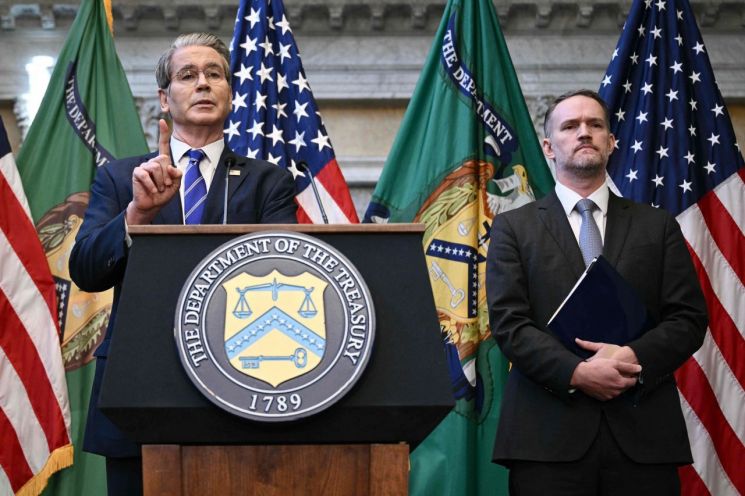
At a press briefing held at the Treasury Department in Washington, D.C. that day, Secretary Besant was asked about the possibility of resolving differences over the details of South Korea's promised investment in the United States. He responded, "I am confident that the differences can be resolved," adding, "We are in talks right now. I expect something within the next 10 days."
Regarding whether the U.S. would accept South Korea's request for an unlimited currency swap, which was raised out of concerns about instability in the foreign exchange market due to large-scale investments in the United States, he said, "That is a matter for the Federal Reserve, not the Treasury Department." However, he added, "If I were the Fed chair, South Korea would already have a currency swap like Singapore." He did not elaborate on why he referenced the Singapore case.
This remark is interpreted as showing his understanding of the South Korean government's position that measures are needed to mitigate the impact of large-scale investments in the United States on Korea's foreign exchange market. Unlike the U.S.'s initially lukewarm response to Korea's request, it appears that discussions on establishing a currency swap or similar safety mechanism linked to the tariff negotiations are making progress. Previously, South Korea and the United States signed temporary currency swap agreements during the 2008 global financial crisis and the 2020 COVID-19 pandemic.
Secretary Besant also stated in a media interview prior to the press conference that trade negotiations with South Korea are in their final stages.
In an interview with CNBC, he said, "We are at the stage of wrapping up negotiations with South Korea," adding, "The devil is in the details, but we are working through those details." He further noted that officials from both countries would meet this week in Washington, D.C., on the sidelines of the International Monetary Fund (IMF) and World Bank (WB) annual meetings. This foreshadowed negotiations with Deputy Prime Minister and Minister of Economy and Finance Koo Yooncheol, who arrived in the United States that day.
With a South Korea-U.S. summit meeting at APEC just two weeks away, Secretary Besant's suggestion that a resolution to the tariff negotiations is imminent is drawing attention to whether the two countries can finally conclude the trade talks that have faced difficulties for three months, despite a broad agreement in July. At the end of July, South Korea and the United States reached a broad trade agreement, but failed to finalize it due to unresolved differences over the structure of the $350 billion investment package South Korea promised for the United States, as well as the distribution of benefits. As a result, South Korea is currently subject to a high 25% tariff on automobiles, which is less favorable than the 15% tariff applied to the European Union and Japan.
The South Korean government is also accelerating the negotiations, with senior officials from the Presidential Office and the economic and trade sectors gathering in Washington, D.C.
Kim Yongbeom, Policy Chief of the Presidential Office, is scheduled to visit the United States on October 16 with Minister of Trade, Industry and Energy Kim Jeonggwan, carrying a revised tariff proposal. They will meet with their counterpart, U.S. Secretary of Commerce Howard Lutnick, for discussions. On October 15, Kim stated, "Recently, the United States gave a very meaningful response to our revised proposal, and a new alternative has been presented," adding, "I see this as significant progress." Deputy Prime Minister Koo, who departed earlier, will hold separate talks with Secretary Besant on measures to stabilize the foreign exchange market.
In addition, major business leaders such as Samsung Electronics Chairman Lee Jaeyong, SK Group Chairman Chey Taewon, Hyundai Motor Group Chairman Chung Euisun, and LG Group Chairman Koo Kwangmo are also visiting the United States to provide support for the tariff negotiations. Invited by Masayoshi Son, Chairman of Japan's SoftBank, these four conglomerate leaders are expected to meet with former U.S. President Donald Trump for a round of golf at the Mar-a-Lago resort in Florida, where Trump resides.
© The Asia Business Daily(www.asiae.co.kr). All rights reserved.
![Clutching a Stolen Dior Bag, Saying "I Hate Being Poor but Real"... The Grotesque Con of a "Human Knockoff" [Slate]](https://cwcontent.asiae.co.kr/asiaresize/183/2026021902243444107_1771435474.jpg)
















