At CNBC Forum, "Collective Response That May Even Be Considered Excessive"
Draws Line on Possibility of U.S.-China Trade Deal Following Market Decline
"U.S.-South Korea Trade Talks in Final Stages"... Hopes for Agreement at APEC Summit
On October 15 (local time), U.S. Treasury Secretary Scott Besant announced that the United States will work together with its allies to respond to China's export controls on rare earth elements. He also predicted that the U.S.-China summit, which is scheduled to take place during the Asia-Pacific Economic Cooperation (APEC) summit in Gyeongju, South Korea at the end of this month, is highly likely to proceed as planned.
He further mentioned that trade negotiations with South Korea are in their final stages, and that there has also been progress in negotiations with other trading partners such as Canada and India.
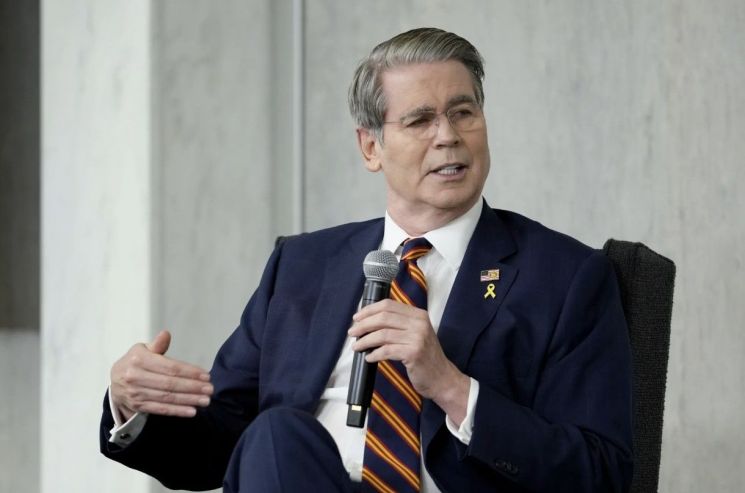
Secretary Besant attended CNBC's "Invest in America Forum" held in Washington, D.C. that day and stated, "Chinese officials cannot manage the global supply chain and manufacturing processes," adding, "We will respond collectively, perhaps even excessively, to this issue."
He added that during the International Monetary Fund (IMF) and World Bank (WB) annual meetings being held in Washington, D.C. this week, "all counterparts are gathering" and that "discussions will take place with European allies, Australia, Canada, India, and Asian democracies."
Previously, China announced even stricter export controls on rare earth elements. On October 9, the Chinese government required that even products manufactured overseas must obtain government export approval if they contain Chinese rare earths or use Chinese refining and processing technology. Rare earth elements are key materials for advanced industries such as semiconductors and electric vehicle batteries, and China controls about 70% of the global supply. This measure is widely interpreted as a strategy to maximize China's bargaining power against the United States ahead of the U.S.-China summit scheduled for the end of this month, effectively targeting a critical weakness of the U.S.
In response, President Trump has warned that he will impose an additional 100% tariff on Chinese goods starting in November, and has even mentioned the possibility of halting purchases of Chinese cooking oil, further escalating tensions between the two countries.
Secretary Besant also dismissed speculation that the recent stock market decline, triggered by renewed U.S.-China trade tensions, would prompt the U.S. government to rush into a trade deal with China. Previously, after President Trump announced additional tariffs on China on October 10 and the stock market plummeted, he commented two days later that "everything will be fine with China." Some have criticized this as "TACO" (Trump Always Chickens Out).
Secretary Besant predicted that the U.S.-China summit scheduled for the end of this month will proceed as planned.
He said that, as far as he knows, it is "a go" for President Trump to meet with Chinese President Xi Jinping in South Korea at the end of this month, and that he himself plans to visit South Korea in advance to meet with Chinese Vice Premier He Lifeng. Secretary Besant and Vice Premier He have already held four rounds of high-level trade talks in Geneva, Switzerland; London, United Kingdom; Stockholm, Sweden; and Madrid, Spain.
Secretary Besant also stated that there has been progress in trade negotiations with major trading partners, including South Korea.
In an interview with CNBC, he said, "We are in the final stages of negotiations with South Korea," adding, "The devil is in the details, but we are working through those details." He went on to say that U.S. and South Korean officials will meet in Washington, D.C. this week on the sidelines of the IMF and WB annual meetings. After reaching a broad trade agreement at the end of July, U.S.-South Korea trade talks had been stalled for three months due to differences over the implementation details of a $350 billion investment in the United States. Attention is now focused on whether these negotiations will gain momentum.
Secretary Besant also stated that negotiations with Canada are "back on track" and that there has been progress in talks with India as well.
© The Asia Business Daily(www.asiae.co.kr). All rights reserved.

















