Largest Monthly Increase This Year
Rebound After March Low, Six Consecutive Months of Growth
Driven by Productive Finance Shift and Household Loan Cap
"Reduce Inefficiencies and Foster Outstanding Companies"

Technology credit loans, which are recognized as a crucial funding source for small and venture businesses with technological capabilities, have recently seen a sharp increase. Commercial banks, which had previously been reluctant to offer such loans, have increased lending by more than 2 trillion won over the past month. This shift is attributed to the combination of government demands for a transition to productive finance and the introduction of total household loan volume regulations. As the technology credit loan market is regaining momentum within the banking sector, there are calls for efforts such as discovering outstanding companies to ensure that funds are directed to growth industries as originally intended.
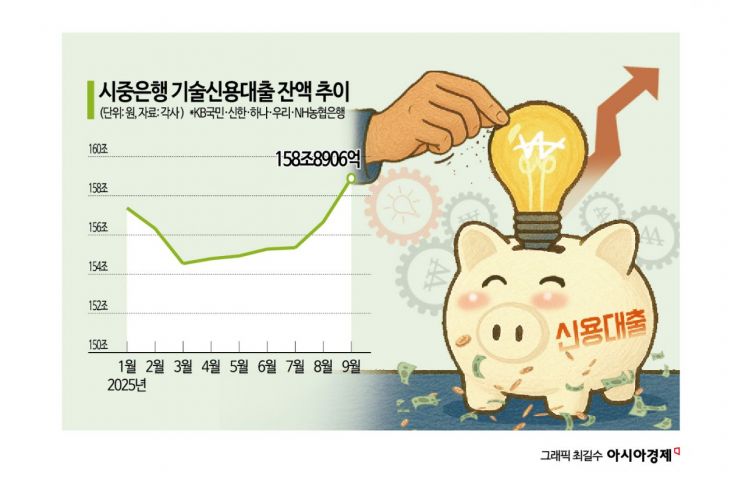
According to the financial sector on October 16, the outstanding balance of technology credit loans at the five major banks (KB Kookmin, Shinhan, Hana, Woori, and NH Nonghyup) as of the end of September 2025 stood at 158.8906 trillion won. This represents an increase of 2.2248 trillion won compared to the previous month.
Technology credit loans are a system that allows companies to obtain loans based on an assessment of their technological prowess and commercialization potential, even if they lack sufficient collateral such as sales or owned assets. By moving away from traditional real estate collateral or credit rating-based reviews and instead evaluating technological competitiveness and future growth potential, these loans are regarded as a representative productive finance product. Introduced in 2014 to supply funds to innovative small and medium-sized enterprises, technology credit loans now account for about 20% of SME loans and serve as a financial lifeline for early-stage venture companies.
Until March of this year, technology credit loans from commercial banks had been contracting. This was due to regulatory authorities tightening the system in July last year, requiring more rigorous technology assessments based on quantitative indicators. However, since April, the outstanding balance of technology credit loans has started to rise, marking six consecutive months of growth. The pace of increase has accelerated particularly in the second half of this year: 78.6 billion won in July, 1.3066 trillion won in August, and 2.2248 trillion won in September, with last month's increase being the largest so far this year.
The increase in technology credit loans is analyzed as a result of banks actively expanding lending, driven by the government's demand to shift toward productive finance and the reduction of the total volume of household loans. The outstanding balance of intellectual property (IP) collateral loans, another form of productive finance, also grew from 1.3393 trillion won at the end of last year to 1.3526 trillion won as of September. IP collateral loans are products that lend money to companies using IP such as patents, design rights, and trademarks as collateral. A financial sector official stated, "Considering that more than 85% of corporate loans are still backed by collateral or guarantees, the increase in these products is seen as a positive development."
However, there are also concerns that for these revitalized loans to truly serve the government's goal of productive finance-namely, supporting innovative small and medium-sized enterprises-efforts must be made to reduce inefficiencies and foster outstanding companies. A bank official who has handled these loans commented, "In practice, it is not easy to find companies with strong technological capabilities eligible for these loans," adding, "The pool is especially limited in regions or industrial complexes focused on simple manufacturing." The official continued, "In the past, there were cases where banks stretched to meet targets, resulting in forced loans. To prevent such practices from recurring, policy support is ultimately needed to ensure that more technology-driven companies are created in line with the original intent of the system."
© The Asia Business Daily(www.asiae.co.kr). All rights reserved.


















