Potential Expansion of Risks for Korean Strategic Industries
U.S. Collaboration by Semiconductor and Battery Firms
"Supply Chain Diversion and De-China Strategies Needed"
As China imposes sanctions on Hanwha Ocean's U.S. subsidiaries in response to the United States' Section 301 trade investigation, concerns are mounting that the U.S.-China trade conflict could expand from the shipbuilding industry to strategic sectors such as semiconductors and batteries. Industry insiders are paying close attention to the possibility that China may broaden its sanctions to include all foreign companies that have cooperated with U.S. industrial restoration policies.
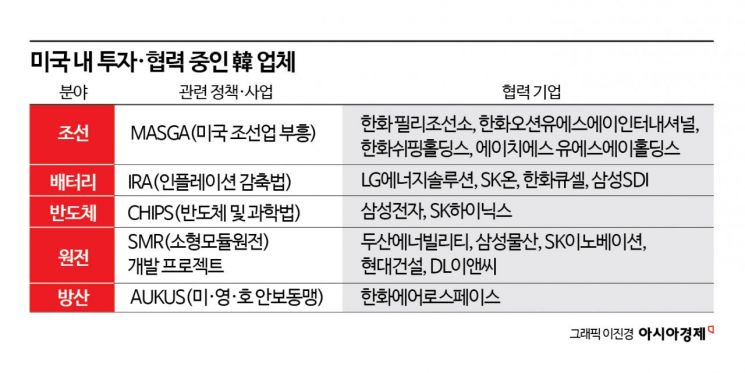
On October 15, industry experts pointed out that these sanctions serve as the first warning to foreign companies participating in the U.S. industrial self-reliance strategy, and that the measures could extend beyond shipbuilding to semiconductors and batteries. They noted that companies involved in U.S. industrial restoration policies-such as the CHIPS Act (semiconductor subsidies), the Inflation Reduction Act (IRA), and the AUKUS (U.S.-U.K.-Australia security alliance)-are all expanding production and restructuring supply chains within the United States, thereby putting pressure on China's industrial competitiveness.
In the semiconductor sector, domestic companies such as Samsung Electronics and SK Hynix have received subsidies under the CHIPS Act and are making large-scale investments in foundry (contract manufacturing) and advanced packaging facilities in the United States. In the battery sector, LG Energy Solution, SK On, and Hanwha Qcells are also pursuing collaborations and investments with U.S. companies to meet local production requirements under the IRA. In the nuclear power and defense sectors, Doosan Enerbility and Hanwha Aerospace are expanding their businesses within the security alliance framework, including the development of small modular reactors (SMRs) and projects linked to AUKUS.
Experts interpreted this action not as simple trade retaliation but as a warning regarding "industrial alliances." Kim Taehwang, a professor of international trade at Myongji University, stated, "China can use a variety of supply chain cards targeting South Korea, such as raw materials, rare earth elements, and secondary battery materials." He also expressed concern that "as in the case of THAAD, China could deploy non-tariff and non-market measures such as restrictions on tourism, visas, and customs clearance delays." He added, "Although South Korea and China are both parties to a Free Trade Agreement and will maintain their relationship on the surface, it is necessary to gradually reduce internal exposure to China risk through a de-risking strategy. Pragmatic diplomatic responses tailored to each issue are required." Professor Kim pointed out, "The biggest problem is that South Korea has emerged as an 'intermediate target' in the U.S.-China conflict."
Jang Sangshik, head of the International Trade and Commerce Research Institute at the Korea International Trade Association, also commented, "With the addition of rare earth sanctions, uncertainty has increased in industries with high dependence on China, such as semiconductors, batteries, and defense." He advised, "Companies should increase their reserves of rare earths and critical minerals, and prepare supply chain bypass strategies through third countries. The government should maintain the framework of economic cooperation between South Korea and the United States, while also activating joint response systems with allied countries to pursue a 'de-China' strategy in parallel."
The Chinese Ministry of Commerce announced its sanctions list the previous day through a spokesperson's statement, saying, "Hanwha Ocean's U.S. subsidiary cooperated with and provided support for the relevant investigation activities of the U.S. government." The sanctions list includes five entities: Hanwha Philly Shipyard in Philadelphia, Pennsylvania; Hanwha Ocean USA International; Hanwha Shipping Holdings; and HS USA Holdings, among others.
Although China did not specify the exact nature of the cooperation provided by Hanwha Ocean's U.S. subsidiaries to the United States, this measure is interpreted as a response to the Section 301 investigation into the shipbuilding and shipping industries initiated by the U.S. in August.
© The Asia Business Daily(www.asiae.co.kr). All rights reserved.

















