Did Not Meet Primary Efficacy Endpoint in Global Phase 3 Trial
But Showed Significant Results in Function, Respiration, and Survival
"We will achieve commercial approval next year for 'Neuronata-AL,' our ALS (Lou Gehrig's disease) cell therapy that has completed global Phase 3 clinical trials."
Yang Gilan, CEO of Corestem ChemOn, stated this in an interview with Asia Economy on October 15. Corestem ChemOn is accelerating efforts to apply for a change in conditional approval in Korea within this year at the earliest and to prepare for an Accelerated Approval application to the United States Food and Drug Administration (FDA) by early next year. Although the drug did not meet the primary efficacy endpoint in the global Phase 3 trial, it showed meaningful results in reducing the neurodegeneration biomarker (NfL) and in functional, respiratory, and survival indicators among the 'slow progressor' patient group (patients whose disease progresses slowly).
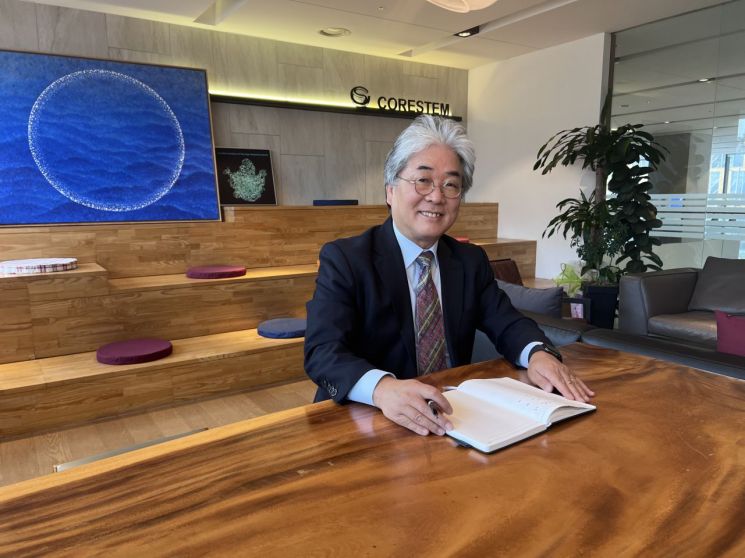
The company has applied this year to the Ministry of Food and Drug Safety for a change in conditional approval for 'Neuronata-AL Injection' and is currently addressing requests for additional information. Lee Taeyong, Head of the Central Research Institute at Corestem ChemOn, said, "In the overall analysis of the Phase 3 trial, the protein (NfL), which indicates the degree of nerve damage, was reduced, and in the slow progressor group, there were significant improvements in function (ALSFRS), the combined survival and function score (CAFS), and respiratory capacity (SVC)."
ALS is considered one of the most intractable diseases. It is a condition in which motor neurons gradually die, but the fundamental cause of neuronal death has not yet been identified. Since damaged nerve cells cannot regenerate, even halting disease progression is extremely difficult. There is no animal model that perfectly replicates ALS pathology, and to date, no drug developed has been able to effectively cross the blood-brain barrier.
This is why the 'need for cell-based therapy' emphasized by CEO Yang is drawing attention. It is the only approach that can directly protect and restore damaged neurons. CEO Yang said, "ALS is a refractory disease with its cause still unclear, but Neuronata-AL Injection has provided clues for inhibiting neuronal damage, reducing inflammation, and restoring function," adding, "This platform could become the foundation for treating not only ALS but also other neurological and rare diseases." CEO Yang further emphasized, "If we only consider economic feasibility, ALS is a challenging field to enter, but someone has to pave the way. Our value lies in being the only company that has independently managed the entire process of clinical trials, manufacturing, and quality control in Korea."
The company's efforts in the United States will become full-scale through a 'Type C Meeting' with the FDA, scheduled between the end of this year and early next year. This meeting is an opportunity for pharmaceutical companies to discuss clinical trial plans (IND), approval strategies, and the overall development process with the FDA. CEO Yang said, "Taking into account the lead time to approval, we plan to complete data preparation within this year and, if we receive positive signals, submit a Biologics License Application (BLA) to the FDA. Our goal is approval next year."
If commercialization is achieved, the initial supply for the United States will be produced at the Osong plant in Korea. Director Lee said, "We have extended the product shelf life from two days to seven days, and the Osong GMP (Good Manufacturing Practice) facility is equipped with the latest equipment and is about seven times larger than the previous plant. After obtaining manufacturing approval this year and completing validation by early next year, we will be able to ensure stable supply once we receive additional manufacturer approval. If demand in the United States increases, contract manufacturing organization (CMO) services or local production are also options."
© The Asia Business Daily(www.asiae.co.kr). All rights reserved.
![Clutching a Stolen Dior Bag, Saying "I Hate Being Poor but Real"... The Grotesque Con of a "Human Knockoff" [Slate]](https://cwcontent.asiae.co.kr/asiaresize/183/2026021902243444107_1771435474.jpg)
















