Signs of Liquidity Tightening Detected
"Labor Market Weakening... Data Gaps Possible if Shutdown Continues"
Jerome Powell, Chair of the United States Federal Reserve (Fed), has indicated that the central bank could end its quantitative tightening (QT), also known as balance sheet reduction, within the next few months. He also reiterated signs of a slowdown in the labor market. While he refrained from making direct comments on the future path of interest rates, his remarks were interpreted as leaving the door open to further rate cuts.
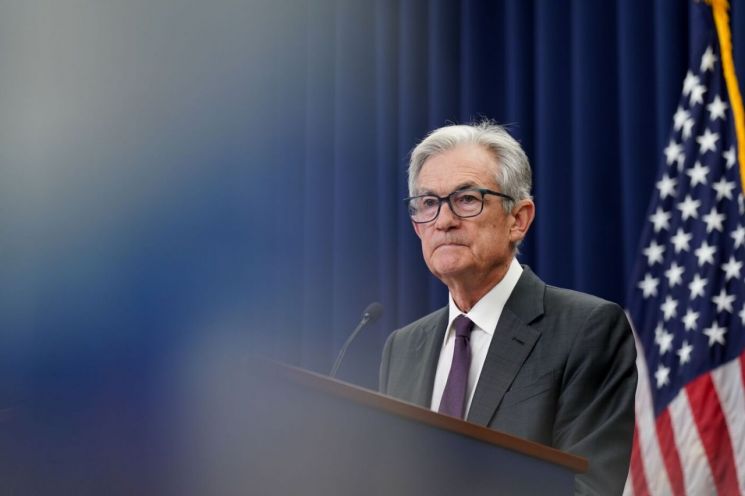
On October 14 (local time), during a speech at the National Association for Business Economics (NABE) conference in Philadelphia, Pennsylvania, Powell stated, "It has long been our plan to halt balance sheet runoff at the point when we judge that reserve levels are sufficient," adding, "We could reach that point within the next few months. We are closely monitoring a wide range of indicators to inform this decision."
He noted that there are some signs of a gradual tightening of liquidity and emphasized that the Fed would proceed cautiously to avoid market instability similar to the 'taper tantrum' that occurred in September 2019.
Quantitative tightening is a measure by which the Fed absorbs market liquidity by selling bonds it holds or by not reinvesting proceeds when bonds mature. This is the opposite of quantitative easing (QE), in which the central bank buys bonds to supply liquidity.
In June 2022, following the COVID-19 pandemic, the Fed resumed quantitative tightening to reduce the assets that had surged in response to the pandemic. By not reinvesting in maturing Treasury securities and mortgage-backed securities (MBS), the Fed has reduced its assets from a peak of $9 trillion to the current level of $6.6 trillion.
However, as bank reserves have declined during this process, liquidity in the short-term funding market has tightened, raising concerns that this could lead to financial market instability, including rising interest rates. As a result, it is now believed that the Fed is approaching the point at which it will halt quantitative tightening.
Regarding employment, Powell assessed, "The labor market has revealed fairly significant downside risks." He added, "The indicators we obtained right after the July meeting showed that the labor market had indeed weakened considerably," and noted, "This suggests that the risks to both price stability and full employment are now more balanced."
He also expressed concern that delays in the release of economic indicators due to the federal government shutdown (temporary work stoppage) could make the situation more challenging, especially if the situation persists and October data are missed, which would complicate monetary policy decisions.
However, he did not provide specific guidance on the future path of interest rates.
At last month's regular Federal Open Market Committee (FOMC) meeting, the Fed lowered the benchmark interest rate by 0.25 percentage points to a range of 4.0% to 4.25% per year. The FOMC is scheduled to decide on the possibility of an additional rate cut at its meeting on October 28-29.
© The Asia Business Daily(www.asiae.co.kr). All rights reserved.
![Clutching a Stolen Dior Bag, Saying "I Hate Being Poor but Real"... The Grotesque Con of a "Human Knockoff" [Slate]](https://cwcontent.asiae.co.kr/asiaresize/183/2026021902243444107_1771435474.jpg)
















