Performance-Linked Stock Compensation for Employees
Up to 100 Million Won If Stock Price Doubles in 3 Years
Compensation Tied to Shareholder Value; Expanded OPI Stock Option
Both Expectations and Concerns Emerge
Positive Effects: Focus
On October 14, Samsung Electronics announced internally that it has decided to implement a Performance Share Unit (PSU) program, under which employees will be granted company shares in proportion to the increase in the company's stock price over a set period.
With the official introduction of this program, opinions both inside and outside the company are sharply divided between positive and negative views. There are both expectations and concerns about the fundamental structure of rewarding with shares instead of cash, as well as the lengthy process required before actual compensation is received.
According to Samsung Electronics, the newly introduced PSU program is centered on granting employees company shares in proportion to the increase in the stock price over the next three years. If the stock price rises significantly over these three years, the amount of compensation employees receive will increase accordingly. This is quite different from the Outperformance Incentive (OPI), which rewards short-term performance over the past year. The PSU program is linked to the company's future performance, and the stock price itself becomes a condition for compensation.
Under this program, Samsung Electronics will sign agreements this month to grant 200 shares each to employees in CL 1-2 and 300 shares each to those in CL 3-4. The final number of shares will be determined based on the stock price increase over three years, and the shares will be distributed in equal installments over three years starting in 2028.
The payout multiple based on the increase in stock price will be calculated by comparing the reference price on October 15, 2025, with the reference price on October 13, 2028. The multiples are as follows: ▲ less than 20% increase, 0x; ▲ 20% to less than 40% increase, 0.5x; ▲ 40% to less than 60% increase, 1x; ▲ 60% to less than 80% increase, 1.3x; ▲ 80% to less than 100% increase, 1.7x; ▲ 100% or more increase, 2x. The reference price is the arithmetic average of the volume-weighted average prices for one week, one month, and two months prior to the reference date.
If Samsung Electronics' stock closes at around 91,000 won on this day, the reference price for October 15 is estimated to be about 84,000 won. If the stock price doubles by October 13, 2028, three years later, it would reach approximately 168,000 won per share, and CL 3-4 employees would receive 600 shares. The total value received over the next three years would exceed 100 million won.
According to this simple calculation, if employees work hard and significantly increase the stock price, the number of shares and the corresponding amount they receive could be substantial. Based on this, internal reactions within the company are reported to be mostly positive. The program is also seen as a way to motivate employees to pursue the company's long-term performance alongside the company. There is also an expectation that it will boost individual employees' motivation to work.
Furthermore, the PSU program is attracting attention for its advantage in retaining talented employees for at least three years. In the current work culture, where many talented employees leave within one or two years of joining, companies are struggling to retain good talent. Samsung Electronics has reportedly not been immune to this risk. However, with the introduction of the PSU program, employees are incentivized to focus on their work for three years until they receive their share-based compensation, which can help prevent attrition. When employees receive substantial share-based compensation after three years, it could serve as a foundation for them to commit to another three years. It is also noteworthy that many global companies have already implemented share-based compensation programs. Most big tech companies in Silicon Valley have long operated share-based compensation systems such as Restricted Stock Units (RSUs).
Additionally, the PSU program can enhance shareholder value by supporting the stock price, which is the ultimate goal of Samsung's adoption of the PSU. While employees benefit from higher compensation as the stock price rises, this is also good news for general shareholders.
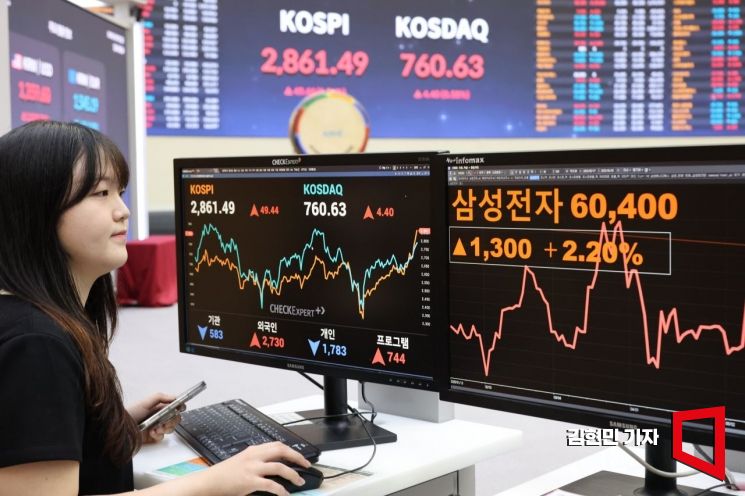 On June 9th, Samsung Electronics' stock price, which surpassed 60,000 won, is displayed on the Korea Exchange monitor in Yeouido, Seoul, along with the KOSPI and KOSDAQ indices. 2025. 6. 9. Photo by Kim Hyunmin
However, the PSU program is subject to criticism for not guaranteeing 100% compensation, as the reward is in shares rather than cash. According to the terms of the PSU, the stock price must rise by at least 20% within three years for employees to receive any compensation. There is no guarantee that the stock price will increase simply because employees work hard. There is also no direct correlation between the maturity and quantity of employees' work and the stock price. This is the main reason why opponents of share-based compensation programs argue that such schemes are essentially a cost-saving measure devised by the company.
Since the PSU program has just been introduced, debates for and against it are expected to continue both inside and outside the company for some time. Samsung Electronics is also moving to diversify and expand its share-based compensation programs. In addition to the PSU, the company announced that from next year, employees will be able to choose to receive part of their OPI in shares instead of cash. Since January, the OPI share-based compensation program has been implemented for executives to strengthen responsible management, and this will now be extended to employees. Accordingly, employees will be able to voluntarily choose the proportion of their OPI payout to be received in shares, in 10% increments from 0% to 50%. Employees who choose to receive part of their OPI in shares will receive an additional 15% of the share-based compensation amount in shares, provided they hold the shares for one year.
© The Asia Business Daily(www.asiae.co.kr). All rights reserved.


















