Anseong City is expected to emerge as a central transportation hub in southern Gyeonggi Province. This momentum is driven by the advancement of major transportation projects, including the Central Region Metropolitan Express Railway, the Metropolitan Inland Line, the extension of the Gyeonggang Line to Anseong, and the Pyeongtaek-Bubal Line. Last month, the privately funded Yongin-Chungju Expressway also passed the feasibility study, further accelerating the expansion of transportation infrastructure.
According to the Ministry of Land, Infrastructure and Transport, the Yongin-Chungju Expressway will be developed as a profit-sharing Build-Transfer-Operate (BTO-a) project. The expressway will stretch approximately 55 kilometers, feature four lanes in both directions, and be designed for speeds up to 110 km/h. Once completed, it will serve as a major corridor connecting Anseong, Yongin, Eumseong, and Chungju, significantly enhancing regional mobility between southern Gyeonggi Province and North Chungcheong Province.
The Central Region Metropolitan Express Railway is also drawing attention. This project, which will connect Jamsil in Seoul to Gwangju, Yongin, Anseong, Chungbuk Innovation City, and Cheongju Airport, is currently undergoing a private investment feasibility study. Upon completion, travel time from Jamsil to Cheongju Airport will be under one hour, and Anseong will effectively secure a direct rail link to the Gangnam area of Seoul.
Notably, the Central Region Metropolitan Express Railway includes sections of both the Metropolitan Inland Line (Hwaseong Dongtan-Anseong-Jincheon-Cheongju Airport) and the Gyeonggang Line extension (Gwangju in Gyeonggi Province-Yongin Cheoin District-Anseong), creating significant synergy between projects. When the Pyeongtaek-Bubal Line is added, the southern Gyeonggi Province east-west transportation network will be completed, connecting Pyeongtaek Station through Anseong to Icheon Bubal Station.
Once all these transportation projects are completed, Anseong will be established as a key transportation hub connecting the Seoul metropolitan area and the Chungcheong region in all directions. The integrated network of railways and expressways is expected to dramatically improve commuting conditions, enhance proximity between residential and business areas, and significantly boost the overall residential appeal of the city by expanding living zones.
Amidst these changes, the final residential complex in the Ayang Residential Development District, 'Anseong Ayang Geumseong Baekjo Yejiji,' is attracting attention as a prime beneficiary of the region’s transformation.
Located in Block B2 of the Ayang Residential Development District in Anseong, Gyeonggi Province, this complex will consist of eight buildings, ranging from one basement level to 25 floors above ground, with a total of 657 units, each with an exclusive area of 84 square meters. The application of the pre-sale price ceiling system ensures competitive pricing, and residents can benefit from both already established living infrastructure and future value potential.
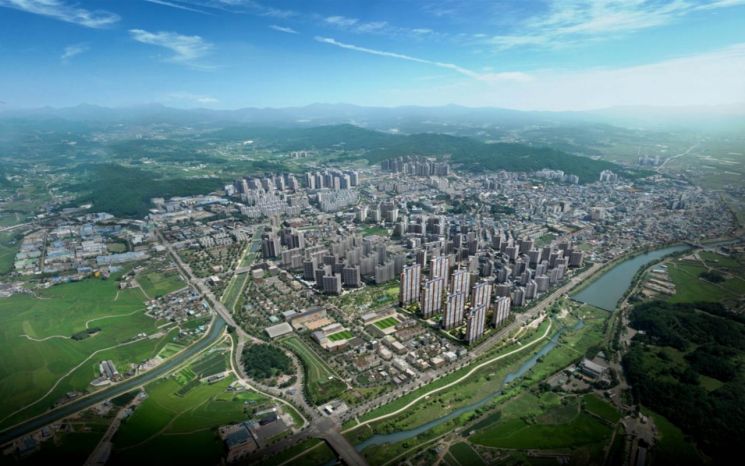
'Anseong Ayang Geumseong Baekjo Yejiji' boasts a comprehensive transportation network, including the Anseong Mat-Chum Interchange on the Sejong-Pocheon Expressway, the Nam Anseong Interchange on the Pyeongtaek-Jecheon Expressway, and the Anseong Interchange on the Gyeongbu Expressway, making travel to key areas of the Seoul metropolitan region, including Seoul itself, highly convenient. With additional transportation networks under development, regional accessibility is expected to improve even further.
The educational environment is also outstanding. Baekseong Elementary School, Anseong Middle School (scheduled to relocate by 2027), and a planned high school site are all within walking distance, providing a triple school zone advantage. In addition, educational infrastructure such as Ayang Library and a cluster of private academies is abundant, drawing strong interest from families with children.
The area features a dense concentration of amenities, including the central commercial district, Emart, Hanaro Mart, CGV, and Gyeonggi Provincial Medical Center Anseong Hospital. There is also ample green space, such as Ayang 2 Neighborhood Park, Aronggae Cultural Park, Almi Mountain Park, and the Anseong Stream, ensuring a pleasant residential environment.
The proximity to workplaces is another notable advantage. Multiple industrial complexes, including Anseong General Industrial Complexes 1 through 5, Miyang Agro-Industrial Complex, and Miyang 2 General Industrial Complex, are all within a 10-minute drive. In particular, Hyundai Motor Group is developing the Mobility Alpha Line Anseong Center (MAAC), covering approximately 200,000 square meters, within the Anseong 5th General Industrial Complex. Meanwhile, the Dongsin General Industrial Complex has been designated as a specialized cluster for semiconductor materials, components, and equipment, with construction set to begin in 2027 and completion targeted for 2030, promising significant future growth and job creation. Additionally, the SK Hynix Yongin Semiconductor Cluster and the Samsung Electronics Advanced System Semiconductor Cluster are both about a 30-minute drive away, allowing the area to attract a broad base of demand.
The model home for 'Anseong Ayang Geumseong Baekjo Yejiji' is located in Oksan-dong, Anseong, Gyeonggi Province.
© The Asia Business Daily(www.asiae.co.kr). All rights reserved.

















