Indian Subsidiary Listed on Indian Stock Exchange
Executives Gather for Bell-Ringing Ceremony on the 14th
Launch of India-Specific Home Appliance Lineup
Positioning India as a Key Hub for the Global South
On October 14, LG Electronics listed its Indian subsidiary on the Indian stock exchange. This marks the first attempt to channel 28 years of achievements in the Indian market back into the company's growth resources at headquarters, establishing a virtuous cycle in which locally generated profits are reinvested into global expansion. This move is seen as a strategic turning point, shifting the company's business focus away from the United States and China and positioning emerging markets as new growth engines.
On this day, LG Electronics announced that it had sold a 15% stake (101,815,859 shares) in its Indian subsidiary, LG Electronics India Limited, to institutional investors and others. The sale amount was finalized at 1.8567 trillion won, and trading of the shares on the Indian stock exchange began the same day. The shares were sold from existing holdings, with no new shares issued. Through this listing, LG Electronics plans to bring locally secured funds back to headquarters to be used as resources for future global investments.
The response from the Indian securities market was enthusiastic. During the initial public offering (IPO) subscription period from October 7 to 9, a total of 443 billion rupees (approximately 70.8 trillion won) was raised, resulting in a competition ratio of 54 to 1. Local analysts attributed this to the combination of LG’s global brand credibility and the growth potential within India. With this listing, LG Electronics achieved a valuation approximately 40 times higher than its book value, successfully driving a revaluation of its overseas subsidiaries.
On October 14 local time, LG Electronics held a listing and future vision announcement event for its Indian subsidiary at the National Stock Exchange of India (NSE) in Mumbai. Key executives, including CEO Jo Ju-wan, CFO Kim Changtae, India subsidiary head Jeon Hongjoo, and India subsidiary board chair Song Daehyun, attended the event along with local investors and analysts. CEO Jo Ju-wan and NSE CEO Ashish Chauhan rang the opening bell at 10:00 a.m. local time to mark the start of trading for LG Electronics India Limited.
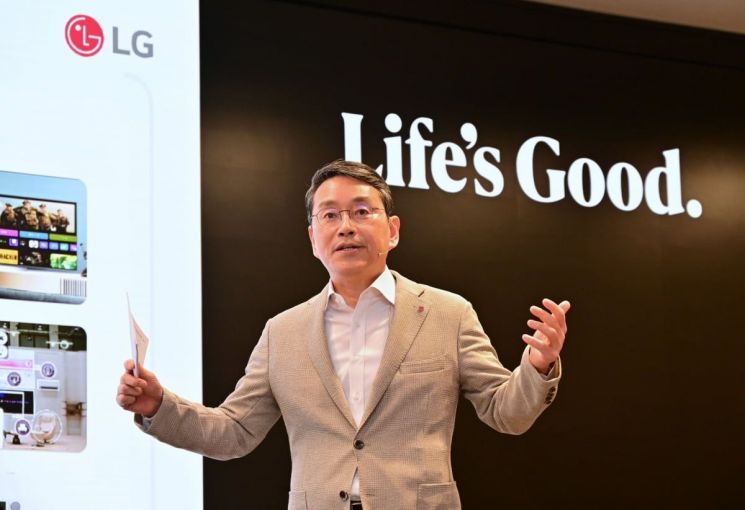 Jo Ju-wan, CEO of LG Electronics, is explaining management performance and mid-to-long-term business strategy directions to shareholders at the 23rd regular shareholders' meeting held on March 25 at the LG Twin Towers in Yeouido, Seoul. Photo by Yonhap News.
Alongside the Indian stock market listing, CEO Jo unveiled the vision of "Make for India," "Make in India," and "Make India Global." The plan is to leverage India, a nation of 1.4 billion people and the largest potential market, by expanding customer- and market-tailored strategies, and to use this as an opportunity to move beyond the current position as the number one brand in market share to become the country’s most beloved national enterprise.
On this day, LG Electronics also unveiled a lineup of specialized home appliances designed specifically for Indian customers. These India-focused products are based on LG’s accumulated local expertise and deep understanding of customers, featuring pricing that reflects local purchasing power and specialized functions and designs tailored to Indian lifestyles and environments.
LG Electronics first entered the Indian market in 1997 by establishing its initial subsidiary in Noida. Over the past 28 years, the company has built a comprehensive business structure in India, encompassing production, sales, service, and research and development. LG has maintained the top market share in major home appliance categories such as refrigerators, washing machines, air conditioners, and TVs, establishing itself as a "premium national brand" locally.
In particular, LG has enhanced its brand competitiveness through localization strategies that consider India’s climate, culture, and power infrastructure. Examples include refrigerators that keep cool for seven hours during power outages, air conditioners equipped with ultrasonic mosquito-repellent functions, convertible refrigerators for vegetarians, and washing machines with dedicated modes for traditional Indian sarees.
Customer-centric service networks are also considered a strength of LG Electronics. The company operates 16 regional offices, 777 brand shops, 23 distribution centers, and employs over 12,000 service engineers across India. By directly managing the entire process from installation to repair, LG has built strong brand trust.
Production infrastructure is also being steadily expanded. In addition to Noida and Pune, LG Electronics is investing $600 million (approximately 840 billion won) to construct its third home appliance factory in Sri City, Andhra Pradesh, southern India. The Boston Consulting Group (BCG) projects that India’s middle class will expand to 46% of the population by 2030.
The Sri City factory is expected to create approximately 2,000 direct and indirect jobs in the local community. Including the new plant, LG’s annual production capacity in India will increase to 3.6 million refrigerators, 3.75 million washing machines, 4.7 million air conditioners, 2 million air conditioner compressors, and 2 million TVs.
LG Electronics plans to use this Indian listing as a springboard to make India a key hub in its "Global South" strategy. The funds secured will be invested not only in home appliances but also in new growth areas such as automotive electronics, robotics, and artificial intelligence appliances.
A company representative stated, "The recently announced third-quarter results show that the automotive electronics division continues to grow, exceeding market expectations. The Indian listing will be an important milestone in expanding LG Electronics’ global business portfolio."
© The Asia Business Daily(www.asiae.co.kr). All rights reserved.
![Clutching a Stolen Dior Bag, Saying "I Hate Being Poor but Real"... The Grotesque Con of a "Human Knockoff" [Slate]](https://cwcontent.asiae.co.kr/asiaresize/183/2026021902243444107_1771435474.jpg)
















