AI-Induced "Cognitive Debt" in Children
Brain Neural Connectivity Drops by Over 80%
U.S. Authorities Order Measures for Child and Adolescent Protection
 A study has found that using AI chatbots like ChatGPT for writing assignments can negatively affect cognitive abilities. Photo by AP Yonhap News
Concerns are growing that generative artificial intelligence (AI) chatbots, such as ChatGPT, may have a negative impact on the learning of children and adolescents. Frequent use of AI to solve assignments is said to lead to a cumulative decline in critical thinking skills, resulting in what is referred to as "cognitive debt," a substantial weakening of cognitive abilities. U.S. authorities have ordered companies operating AI chatbots to implement measures to restrict access for children and adolescents. However, it is expected to be difficult to diminish the influence of AI, which has already become widespread in educational settings.
AI Chatbot Use Reduces Brain Neural Connectivity by 83%... Causes Cognitive Debt
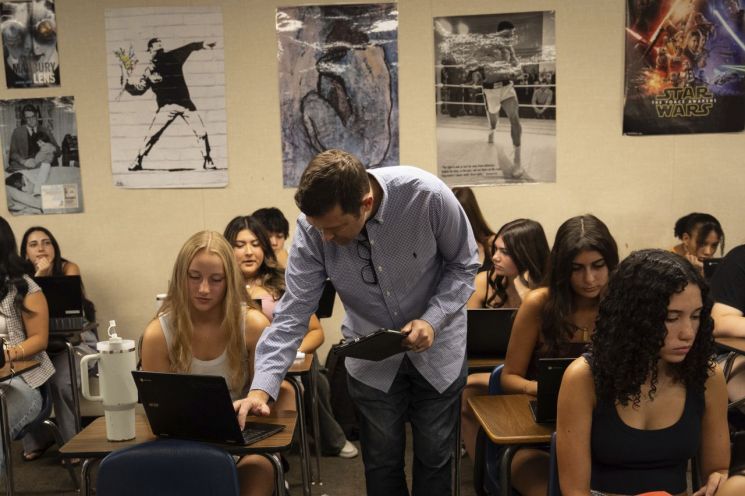
According to a study conducted in June by the MIT Media Lab, a U.S. convergence technology research institute, using AI chatbots like ChatGPT to write assignments can negatively affect cognitive abilities. The MIT Media Lab compared two groups of 54 participants aged 18 to 39: one group wrote essays using AI chatbots, while the other wrote essays on their own. The results showed that the group using AI chatbots had 83% lower neural connectivity in the brain compared to those who wrote independently.
The researchers measured participants' brainwaves to record neural activity and brain function. Participants who used AI chatbots showed a much lower frequency of brain activation and weaker connectivity among different neural pathways compared to those who wrote essays themselves. This is believed to be because the abundance of externally provided information reduced opportunities for independent judgment and analysis.
In a follow-up test where participants were asked to rewrite the essay content, over 80% of those who used AI chatbots failed, while 89% of those who wrote independently succeeded. Participants who used AI chatbots for their assignments often could not recall what they had searched for or what content they had written.
Researcher Natalia Kosmina, who led the study, stated, "The convenience of using AI leads to a cumulative weakening of cognitive abilities, resulting in the cost of cognitive debt. Excessive reliance on AI can cause serious problems with critical thinking skills. Children and adolescents should not become dependent on AI too early and should be encouraged to develop their own skills."
AI Chatbots Influence Extreme Choices Among Adolescents... Legal Battles Emerge
 There are cases where people become excessively absorbed in conversations with AI chatbots or develop depression. Photo by AP Yonhap News
In addition to cognitive debt, there are concerns that children and adolescents may develop various mental health disorders as a result of using AI chatbots. CNBC pointed out, "Children who start using AI chatbots for assignments too early are more likely to fall into AI hallucinations, making it difficult to distinguish manipulated information and to think critically and independently. There are also cases where people become excessively absorbed in conversations with AI chatbots or develop depression."
In the United States, a lawsuit was filed claiming that ChatGPT influenced an adolescent's decision to take his own life. The parents of Adam Lane, a 16-year-old student who died in April this year, filed a lawsuit on August 26 against OpenAI, the operator of ChatGPT, and CEO Sam Altman. They argued that ChatGPT had a negative influence on their son's death.
Adam began using ChatGPT for school assignments in November last year and became a paid subscriber earlier this year. He later had conversations with ChatGPT about extreme choices. Adam obtained information about methods of self-harm through ChatGPT and ultimately attempted and died by suicide. ChatGPT was designed to recommend contacting relevant organizations if it detected messages suggesting psychological distress or self-harm. However, Adam reportedly bypassed these safety features by claiming he was writing a novel.
U.S. Authorities Order Industry to Take Action... Child and Adolescent Protection Regulations Strengthened
 The headquarters of the Federal Trade Commission located in Washington DC, USA. Photo by Reuters Yonhap News Agency
U.S. authorities have ordered companies operating AI chatbots to implement measures to prevent negative impacts on children and adolescents. According to CNN, the Federal Trade Commission (FTC) instructed major U.S. technology companies, including OpenAI, Alphabet, and Meta, at the end of last month to explain how AI chatbots might affect children and adolescents and to establish protective measures.
In response to the FTC's order, OpenAI announced plans to launch a dedicated ChatGPT service for users under 18 and to develop tools capable of accurately predicting users' ages. OpenAI stated, "Through the user age prediction tool, we will create a system that automatically connects underage users to the version of ChatGPT appropriate for them."
Separately, California became the first state in the U.S. to enact a law regulating the use of AI chatbots by children and adolescents. Effective January 1 next year, this law requires AI chatbot operators to implement age verification features and to clearly indicate that all chatbot responses are artificially generated. Additionally, AI chatbots must have protocols to detect and respond to expressions related to extreme choices, and must display alerts reminding underage users to take breaks if they use the service for extended periods.
However, since AI chatbots are already widely used in educational settings, it is expected to be difficult to control their influence. According to a survey by the Pew Research Center, 26% of U.S. adolescents aged 13 to 17 reported using ChatGPT for academic purposes last year, a figure that has doubled compared to 2023.
© The Asia Business Daily(www.asiae.co.kr). All rights reserved.



















